
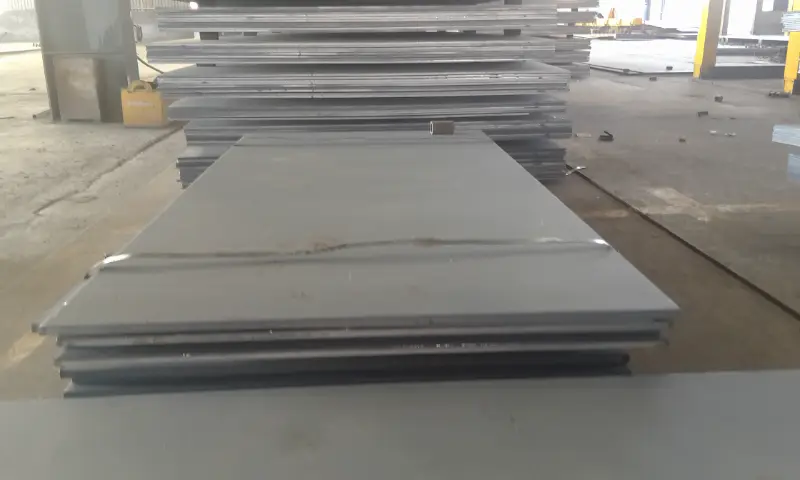
S275NL Steel Plate to EN 10025-3
S275NL Steel Plate: Superior Low-Temperature Toughness for Welded Structures – EN 10025-3
Explore in-depth technical data on S275NL carbon and low-alloy high-strength steel plate to EN 10025-3, featuring guaranteed impact toughness at -50°C, excellent weldability, and fine-grain structure for demanding structural applications.
Hot rolling, normalizing, normalizing rolling, cutting, cold forming, welding
- Phone : +8618037372205
- Email : [email protected]
- WhatsApp: Contact via Whtsapp
- WeChat: +8618037372205
S275NL Steel Plate to EN 10025-3 Introduction
S275NL is a normalized / normalized rolled weldable fine-grain structural steel defined in EN 10025-3. The grade designation indicates a minimum yield strength of 275 MPa for thicknesses ≤ 16 mm, delivery condition normalized (N), and guaranteed impact energy at -50 °C (L). Its fine-grained microstructure, achieved through controlled aluminum, niobium, and vanadium additions, provides a fine balance of strength, ductility, and exceptional low-temperature toughness. Typical applications include bridges, pressure vessels, offshore structures, and heavy machinery operating in cold climates. The material offers excellent weldability with low carbon equivalent, making it suitable for complex fabrications without post-weld heat treatment in many cases.
S275NL Steel Plate to EN 10025-3 Chemical Composition
The chemical composition complies with EN 10025-3 requirements for S275NL. Values are maximum unless a range is given. The steel is fully killed and contains grain-refining elements such as aluminum, niobium, and vanadium. Additional restrictions on carbon equivalent (CEV) apply to guarantee weldability.
- CEV = C + Mn/6 + (Cr+Mo+V)/5 + (Ni+Cu)/15, maximum 0.40 for thicknesses ≤ 30 mm, 0.42 for 30-63 mm, and 0.45 for 63-100 mm.
| Element | Content (%) | Remarks |
|---|---|---|
| Carbon (C) | ≤ 0.16 | For thickness > 30 mm, C ≤ 0.18 is permitted (max in practice often ≤0.16) |
| Silicon (Si) | ≤ 0.50 | |
| Manganese (Mn) | 0.80 – 1.50 | |
| Phosphorus (P) | ≤ 0.025 | |
| Sulfur (S) | ≤ 0.020 | |
| Aluminium total (Al) | ≥ 0.020 | Acid-soluble aluminum ≥ 0.015 % is also acceptable |
| Niobium (Nb) | ≤ 0.05 | |
| Vanadium (V) | ≤ 0.05 | |
| Titanium (Ti) | ≤ 0.05 | |
| Cr (Chromium) | ≤ 0.30 | |
| Ni (Nickel) | ≤ 0.50 | |
| Mo (Molybdenum) | ≤ 0.10 | |
| Cu (Copper) | ≤ 0.35 | |
| N (Nitrogen) | ≤ 0.015 | |
| Nb+V+Ti | ≤ 0.12 | Sum of niobium, vanadium and titanium |
S275NL Steel Plate to EN 10025-3 Thermal and Electrical Physical Properties
These physical properties are typical for carbon-manganese normalized steels and are provided for general design guidance. They are not mandatory requirements of EN 10025-3 but are representative of S275NL grade. Actual values may vary slightly depending on exact composition and heat treatment.
- Thermal conductivity decreases slightly with increasing temperature.
- Electrical resistivity is applicable to steel in the ferritic-pearlitic condition.
| Property | Typical Value | Unit | Test Condition / Remarks |
|---|---|---|---|
| Density (ρ) | 7850 | kg/m³ | At 20 °C |
| Modulus of elasticity (E) | 210 | GPa | Tension, room temperature |
| Shear modulus (G) | 81 | GPa | Calculated from E and Poisson ratio |
| Poisson's ratio (ν) | 0.3 | - | Elastic range |
| Thermal expansion coefficient (α) | 12 x 10⁻⁶ | K⁻¹ | Between 20 °C and 100 °C |
| Thermal expansion coefficient (α) | 13 x 10⁻⁶ | K⁻¹ | Between 20 °C and 200 °C |
| Thermal expansion coefficient (α) | 14 x 10⁻⁶ | K⁻¹ | Between 20 °C and 300 °C |
| Thermal conductivity (λ) | 50 | W/(m·K) | At 20 °C |
| Specific heat capacity (cp) | 460 | J/(kg·K) | At 20 °C to 100 °C |
| Electrical resistivity (ρe) | 0.25 | μΩ·m | At 20 °C, approximate |
S275NL Steel Plate to EN 10025-3 Mechanical Properties
Mechanical properties are valid for the normalized / normalized rolled condition. Yield strength depends on product thickness. Tensile test pieces taken transverse to rolling direction. Impact test on Charpy V-notch longitudinal specimens at -50 °C. Bending test mandrel diameter depends on thickness and specification.
- For plates and wide flats, the specified impact energy is 27 J minimum for thicknesses ≤ 60 mm.
- For thicknesses > 60 mm up to 100 mm, impact energy 27 J minimum is guaranteed on option.
| Property | Minimum / Typical Value | Unit | Test Condition / Remarks |
|---|---|---|---|
| Yield strength (ReH) – t ≤ 16 mm | ≥ 275 | MPa | Transverse |
| Yield strength (ReH) – 16 < t ≤ 40 mm | ≥ 265 | MPa | Transverse |
| Yield strength (ReH) – 40 < t ≤ 63 mm | ≥ 255 | MPa | Transverse |
| Yield strength (ReH) – 63 < t ≤ 80 mm | ≥ 245 | MPa | Transverse |
| Yield strength (ReH) – 80 < t ≤ 100 mm | ≥ 235 | MPa | Transverse |
| Tensile strength (Rm) – t ≤ 100 mm | 370 – 510 | MPa | Transverse |
| Elongation (A) – t ≤ 40 mm | ≥ 24 | % | Gauge length 5.65√So, transverse |
| Elongation (A) – 40 < t ≤ 63 mm | ≥ 24 | % | Gauge length 5.65√So, transverse |
| Elongation (A) – 63 < t ≤ 100 mm | ≥ 23 | % | Gauge length 5.65√So, transverse |
| Charpy impact (KV) – longitudinal | ≥ 27 (-50 °C) | J | Average of three tests, min single value 70% of average. Applicable for t ≤ 60 mm |
| Charpy impact (KV) – longitudinal, option | ≥ 27 (-50 °C) | J | For 60 < t ≤ 100 mm, by agreement |
| Bend test (mandrel diameter) – t ≤ 16 mm | 0.5 a | - | 180° bend, a = specimen thickness |
| Bend test – 16 < t ≤ 100 mm | 1.0 a | - | 180° bend |
S275NL Steel Plate to EN 10025-3 Fully Equivalent Material Standards and Substitutable Grades
| Country / Region | Standard | Grade | Remarks |
|---|---|---|---|
| Europe | EN 10025-3:2019 | S275NL | Original specification, normalized fine-grain steel, impact -50 °C |
| International | ISO 630-3:2012 | S275NL | Technically identical, fine grain structural steel plates |
| Germany | DIN EN 10025-3 | S275NL | Direct adoption, formerly SE 275NL in DIN 17102 |
| France | NF EN 10025-3 | S275NL | Direct adoption |
| United Kingdom | BS EN 10025-3 | S275NL | Direct adoption, formerly 50EE in BS 4360 |
| Japan | JIS G 3106 (comparison only) | SM490B (not fully equal) | Not fully equivalent; SM490B has higher yield, but impact test at 0 °C. SM490YB with low-temp toughness may approach. |
| USA | ASTM A572/A572M | Grade 42 / Grade 50 | Not fully equivalent; impact requirements differ. Use ASTM A572 with supplementary S5 for -50 °C toughness. |
S275NL Steel Plate to EN 10025-3 Application Introduction
S275NL steel is ideally suited for welded load-bearing structures that require guaranteed toughness at sub-zero temperatures down to -50 °C. The fine-grain structure and low carbon equivalent allow reliable welding without excessive preheat. It is delivered in normalized or normalized rolled condition, ensuring uniform mechanical properties through thickness. Common applications span civil engineering, heavy machinery, shipbuilding, and offshore engineering.
Product Applications: Welded I-beams and box girders for bridges, Wind turbine towers and foundations, LNG storage tank outer shells, Pressure vessel shells and heads, Offshore jacket structures and nodes, Heavy-duty crane booms and lifting devices, Ship deck plates and stiffeners
Processed into products: Bridge girders and cross-bracing plates, Column base plates and splice plates, Tank annular ring plates and shell courses, Jack-up rig leg chords and rack plates, Excavator booms and dipper handles, Bogie frames for locomotives, Low-temperature pipe support structures
Application industries: Bridge construction (road and railway bridges in cold regions), Building and civil engineering (columns, girders, high-rise frames), Pressure vessel and storage tank manufacturing (cryogenic and low-temperature service), Offshore structures (platforms, wind turbine foundations, transition pieces), Shipbuilding (hull and deck components for Arctic vessels), Mining and earth-moving equipment (dumper bodies, excavator booms), Railway vehicles (underframes, bogies)
S275NL Steel Plate to EN 10025-3 Similar / Comparable Alternative Materials
| Country / Region | Standard | Grade | Remarks |
|---|---|---|---|
| Europe | EN 10025-3 | S275N | Same strength level, impact at -20 °C (instead of -50 °C). Suitable for less severe cold service. |
| Europe | EN 10025-3 | S355NL | Higher strength (min 355 MPa), same low-temperature toughness -50 °C. Heavier sections can be reduced. |
| Europe | EN 10025-4 | S275ML | Thermomechanical rolled, same strength and toughness level. Thinner dimensions and potentially better weldability. |
| Europe | EN 10025-2 | S275JR/J0/J2 | Non-alloy structural steels; similar strength but not fine-grained. Impact properties limited to 20/0/-20 °C. Not a direct substitute for low-temperature applications. |
| International | ISO 630-3 | S355NL | Higher strength variant with -50 °C impact guarantee. |
| USA | ASTM A572/A572M | Grade 50 Type 1 | Higher strength, but standard does not mandate fine-grain practice or low-temperature impact. Requires supplementary S5. |
| USA | ASTM A516/A516M | Grade 70 | Carbon steel for pressure vessels, good low-temperature toughness, but mainly for pressure vessel shells, not identical strength/yield. |
Notes:
Weldability: S275NL offers excellent weldability with low carbon equivalent (CEV ≤ 0.40 typical). Preheating may be required for thick sections or when combined with high hydrogen processes. Post-weld heat treatment is normally not required for stress relief except for thick, highly restrained joints.
Identification: The steel is marked with grade, heat number, manufacturer, and standard designation.
CE marking: Under the Construction Products Regulation (CPR), EN 10025-3 products can be CE marked.
Supplementary testing: Ultrasonic testing to EN 10160, through-thickness properties (Z-quality) per EN 10164, and elevated temperature properties can be agreed at the time of order.
- Share



