
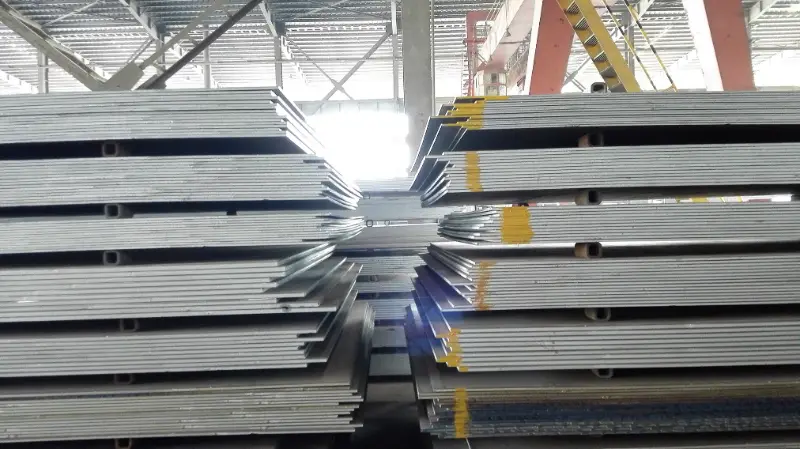
S460M Steel Plate
S460M Steel Plate: High-Strength Thermomechanical Rolled Structural Steel
Detailed material data for S460M carbon and low-alloy high-strength steel plate according to EN 10025-4, including chemical composition, mechanical and physical properties, equivalent grades, and application guidance.
Hot rolling, thermomechanical rolling, cutting, welding, bending, cold forming, machining
- Phone : +8618037372205
- Email : [email protected]
- WhatsApp: Contact via Whtsapp
- WeChat: +8618037372205
S460M Steel Plate Introduction
S460M is a weldable fine-grain structural steel supplied in the thermomechanically rolled (M) condition according to EN 10025-4. It offers a minimum yield strength of 460 MPa in thickness up to 16 mm, combined with excellent toughness at low temperatures and good cold formability. The thermomechanical rolling process refines the grain structure, providing higher strength without the need for additional heat treatment. Key characteristics include:
- High yield and tensile strength
- Good impact toughness at -20°C (when ordered as J2 quality)
- Excellent weldability due to low carbon equivalent
- Suitable for heavy structural fabrications, bridges, offshore structures, and cranes
S460M Steel Plate Chemical Composition
Chemical composition of S460M as specified in EN 10025-4:2004 (Table 3). Maximum values unless a range is given. The steel is microalloyed with niobium, vanadium, and titanium for grain refinement and precipitation strengthening. A fine balance of elements ensures good weldability and toughness. The carbon equivalent (CEV) is controlled to guarantee cold cracking resistance.
| Element | Content (%) | Remarks |
|---|---|---|
| Carbon (C) | ≤0.16 | For thickness ≤40 mm; ≤0.18 for >40 mm |
| Silicon (Si) | ≤0.60 | Deoxidation and strength contribution |
| Manganese (Mn) | ≤1.70 | Enhances hardenability and strength |
| Phosphorus (P) | ≤0.030 | Controlled for toughness; lower in J2/K2 qualities |
| Sulfur (S) | ≤0.025 | Kept low for weldability and ductility |
| Aluminum (Al total) | ≥0.020 | Minimum for fine grain practice, acid-soluble |
| Niobium (Nb) | ≤0.05 | Grain refinement and precipitation hardening |
| Vanadium (V) | ≤0.12 | Precipitation strengthening |
| Titanium (Ti) | ≤0.05 | Grain refinement and sulfide shape control |
| Chromium (Cr) | ≤0.30 | Optional, improves hardenability |
| Nickel (Ni) | ≤0.50 | Optional, enhances toughness |
| Molybdenum (Mo) | ≤0.10 | Optional, increases strength and hardenability |
| Copper (Cu) | ≤0.50 | Optional, improves atmospheric corrosion resistance |
| Nitrogen (N) | ≤0.015 | Restricted to avoid strain aging |
| Others (total) | ≤0.30 | Sum of unspecified residual elements |
S460M Steel Plate Physical Properties
Typical physical and thermal properties for low-alloy structural steels at room temperature and elevated temperatures. These values are not specified in EN 10025-4 but are representative for S460M and can be used for design calculations. Slight variations may occur depending on exact chemical composition and heat treatment.
| Property | Value | Unit | Test condition / Temperature |
|---|---|---|---|
| Density (ρ) | 7850 | kg/m³ | At 20°C |
| Modulus of elasticity (E) | 210 | GPa | At 20°C (static, tension/compression) |
| Shear modulus (G) | 81 | GPa | At 20°C (calculated from E and ν) |
| Poisson's ratio (ν) | 0.3 | — | Typical for structural steel |
| Thermal expansion (α) | 12.0 | 10⁻⁶ /K | Mean coefficient, 20–100°C |
| Thermal expansion (α) | 12.5 | 10⁻⁶ /K | 20–200°C |
| Thermal expansion (α) | 13.0 | 10⁻⁶ /K | 20–300°C |
| Thermal conductivity (λ) | 50 | W/(m·K) | At 20°C (typical for low-alloy steel) |
| Specific heat capacity (cp) | 460 | J/(kg·K) | At 20°C |
| Electrical resistivity (ρe) | 0.20 | µΩ·m | At 20°C (typical) |
S460M Steel Plate Mechanical Properties
Minimum mechanical properties for S460M thermomechanically rolled steel according to EN 10025-4:2004 (Table 4). Values apply to longitudinal test pieces (transverse values are slightly lower). Impact requirements correspond to J2 quality (-20°C) unless otherwise noted. For thicknesses below 10 mm, impact testing is not mandatory. The steel exhibits a fine ferritic-pearlitic microstructure with excellent ductility and weldability.
| Property | Value (min unless range) | Unit | Test condition / Thickness range |
|---|---|---|---|
| Yield strength (ReH) | 460 | MPa | Nominal thickness ≤16 mm |
| Yield strength (ReH) | 440 | MPa | 16 mm < thickness ≤40 mm |
| Yield strength (ReH) | 420 | MPa | 40 mm < thickness ≤63 mm |
| Yield strength (ReH) | 400 | MPa | 63 mm < thickness ≤80 mm |
| Yield strength (ReH) | 380 | MPa | 80 mm < thickness ≤100 mm |
| Yield strength (ReH) | 360 | MPa | 100 mm < thickness ≤150 mm |
| Tensile strength (Rm) | 540 – 720 | MPa | Nominal thickness ≤40 mm |
| Tensile strength (Rm) | 530 – 710 | MPa | 40 mm < thickness ≤63 mm |
| Tensile strength (Rm) | 510 – 690 | MPa | 63 mm < thickness ≤80 mm |
| Tensile strength (Rm) | 490 – 670 | MPa | 80 mm < thickness ≤100 mm |
| Tensile strength (Rm) | 470 – 650 | MPa | 100 mm < thickness ≤150 mm |
| Elongation after fracture (A) | 17 | % | Thickness ≤40 mm, longitudinal, gauge L₀ = 5.65√S₀ |
| Elongation after fracture (A) | 17 | % | 40 mm < thickness ≤63 mm |
| Elongation after fracture (A) | 16 | % | 63 mm < thickness ≤80 mm |
| Elongation after fracture (A) | 16 | % | 80 mm < thickness ≤100 mm |
| Elongation after fracture (A) | 15 | % | 100 mm < thickness ≤150 mm |
| Impact energy (KV₂) | 40 | J | -20°C, longitudinal, Charpy V-notch, average of 3 tests, t ≥10 mm |
| Impact energy (KV₂) | 27 | J | -20°C, transverse, Charpy V-notch, average of 3 tests, t ≥10 mm |
S460M Steel Plate Fully Equivalent Material Standards and Substitute Grades
| Country/Region | Standard | Grade | Remarks |
|---|---|---|---|
| Europe | EN 10025-4 | S460M | Base European standard, thermomechanically rolled |
| International | ISO 4950-2 | S460M | High yield strength flat products – thermomechanically rolled |
| Germany | DIN EN 10025-4 | S460M | National adoption of EN 10025-4 |
| United Kingdom | BS EN 10025-4 | S460M | British standard adoption |
| France | NF EN 10025-4 | S460M | French standard adoption |
| Italy | UNI EN 10025-4 | S460M | Italian standard adoption |
| Spain | UNE EN 10025-4 | S460M | Spanish standard adoption |
| Sweden | SS-EN 10025-4 | S460M | Swedish standard adoption |
S460M Steel Plate Application Introduction
S460M steel plate is engineered for demanding structural applications where weight reduction and high strength are critical. Its superior weldability and toughness allow fabrication of thick sections without preheat, reducing production cost. The steel can be cold formed to tight radii and joined using all common arc welding processes. Typical service environments range from arctic offshore to tropical conditions. Contact a steel manufacturer for availability of improved atmospheric corrosion resistance (weathering grades) or extra through-thickness properties (Z-quality) if required.
Product Applications: Bridge girders, box girders, and trusses, Offshore platform decks, legs, and modules, Cranes and lifting equipment (mobile, crawler, tower), Wind turbine tower sections and transition pieces, Heavy vehicle chassis frames, Mining dump truck bodies and excavator booms, High-rise building columns and transfer beams, Pressure vessels (when certified to PED/ASME as applicable)
Processed into products: Welded built-up sections (I, H, box profiles), Flanges and web stiffeners, Crane main chords and lattice members, Bolted end plates and base plates, Cut and bent stiffening rings, Drilled and tapped connecting brackets, Lifting lugs and pad eyes, Heavy-duty fasteners matched to plate strength
Application industries: Civil and structural engineering, Marine and offshore engineering, Heavy machinery manufacturing, Wind energy generation, Mining and earthmoving, Transportation infrastructure (bridges & highways), Shipbuilding (for selected grades with certification)
S460M Steel Plate Similar or Comparable Alternative Materials
| Country/Region | Standard | Grade | Remarks |
|---|---|---|---|
| USA | ASTM A572/A572M | Grade 65 | High-strength low-alloy Nb-V steel, min YS 450 MPa; similar but slightly lower strength |
| USA | ASTM A913/A913M | Grade 65 | TMCP steel, 450 MPa YS; similar delivery condition |
| Japan | JIS G3106 | SM570 | Weldable structural steel, 460 MPa YS for thickness ≤16 mm; common in Asia |
| China | GB/T 1591 | Q460D | Low-alloy high-strength steel, 460 MPa, impact at -20°C; may be supplied as-rolled, normalized, or TMCP |
| Europe | EN 10025-3 | S460N / S460NL | Normalized fine-grain steel; similar strength but different microstructure |
| Europe | EN 10025-6 | S460QL / S460QL1 | Quenched & tempered steel; higher toughness, especially at low temperatures |
| Russia | GOST 19281 | 17G1S / 10G2S1 or similar | Approximate comparison; verify with current standard |
Notes:
Impact quality options: S460M is typically supplied as J2 (-20°C) but J0 (0°C) and K2 (-40°C) are available by agreement. Carbon equivalent (CEV): CEV is limited to ≤0.47% for t≤40 mm, ≤0.49% for 40<t≤63 mm, etc., ensuring good weldability without preheat. For cold forming: Minimum bending radii should follow EN ISO 7438; typical r/t ≥ 3 for transverse rolling. Post-weld heat treatment (PWHT): Usually not required due to low CEV, but if needed, keep below 580°C to avoid strength loss. Z-quality (through-thickness): Available as S460M-Z15, -Z25, or -Z35 for improved resistance to lamellar tearing in highly restrained welded joints. Pressure equipment: Verify compliance with EN 10028 or ASME equivalents for pressure retaining applications.
- Share



