
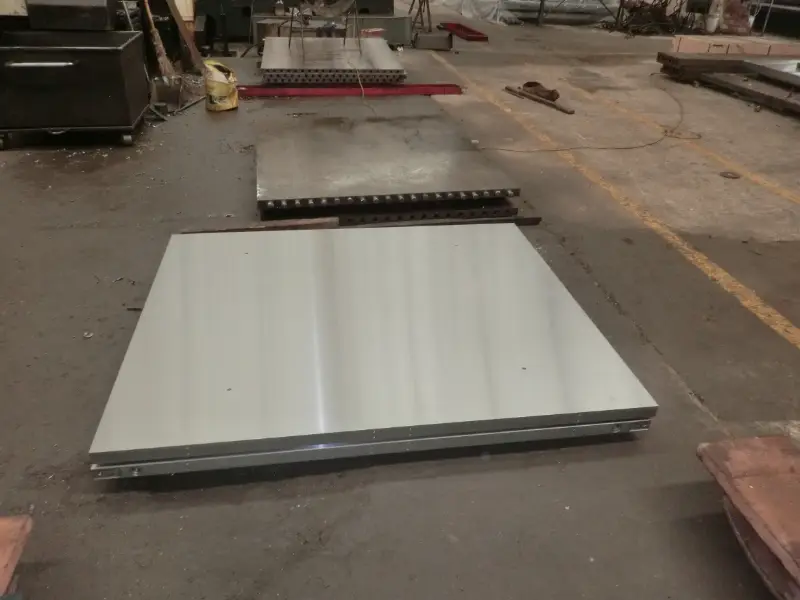
S420M Thermomechanical Rolled High-Strength Structural Steel
S420M Thermomechanical Rolled High-Strength Structural Steel | EN 10025-4 Data & Equivalents
Complete material data for S420M steel according to EN 10025-4: chemical composition, mechanical properties, physical characteristics, international equivalents, and application examples.
Welding, cutting, cold forming, bending, machining, drilling
- Phone : +8618037372205
- Email : [email protected]
- WhatsApp: Contact via Whtsapp
- WeChat: +8618037372205
S420M Thermomechanical Rolled High-Strength Structural Steel Introduction
S420M is a thermomechanically rolled, weldable fine-grain structural steel grade defined in EN 10025-4. It belongs to the family of high-strength low-alloy (HSLA) steels and offers a minimum yield strength of 420 MPa at thicknesses ≤16 mm. The 'M' designation indicates that the steel is produced by a thermomechanical rolling process, which refines the grain structure and enhances strength and toughness without the need for subsequent normalizing heat treatment.
Key features of S420M include:
- Excellent weldability due to low carbon content and controlled carbon equivalent (CEV ≤0.45)
- Good notch toughness down to -20°C (min. 40 J longitudinal)
- High strength combined with adequate ductility and formability
- Uniform mechanical properties through the thickness in standard thickness ranges
- Widely available in hot-rolled plates and strips
The steel is employed in heavily loaded welded structures such as bridges, buildings, offshore platforms, cranes, and heavy machinery. The grade is harmonized within the European Union and is supplied in the as-rolled thermomechanical condition.
S420M Thermomechanical Rolled High-Strength Structural Steel Chemical Composition
The chemical composition of S420M is specified in accordance with EN 10025-4. The steel features a low carbon content to ensure good weldability, with microalloying elements (Nb, V, Ti) added for grain refinement and precipitation strengthening. The carbon equivalent value (CEV) is controlled to a maximum of 0.45 to avoid cold cracking.
| Element | Standard Value (% by mass) | Remarks |
|---|---|---|
| Carbon (C) | ≤ 0.16 | Ladle analysis |
| Silicon (Si) | ≤ 0.50 | |
| Manganese (Mn) | ≤ 1.70 | |
| Phosphorus (P) | ≤ 0.030 | |
| Sulfur (S) | ≤ 0.025 | |
| Aluminum (Altotal) | ≥ 0.015 | Total aluminum |
| Niobium (Nb) | ≤ 0.05 | Grain refiner |
| Vanadium (V) | ≤ 0.12 | Grain refiner, precipitation hardening |
| Titanium (Ti) | ≤ 0.05 | Grain refiner |
| Chromium (Cr) | ≤ 0.30 | |
| Nickel (Ni) | ≤ 0.80 | |
| Molybdenum (Mo) | ≤ 0.20 | |
| Copper (Cu) | ≤ 0.55 | |
| Nitrogen (N) | ≤ 0.015 |
S420M Thermomechanical Rolled High-Strength Structural Steel Thermal and Electrical Physical Properties
The values listed below are typical for hot-rolled fine-grain structural steels of this strength level. They are not specified in the standard but are commonly used for design calculations. Density, elastic moduli, thermal expansion, and thermal conductivity show minor variations depending on exact composition and temperature.
| Property | Typical Value | Unit | Test Condition |
|---|---|---|---|
| Density (ρ) | 7.85 | g/cm³ | Room temperature |
| Elastic modulus (E) | 210 | GPa | Room temperature |
| Shear modulus (G) | ≈ 80 | GPa | Calculated from E and ν |
| Poisson's ratio (ν) | 0.3 | – | |
| Coefficient of thermal expansion (α) | 12.0 × 10⁻⁶ | K⁻¹ | 20°C to 100°C |
| Thermal conductivity (λ) | ≈ 45 | W/(m·K) | At 20°C |
| Specific heat capacity (Cp) | ≈ 500 | J/(kg·K) | Room temperature |
| Electrical resistivity (ρe) | ≈ 0.25 | µΩ·m | At 20°C |
S420M Thermomechanical Rolled High-Strength Structural Steel Mechanical Properties
The mechanical properties are determined on transverse test pieces unless otherwise stated. The values are guaranteed for the thermomechanical rolled condition and depend on the product thickness. Testing is performed in accordance with EN 10025-4. Notch impact energy values refer to standard Charpy V-notch specimens.
| Property | Required Value | Unit | Test Condition |
|---|---|---|---|
| Yield strength (ReH) | ≥ 420 | MPa | Thickness ≤ 16 mm, transverse |
| Yield strength (ReH) | ≥ 400 | MPa | Thickness >16 ≤40 mm, transverse |
| Yield strength (ReH) | ≥ 390 | MPa | Thickness >40 ≤63 mm, transverse |
| Yield strength (ReH) | ≥ 370 | MPa | Thickness >63 ≤80 mm, transverse |
| Yield strength (ReH) | ≥ 360 | MPa | Thickness >80 ≤100 mm, transverse |
| Yield strength (ReH) | ≥ 340 | MPa | Thickness >100 ≤120 mm, transverse |
| Tensile strength (Rm) | 520 – 680 | MPa | Thickness ≤ 63 mm, transverse |
| Tensile strength (Rm) | 510 – 670 | MPa | Thickness >63 ≤80 mm, transverse |
| Tensile strength (Rm) | 500 – 660 | MPa | Thickness >80 ≤100 mm, transverse |
| Tensile strength (Rm) | 490 – 650 | MPa | Thickness >100 ≤120 mm, transverse |
| Elongation after fracture (A) | ≥ 19 | % | Thickness ≤ 40 mm, gauge length 5.65√S0 |
| Elongation after fracture (A) | ≥ 18 | % | Thickness >40 ≤63 mm |
| Elongation after fracture (A) | ≥ 17 | % | Thickness >63 ≤100 mm |
| Elongation after fracture (A) | ≥ 16 | % | Thickness >100 ≤120 mm |
| Bend test (mandrel diameter) | 2t | – | Thickness ≤ 16 mm, 180° bend, transverse |
| Bend test (mandrel diameter) | 3t | – | Thickness >16 ≤40 mm, transverse |
| Bend test (mandrel diameter) | 4t | – | Thickness >40 ≤63 mm, transverse |
| Bend test (mandrel diameter) | 5t | – | Thickness >63 ≤80 mm, transverse |
| Bend test (mandrel diameter) | 6t | – | Thickness >80 ≤100 mm, transverse |
| Impact energy (KV) | ≥ 40 | J | At -20°C, longitudinal, thickness ≤ 150 mm |
| Impact energy (KV) | ≥ 27 | J | At -20°C, transverse, thickness ≤ 150 mm |
S420M Thermomechanical Rolled High-Strength Structural Steel Exactly Equivalent Material Standards and Substitutable Grades
| Country/Region | Standard | Grade | Remarks |
|---|---|---|---|
| Germany | DIN EN 10025-4 | S420M | Identical to EN 10025-4 |
| France | NF EN 10025-4 | S420M | Identical to EN 10025-4 |
| United Kingdom | BS EN 10025-4 | S420M | Identical to EN 10025-4 |
| Italy | UNI EN 10025-4 | S420M | Identical to EN 10025-4 |
| Spain | UNE EN 10025-4 | S420M | Identical to EN 10025-4 |
| Poland | PN-EN 10025-4 | S420M | Identical to EN 10025-4 |
| Sweden | SS-EN 10025-4 | S420M | Identical to EN 10025-4 |
S420M Thermomechanical Rolled High-Strength Structural Steel Application Introduction
S420M is primarily designed for demanding welded structural applications where high strength-to-weight ratio, reliability, and cost-effectiveness are critical. Its low CEV and fine microstructure guarantee excellent weldability without excessive preheating, making it suitable for thick-section fabrications. Typical end-uses span civil engineering, heavy industry, and energy sectors.
Product Applications: Welded bridge girders and box sections, Steel building columns and trusses, Offshore platform decks, jackets, and modules, Tubular structures for masts and towers, Heavy-duty crane booms and frames, Mining excavator buckets and chassis, Wind turbine tubular towers, Ship decks and hull stiffeners, Railcar underframes and container frames
Processed into products: Flanges and webs for plate girders, Welded I-beams and H-columns, Crane rail beams and runway girders, Stiffeners, base plates, and connection plates, Milling fixtures and press frames, Boom chords and lacing members for crawler cranes, Offshore structural tubular joints (Y-, K-, T-joints), Winch frames and winch foundation plates, Support brackets and bearing housings in heavy machinery
Application industries: Bridge construction (road, railway, pedestrian bridges), Multi-storey and industrial building frameworks, Offshore oil & gas platforms and subsea structures, Shipbuilding (hull sections, decks), Wind energy (tower sections and foundations), Crane and heavy lifting equipment manufacturing, Mining and earthmoving machinery, Pressure vessel supporting structures, Transportation (railcar, trailer frames)
S420M Thermomechanical Rolled High-Strength Structural Steel Closely Related or Similar Alternative Materials
| Country/Region | Standard | Grade | Remarks |
|---|---|---|---|
| Europe | EN 10025-3 | S420N | Normalized or normalized-rolled variant; comparable strength, different toughness requirements and rolling process. |
| Europe | EN 10025-4 | S420ML | Thermomechanical rolled with guaranteed low-temperature impact properties at -50°C; otherwise same strength. |
| USA | ASTM A572/A572M | Grade 60 | Min. yield 415 MPa (60 ksi), C-Mn-V structural steel. Not directly identical; verify weldability and toughness. |
| China | GB/T 1591 | Q420D | High-strength low-alloy structural steel, min. yield 420 MPa, impact test at -20°C; similar use. |
| Japan | JIS G3106 | SM490B | Min. yield 490 MPa, tensile 570–720 MPa, slightly higher strength; requires design adjustment. |
| International | ISO 4951-1 | E420 | High yield strength structural steel; thermomechanical rolled condition available; close in strength but may differ in chemical limits. |
Notes:
S420M exhibits good weldability due to its low carbon content (≤0.16%) and controlled CEV (max 0.45). For thick sections (>40 mm) and low ambient temperature, a moderate preheat (50–100°C) may be recommended to avoid hydrogen-induced cracking. Post-weld heat treatment is generally not required. The steel can be cold-formed to limited radii, respecting the minimum bend radii specified in EN 10025-4. When ordering, the standard and grade, delivery condition (M), dimensions, and any supplementary requirements (e.g., improved through-thickness properties, Z-quality) shall be clearly indicated.
- Share



