
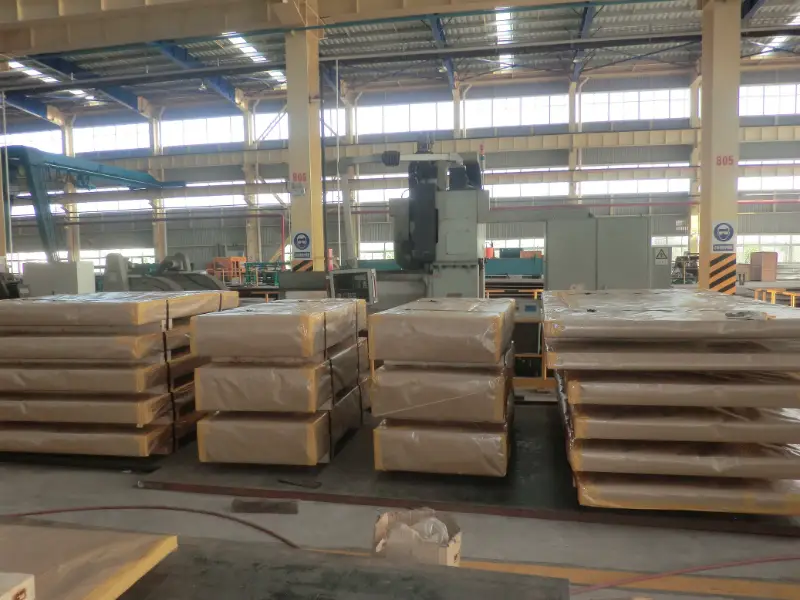
EN10025-4 S460ML Thermomechanical Rolled Weldable Fine Grain Structural Steel
EN10025-4 S460ML Thermomechanical Rolled Weldable Fine Grain Structural Steel - Properties, Equivalents, and Applications
Explore the chemical composition, mechanical and physical properties, international equivalents, and typical applications of S460ML steel, a 460 MPa yield strength fine-grain steel with guaranteed toughness at -50°C.
Hot rolling (thermomechanical controlled processing), optional normalizing rolling by agreement; cold forming possible with limitations; suitable for welding using common processes (SMAW, GMAW, SAW, FCAW) with appropriate heat input control
- Phone : +8618037372205
- Email : [email protected]
- WhatsApp: Contact via Whtsapp
- WeChat: +8618037372205
EN10025-4 S460ML Thermomechanical Rolled Weldable Fine Grain Structural Steel Introduction
S460ML is a high-strength weldable fine grain structural steel conforming to EN 10025-4:2019. It is produced by thermomechanical rolling (TMCP) and achieves a minimum yield strength of 460 MPa. The grade designation 'ML' indicates that the material is subject to thermomechanical rolling and is guaranteed to provide impact energy values of at least 27 J at -50°C (longitudinal Charpy V-notch). The fine grain structure is achieved through controlled rolling and cooling, ensuring a good combination of strength, toughness, and weldability. S460ML is supplied in the thermomechanically rolled condition and may be delivered with normalizing rolling upon agreement. This steel is widely used in heavy structural applications such as bridges, offshore platforms, crane booms, and pressure vessels where high strength-to-weight ratio and resistance to brittle fracture are essential. The maximum carbon equivalent (CEV) is limited to ensure good weldability.
EN10025-4 S460ML Thermomechanical Rolled Weldable Fine Grain Structural Steel Chemical Composition
The chemical composition of S460ML is controlled to obtain fine grain structure and high strength with good weldability. Maximum limits are specified for elements that could impair toughness or weldability, while microalloying elements (Nb, V, Ti) are added to refine grain size and increase strength. Total aluminium content is required to ensure fine grain practice. The table shows the maximum or range as per EN 10025-4:2019, applicable for all thicknesses.
| Element | Standard Value (wt%) | Remarks |
|---|---|---|
| Carbon (C) | ≤ 0.16 | Maximum |
| Silicon (Si) | ≤ 0.60 | Maximum |
| Manganese (Mn) | ≤ 1.70 | Maximum |
| Phosphorus (P) | ≤ 0.020 | Maximum |
| Sulfur (S) | ≤ 0.010 | Maximum |
| Nitrogen (N) | ≤ 0.015 | Maximum |
| Aluminium (Al total) | ≥ 0.020 | Minimum; typically used for grain refinement |
| Niobium (Nb) | ≤ 0.05 | Maximum; microalloying element |
| Vanadium (V) | ≤ 0.12 | Maximum; microalloying element |
| Titanium (Ti) | ≤ 0.05 | Maximum; microalloying element |
| Molybdenum (Mo) | ≤ 0.20 | Maximum |
| Nickel (Ni) | ≤ 0.80 | Maximum |
| Chromium (Cr) | ≤ 0.30 | Maximum |
| Copper (Cu) | ≤ 0.55 | Maximum |
EN10025-4 S460ML Thermomechanical Rolled Weldable Fine Grain Structural Steel Thermal and Electrical Physical Properties
The physical properties listed are typical values for fine grain structural steel grades like S460ML at room temperature unless otherwise noted. They are not required by the product standard but are essential for design calculations, heat transfer analysis, and welding preheating. Actual values may vary slightly with composition and processing.
| Property | Value | Unit | Test Condition |
|---|---|---|---|
| Density ρ | 7.85 | g/cm³ | At ambient temperature |
| Modulus of elasticity E | 210 | GPa | At ambient temperature |
| Shear modulus G | ~ 81 | GPa | Calculated from E and ν |
| Poisson's ratio ν | 0.3 | - | - |
| Coefficient of thermal expansion α | 12.0 × 10⁻⁶ | 1/K | Between 20 °C and 100 °C |
| Thermal conductivity λ | ~ 50 | W/(m·K) | At 20 °C |
| Specific heat capacity c | ~ 460 | J/(kg·K) | At 20 °C to 100 °C |
| Electrical resistivity ρe | 0.20 – 0.25 | μΩ·m | At ambient temperature |
EN10025-4 S460ML Thermomechanical Rolled Weldable Fine Grain Structural Steel Mechanical Properties
The mechanical properties are guaranteed based on the testing of specimens taken in the longitudinal direction from products in the as-delivered condition. Tensile properties and impact energy requirements depend on the product thickness. For thicknesses beyond 120 mm, properties may be agreed at the time of order. The bending test requires a mandrel diameter dependent on thickness and tensile strength; for S460ML, the parameters shown ensure the material can withstand cold bending without cracking.
| Property | Value | Unit | Test Condition |
|---|---|---|---|
| Yield strength ReH | ≥ 460 | MPa | Thickness ≤ 16 mm |
| Yield strength ReH | ≥ 440 | MPa | Thickness 16 < t ≤ 40 mm |
| Yield strength ReH | ≥ 420 | MPa | Thickness 40 < t ≤ 63 mm |
| Yield strength ReH | ≥ 400 | MPa | Thickness 63 < t ≤ 80 mm |
| Yield strength ReH | ≥ 400 | MPa | Thickness 80 < t ≤ 100 mm |
| Yield strength ReH | ≥ 380 | MPa | Thickness 100 < t ≤ 120 mm |
| Tensile strength Rm | 540 – 720 | MPa | Thickness ≤ 100 mm |
| Tensile strength Rm | 500 – 680 | MPa | Thickness 100 < t ≤ 120 mm |
| Elongation A (L0 = 5.65√S0) | ≥ 17 | % | Thickness ≤ 40 mm |
| Elongation A (L0 = 5.65√S0) | ≥ 17 | % | Thickness 40 < t ≤ 63 mm |
| Elongation A (L0 = 5.65√S0) | ≥ 17 | % | Thickness 63 < t ≤ 100 mm |
| Elongation A (L0 = 5.65√S0) | ≥ 16 | % | Thickness 100 < t ≤ 120 mm |
| Charpy-V impact energy KV2 | ≥ 27 (long.) | J | At -50 °C |
| Bend test (mandrel diameter) | 3t | - | Thickness ≤ 16 mm, 180° bend |
| Bend test (mandrel diameter) | 4t | - | Thickness 16 < t ≤ 40 mm, 180° bend |
EN10025-4 S460ML Thermomechanical Rolled Weldable Fine Grain Structural Steel Fully Equivalent Material Standards and Designations
| Country/Region | Standard / Designation | Grade | Remarks |
|---|---|---|---|
| European Union | EN 10025-4:2019 | S460ML | Base standard |
| International (ISO) | ISO 4951-2:2014 | S460ML | Identical in chemical and mechanical requirements |
| Germany | DIN EN 10025-4 | S460ML | German adoption of EN standard, identical |
| United Kingdom | BS EN 10025-4 | S460ML | British adoption of EN standard, identical |
| France | NF EN 10025-4 | S460ML | French adoption of EN standard, identical |
| Italy | UNI EN 10025-4 | S460ML | Italian adoption of EN standard, identical |
| Spain | UNE EN 10025-4 | S460ML | Spanish adoption of EN standard, identical |
EN10025-4 S460ML Thermomechanical Rolled Weldable Fine Grain Structural Steel Application Introduction
S460ML combines high strength, excellent low-temperature toughness, and good weldability, making it suitable for demanding structural applications where weight reduction and safety are critical. Its thermomechanical rolling process eliminates the need for subsequent heat treatment in many cases, simplifying fabrication.
Typical industries, products, and components:
Product Applications: Hot rolled steel plates and sheets, Wide flats and bars, Structural sections (beams, channels, angles), Welded pipes and hollow structural sections (HSS), Offshore structural components
Processed into products: Bridge main girders and cross beams, Offshore jacket legs and braces, Crane booms and outriggers, Ship decks and longitudinal stiffeners, Wind turbine tower shells and internal platforms, Pressure vessel shells and heads (subject to code approval), Heavy-duty machine frames and welded structures, Penstocks and hydraulic gates
Application industries: Bridge construction (highway and railway bridges), Offshore engineering (platforms, jacket structures, topsides), Shipbuilding (hull plates, stiffeners), Lifting and transport equipment (cranes, mobile crane booms, lifting beams), Heavy machinery (frames, chassis, load-bearing parts), Pressure vessel manufacturing, Wind energy (tower sections, transition pieces), Building and civil engineering (stadium roofs, high-rise columns)
EN10025-4 S460ML Thermomechanical Rolled Weldable Fine Grain Structural Steel Similar or Alternative Material Recommendations
| Country/Region | Standard / Designation | Grade | Remarks |
|---|---|---|---|
| USA (ASTM) | ASTM A572/A572M | Grade 65 (Type 1) | Min. yield 450 MPa; toughness usually only guaranteed at temperatures down to -18 °C if specified (e.g., Supplementary Requirement S5); different chemical composition. |
| USA (ASTM) | ASTM A913/A913M | Grade 65 | Thermomechanical rolled structural shapes (limited to sections); yield 460 MPa; impact test at -18 °C by default unless lower temperature agreed. |
| Japan (JIS) | JIS G3106 | SM570 | Min. yield 450–460 MPa depending on thickness; Charpy impact tests typically at 0 °C or -5 °C (lower temperature available as option); not strictly equivalent in toughness. |
| China (GB/T) | GB/T 1591-2018 | Q460E | Min. yield 460 MPa for thickness ≤16 mm; -40 °C impact test (27 J); close in strength but higher temperature than S460ML's -50 °C requirement. |
| China (GB/T) | GB/T 1591-2018 | Q460D | Same strength as Q460E but -20 °C impact test; lower toughness; not a direct substitute for low-temperature applications. |
Notes:
The maximum carbon equivalent value (CEV) is limited to 0.45% (for thickness ≤ 40 mm) and 0.47% (for 40 < t ≤ 120 mm) to ensure weldability without excessive preheat. For greater thicknesses, CEV must be agreed. The steel is fully killed and fine grain treated. When utilising S460ML, welding procedures should follow EN 1011-2 or equivalent guidelines; preheat and interpass temperature control are required based on thickness and hydrogen scale. Further processing such as hot-dip galvanizing is possible but may require consideration of the chemical composition to avoid liquid metal embrittlement.
- Share



