
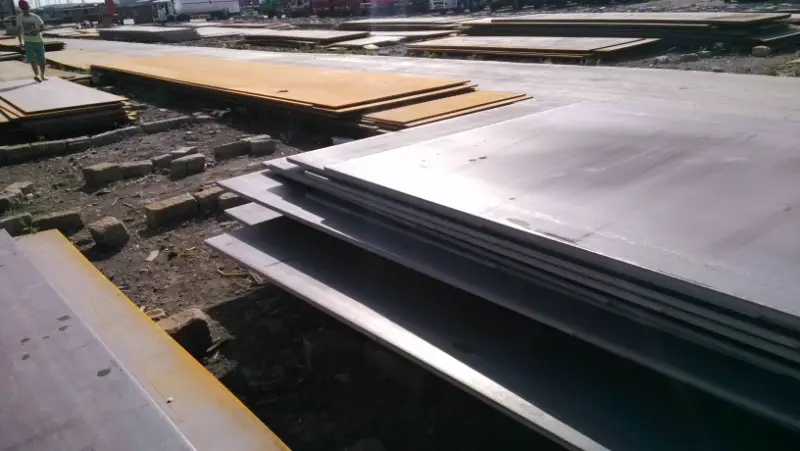
EN10025-6 S460Q
EN10025-6 S460Q: Quenched & Tempered High-Strength Steel Plate for Structural Engineering
Comprehensive data for S460Q steel plate: chemical composition, mechanical properties, thermal and electrical performance, international equivalents and application guide.
Hot rolling, quenching and tempering, normalizing (alternative), cutting, welding, bending, cold forming
- Phone : +8618037372205
- Email : [email protected]
- WhatsApp: Contact via Whtsapp
- WeChat: +8618037372205
EN10025-6 S460Q Introduction
S460Q is a quenched and tempered high-yield strength structural steel grade specified in EN 10025-6. It offers a minimum yield strength of 460 MPa in thicknesses up to 50 mm, combined with excellent toughness and weldability. This low-alloy steel is optimized for heavy structural applications requiring high load-bearing capacity and good low-temperature toughness. It is typically supplied in quenched and tempered condition. Key features include:
- High strength-to-weight ratio
- Good formability and weldability
- Impact tested at -20°C
- Suitable for welded structures in aggressive environments
EN10025-6 S460Q Chemical Composition
The chemical composition conforms to the requirements of EN 10025-6 for S460Q. All values are maximum unless otherwise stated.
- Carbon equivalent value (CEV) is controlled to ensure weldability.
- Fine grain practice is applied, typically through aluminium or niobium additions.
- Elements not listed, like Al, may be added for grain refinement.
| Element | Standard Value (max %) | Remarks |
|---|---|---|
| C | ≤0.20 | |
| Si | ≤0.50 | |
| Mn | ≤1.70 | |
| P | ≤0.025 | |
| S | ≤0.015 | |
| N | ≤0.015 | |
| B | ≤0.005 | |
| Cr | ≤0.30 | |
| Cu | ≤0.20 | |
| Mo | ≤0.10 | |
| Nb | ≤0.05 | |
| Ni | ≤0.30 | |
| Ti | ≤0.05 | |
| V | ≤0.08 | |
| Zr | ≤0.05 | |
| CEV | ≤0.47 (t≤50mm); ≤0.49 (50mm| Carbon equivalent value per product thickness | |
EN10025-6 S460Q Thermal and Electrical Physical Properties
The values listed are typical for quenched and tempered low-alloy structural steel at room temperature, unless another temperature is specified.
- Data are provided for general engineering guidance and may vary slightly with exact composition and heat treatment.
- No standardised values are mandatory in EN 10025-6 for these physical properties; the figures represent common industry data.
| Property | Standard Value | Unit | Test Condition |
|---|---|---|---|
| Density (ρ) | 7850 | kg/m³ | at 20 °C |
| Modulus of elasticity (E) | 205 | GPa | at 20 °C |
| Shear modulus (G) | 80 | GPa | at 20 °C |
| Poisson's ratio (ν) | 0.3 | - | at 20 °C |
| Thermal expansion coefficient (α) | 12.0 | 10⁻⁶/K | mean, 20–100 °C |
| Thermal expansion coefficient (α) | 13.0 | 10⁻⁶/K | mean, 20–200 °C |
| Thermal conductivity (λ) | 42 | W/(m·K) | at 20 °C |
| Specific heat capacity | 460 | J/(kg·K) | at 20 °C |
| Electrical resistivity (ρₑ) | 0.20 | μΩ·m | at 20 °C |
EN10025-6 S460Q Mechanical Properties
Mechanical properties are valid for longitudinal test pieces at ambient temperature unless otherwise noted. Values comply with EN 10025-6.
- Thickness ranges define the specified minimum yield and tensile strength.
- Impact energy is the minimum average for three full-size Charpy V-notch specimens.
- Elongation measured on gauge length 5.65√So (proportional to cross section).
| Property | Standard Value | Unit | Test Condition |
|---|---|---|---|
| Yield strength (ReH) min. | 460 | MPa | t ≤ 50 mm |
| Yield strength (ReH) min. | 440 | MPa | 50 mm < t ≤ 100 mm |
| Yield strength (ReH) min. | 400 | MPa | 100 mm < t ≤ 150 mm |
| Tensile strength (Rm) | 550 - 720 | MPa | t ≤ 100 mm |
| Tensile strength (Rm) | 500 - 670 | MPa | 100 mm < t ≤ 150 mm |
| Elongation (A) min. | 17 | % | t ≤ 50 mm |
| Elongation (A) min. | 17 | % | 50 mm < t ≤ 100 mm |
| Elongation (A) min. | 17 | % | 100 mm < t ≤ 150 mm |
| Impact energy (KV) min. | 27 | J | at -20 °C, longitudinal, t ≤ 150 mm |
EN10025-6 S460Q Completely Equivalent Material Standards and Replaceable Grades
| Country/Region | Standard | Grade | Remarks |
|---|---|---|---|
| Europe | EN 10025-6 | S460Q | Base specification; quenched and tempered, -20 °C impact test |
| International | ISO 4950-2 | E460DD | High yield strength quenched and tempered flat products; yield strength 460 MPa |
| China | GB/T 16270 | Q460D | Quenched and tempered high strength structural steel; impact at -20 °C; check thickness equivalence |
| Japan | JIS G3106 | SM570 | Welded structural steel; yield 460 MPa for ≤16 mm, 450 MPa for 16–40 mm; mechanical values may differ above 40 mm |
EN10025-6 S460Q Application Introduction
S460Q steel plate is used in heavy-duty welded structures that demand high strength and good low-temperature toughness. Typical applications are drawn from infrastructure, heavy engineering and offshore sectors. Its controlled carbon equivalent ensures good weldability, and the quenched and tempered condition provides a favourable strength-to-weight ratio.
- Perfect for dynamically loaded structures subjected to fatigue and impact.
- Often chosen for mobile equipment where weight reduction is critical.
Product Applications: Crane booms and lattice structures, Offshore platform legs and decks, Bridge girders and box sections, Pressure vessels and storage tanks, Excavator arms and buckets, Building columns and transfer beams
Processed into products: Welded structural beams (I, H, box), Base plates and stiffeners, Heavy-duty brackets and gussets, Support frames for heavy machinery, Mining truck bodies, Ship hull reinforcements
Application industries: Heavy Machinery, Offshore & Marine Engineering, Bridge Construction, Structural Engineering (high-rise, stadiums), Mining Equipment, Shipbuilding
EN10025-6 S460Q Similar or Comparable Substitute Materials
| Country/Region | Standard | Grade | Remarks |
|---|---|---|---|
| Europe | EN 10025-6 | S460QL | Same strength level with improved toughness at -40 °C; directly replaceable in low-temperature applications |
| Europe | EN 10025-6 | S500Q | Higher yield strength (500 MPa); may require design adjustment |
| Europe | EN 10025-4 | S460M | Thermomechanical rolled steel, same minimum yield but no quench & temper; not equivalent for toughness requirements |
| USA | ASTM A572 | Grade 65 | Yield strength 450 MPa; as-rolled or normalised; not quenched and tempered; limited weldability guarantees |
| USA | ASTM A514 | Grade S | Quenched and tempered, 690 MPa yield; significantly higher strength; suitable only with redesign |
Notes:
- The carbon equivalent value (CEV) is controlled to ensure good weldability. For thicknesses above 30mm, preheating (e.g. 100–150°C) is commonly recommended. Follow relevant welding guidelines (e.g. EN 1011) to avoid hydrogen cracking.
- Post-weld heat treatment (PWHT) is generally not required, but if performed, keep temperature below tempering temperature (typically ≤ 580°C) to avoid strength reduction.
- Surface condition: products are usually supplied with mill scale or blast cleaned; internal quality is verified by ultrasonic testing as agreed.
- Impact test values are valid for standard Charpy V-notch specimens; sub-size specimens may give different results – refer to the standard for conversion factors.
- Share



