
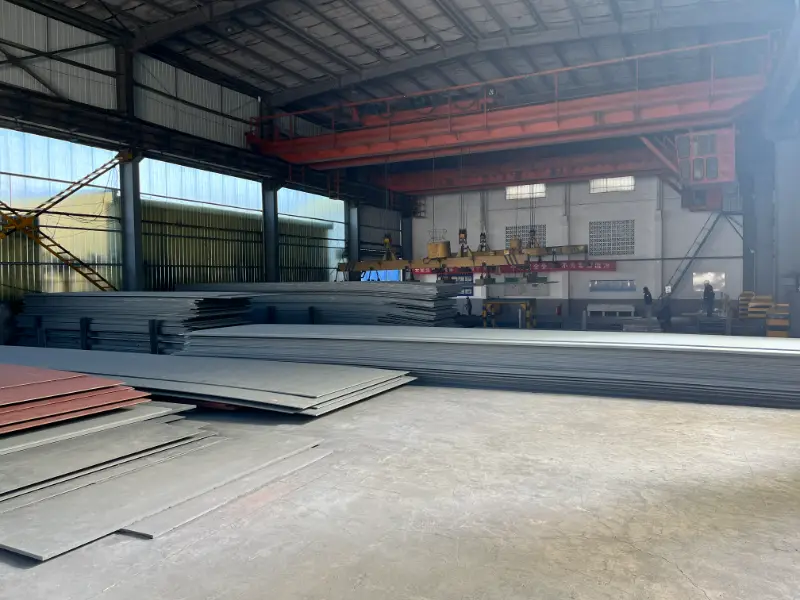
S460QL Steel Plate
S460QL High-Strength Low-Alloy Q&T Steel Plate (EN 10025-6) – Properties & Applications
Comprehensive material data for S460QL steel according to EN 10025-6. Chemical composition, mechanical and thermal properties, equivalent grades, and typical applications.
Hot rolling followed by quenching and tempering; weldable, suitable for cold bending, cutting, and machining
- Phone : +8618037372205
- Email : [email protected]
- WhatsApp: Contact via Whtsapp
- WeChat: +8618037372205
S460QL Steel Plate Introduction
S460QL is a high-strength structural steel grade defined in EN 10025-6, supplied in the quenched and tempered condition. It offers a minimum yield strength of 460 MPa and is characterized by excellent notch toughness at temperatures as low as -50°C ("L" designation).
Key features:
- Fine grain structure for superior toughness and weldability
- High strength-to-weight ratio enabling lighter structures
- Excellent resistance to brittle fracture in severe cold climates
- Good cold formability and machinability under controlled conditions
- Widely used in heavy-loaded welded constructions
S460QL Steel Plate Chemical Composition
The chemical composition of S460QL complies with EN 10025-6, ensuring fine grain practice and good weldability. Maximum values are listed; typical practice aims for a low carbon equivalent (CEV ≤ 0.47 for thickness ≤ 50 mm) to facilitate welding without preheating. All elements are controlled to meet the specified mechanical properties and low-temperature impact toughness.
| Element | Maximum value (wt%) | Remarks |
|---|---|---|
| C | 0.20 | Max. |
| Si | 0.80 | Max. |
| Mn | 1.70 | Max. |
| P | 0.020 | Max. |
| S | 0.010 | Max. |
| N | 0.015 | Max. |
| B | 0.005 | Max. |
| Cr | 1.50 | Max. |
| Cu | 0.50 | Max. |
| Mo | 0.70 | Max. |
| Nb | 0.06 | Max. |
| Ni | 2.0 | Max. |
| Ti | 0.05 | Max. |
| V | 0.12 | Max. |
| Zr | 0.15 | Max. |
| CEV | 0.47 (t ≤ 50 mm) | Typical maximum for thickness ≤ 50 mm, according to EN 10025-6 |
S460QL Steel Plate Thermal and Electrical Physical Properties
Typical physical properties for quenched and tempered S460QL steel at room temperature and elevated temperatures. Data are based on general low-alloy structural steel performance and can be used for design calculations. Thermal expansion and conductivity values are similar to those of conventional structural steels.
| Property | Typical value | Unit | Conditions / Temperature |
|---|---|---|---|
| Density (ρ) | 7.85 | g/cm³ | at 20 °C |
| Modulus of elasticity (E) | 210 | GPa | at 20 °C |
| Shear modulus (G) | 81 | GPa | at 20 °C |
| Poisson's ratio (ν) | 0.3 | – | elastic range |
| Thermal expansion coefficient (α) | 11.1 × 10⁻⁶ | 1/K | 20 – 100 °C |
| Thermal expansion coefficient (α) | 11.9 × 10⁻⁶ | 1/K | 20 – 200 °C |
| Thermal expansion coefficient (α) | 12.5 × 10⁻⁶ | 1/K | 20 – 300 °C |
| Thermal expansion coefficient (α) | 13.1 × 10⁻⁶ | 1/K | 20 – 400 °C |
| Thermal expansion coefficient (α) | 13.6 × 10⁻⁶ | 1/K | 20 – 500 °C |
| Thermal conductivity (λ) | 50 | W/(m·K) | at 20 °C |
| Specific heat capacity (cp) | 460 | J/(kg·K) | at 20 °C |
| Electrical resistivity (ρe) | approx. 0.23 | µΩ·m | at 20 °C |
S460QL Steel Plate Mechanical Properties
Minimum mechanical properties specified in EN 10025-6 for transverse test pieces, unless otherwise noted. Yield strength and tensile strength vary with plate thickness. Impact energy (Charpy V-notch) is guaranteed at -50°C for longitudinal specimens; transverse values are approximately 70% of the longitudinal minimum. Bend test confirms formability without cracking.
| Property | Value | Unit | Test conditions |
|---|---|---|---|
| Yield strength (ReH) | ≥ 460 | MPa | Nominal thickness t ≤ 50 mm |
| Yield strength (ReH) | ≥ 440 | MPa | 50 mm < t ≤ 100 mm |
| Yield strength (ReH) | ≥ 400 | MPa | 100 mm < t ≤ 150 mm |
| Tensile strength (Rm) | 550 – 720 | MPa | t ≤ 50 mm |
| Tensile strength (Rm) | 500 – 670 | MPa | 50 mm < t ≤ 100 mm |
| Tensile strength (Rm) | 470 – 630 | MPa | 100 mm < t ≤ 150 mm |
| Elongation after fracture (A) | ≥ 17 | % | t ≤ 50 mm, longitudinal |
| Elongation after fracture (A) | ≥ 16 | % | 50 mm < t ≤ 100 mm, longitudinal |
| Elongation after fracture (A) | ≥ 15 | % | 100 mm < t ≤ 150 mm, longitudinal |
| Impact energy (KV), average | ≥ 27 (single min. 21) | J | at -50 °C, longitudinal, t ≤ 50 mm |
| Bend test (180° bend) | d = 3t | – | t < 16 mm |
| Bend test (180° bend) | d = 4t | – | 16 mm ≤ t ≤ 50 mm |
| Bend test (180° bend) | d = 5t | – | 50 mm < t ≤ 100 mm |
| Bend test (180° bend) | d = 6t | – | 100 mm < t ≤ 150 mm |
S460QL Steel Plate Exact Equivalent Material Standards and Substitutable Grades
| Country/Region | Standard | Grade / Designation | Remarks |
|---|---|---|---|
| Europe | EN 10025-6 | S460QL | Current European standard, quenched and tempered fine grain steel |
| Germany | DIN EN 10025-6 | S460QL (W.-Nr. 1.8908) | Identical technical delivery conditions |
| United Kingdom | BS EN 10025-6 | S460QL | Adopted European standard |
| France | NF EN 10025-6 | S460QL | Adopted European standard |
| Italy | UNI EN 10025-6 | S460QL | Adopted European standard |
| Spain | UNE EN 10025-6 | S460QL | Adopted European standard |
| Sweden | SS EN 10025-6 | S460QL | Swedish implementation of EN standard |
| International (ISO) | ISO 630-6 | S460QL | Equivalent grade with minor differences; also suitable for low temperature service |
| Europe (previous) | EN 10137-2 | S460QL | Superseded by EN 10025-6 |
S460QL Steel Plate Application Introduction
S460QL steel is especially suited for demanding load-bearing structures exposed to low temperatures. Its combination of high strength, good weldability, and excellent low-temperature notch toughness makes it a preferred choice for heavy-duty welded constructions.
Typical applications include:
- Bridge building (long-span and high-stress components)
- Cranes and mobile lifting equipment
- Offshore structures and shipbuilding
- Heavy transport vehicles and trailers
- Pressure vessels and storage tanks for low-temperature service
- Mining and earth-moving equipment
Product Applications: Welded heavy-duty structural plates, Bridge girder and box section components, Crane booms and chassis frames, Offshore platform legs, bracings and deck components, Low-temperature liquid storage tanks, Trailer and tipper body parts, Penstock and pressure vessel shells
Processed into products: Main chords and diagonal bracing members in cranes, Flanges and webs of welded plate girders, Structural joints and node connectors, Boom sections in mobile cranes, Support brackets for wind turbine towers, Heavy-duty hydraulic cylinder supports, Reinforcements and stiffeners in offshore structures
Application industries: Bridge Construction, Crane & Lifting Equipment, Offshore & Marine Engineering, Heavy Machinery, Transportation & Logistics, Pressure Vessel Manufacturing, Mining & Quarrying
S460QL Steel Plate Similar/Comparable Material Alternatives
| Country/Region | Standard | Grade | Remarks |
|---|---|---|---|
| Europe | EN 10025-6 | S460Q | Same yield strength class but impact tested at -20 °C instead of -50 °C |
| Europe | EN 10025-4 | S460ML | Thermomechanical rolled, min. yield 460 MPa, impact at -50 °C; lower carbon equivalent and good weldability |
| USA | ASTM A572/A572M | Grade 65 (450 MPa) | Similar strength level (min. 450 MPa yield); not specifically graded for low‑temperature toughness |
| USA | ASTM A913/A913M | Grade 65 (450 MPa) | Quenched and tempered sections; Charpy options down to -46 °C may be ordered |
| China | GB/T 16270 | Q460E | High strength quenched and tempered steel, min. 460 MPa yield, impact energy guaranteed at -40 °C |
| Japan | JIS G 3106 | SM570 | Welded structural steel, min. 460 MPa tensile; low-temperature toughness can be negotiated (no guaranteed -50 °C) |
| Europe | EN 10025-3 | S460NL | Normalized/normalized rolled fine-grain steel, min. 460 MPa yield, impact at -50 °C |
Notes:
For welding, appropriate preheating and controlled heat input are recommended to avoid cold cracking, especially with thicker sections. Post-weld heat treatment (PWHT) is generally not required but may be applied for stress relief; however, any additional tempering must be carefully evaluated so as not to degrade the quenched and tempered microstructure. Additional requirements such as ultrasonic testing (EN 10160), through-thickness properties (Z-grade according to EN 10164), or impact testing on simulated heat-affected zones can be specified at the time of ordering.
- Share



