
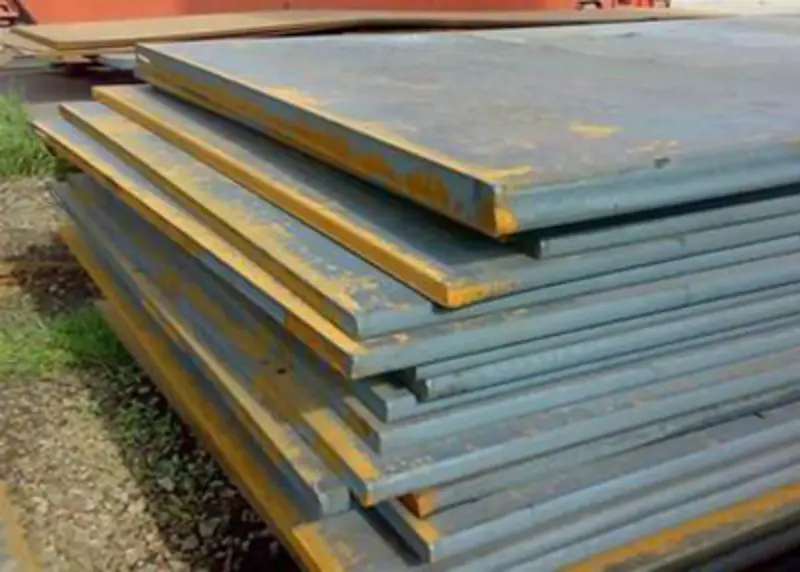
ASME SA709 HPS100W (SA709GRHPS100W) High-Performance Bridge Steel Plate
ASME SA709 HPS100W (SA709GRHPS100W) - High-Performance Bridge Steel Plate & Technical Data
Complete technical data for ASME SA709 Grade HPS100W (SA709GRHPS100W) low-alloy high-strength steel plate: chemical composition, mechanical properties, thermal and electrical properties, equivalent standards, and application guide for bridge and structural engineering.
Hot rolling, Quenching & Tempering (Q&T), Cutting, Welding, Forming
- Phone : +8618037372205
- Email : [email protected]
- WhatsApp: Contact via Whtsapp
- WeChat: +8618037372205
ASME SA709 HPS100W High-Performance Bridge Steel Plate Introduction
ASME SA709 Grade HPS100W (SA709GRHPS100W) is a high-performance low-alloy steel plate developed under the ASTM A709/A709M specification, primarily intended for bridge construction and other structural applications requiring excellent weldability, high toughness, and superior atmospheric corrosion resistance. With a minimum yield strength of 100 ksi (690 MPa), HPS100W embodies the next generation of High Performance Steel (HPS) grades, combining high strength with improved fracture toughness and formability. The steel is produced to controlled chemistry, with low carbon, very low sulfur, and microalloying elements (vanadium, aluminum) to provide strength through grain refinement and precipitation hardening. It is typically supplied in the quenched and tempered (Q&T) condition, delivering an optimal balance of strength, ductility, and notch toughness even at low temperatures. The "W" suffix indicates enhanced weathering resistance (atmospheric corrosion resistance significantly better than plain carbon steel), making it suitable for unpainted applications in many environments.
ASME SA709 HPS100W High-Performance Bridge Steel Plate Chemical Composition
The chemical composition of ASME SA709 HPS100W is tightly controlled to ensure high strength, low-temperature toughness, and good weldability. Maximum limits for sulfur and phosphorus are very low to avoid hot cracking and enhance impact properties. The addition of copper, chromium, and nickel provides atmospheric corrosion resistance, while microalloying with vanadium and aluminum contributes to fine grain size and precipitation strengthening. Carbon equivalent (CE) is limited to ensure weldability without excessive preheat. The values below comply with the standard requirements for product thickness ≤4 in. (100 mm), unless otherwise noted.
| Element | Standard Value | Remarks |
|---|---|---|
| Carbon (C) | ≤ 0.08 | Lower carbon for weldability |
| Manganese (Mn) | 1.10 – 1.50 | |
| Phosphorus (P) | ≤ 0.015 | |
| Sulfur (S) | ≤ 0.005 | Maximum for high toughness |
| Silicon (Si) | 0.40 – 0.65 | |
| Copper (Cu) | 0.25 – 0.50 | Weathering element |
| Nickel (Ni) | 0.65 – 1.00 | Weathering and toughness |
| Chromium (Cr) | 0.55 – 0.90 | Weathering element |
| Molybdenum (Mo) | 0.30 – 0.55 | Hardenability and strength |
| Vanadium (V) | 0.04 – 0.08 | Microalloying, grain refinement |
| Aluminum (Al) | 0.020 – 0.050 | Grain refinement and deoxidation |
| Nitrogen (N) | ≤ 0.015 | |
| Boron (B) | Not specified | Typically not added |
| CE (C.E.)* | ≤ 0.80 (typical) | Carbon equivalent = C + Mn/6 + (Cr+Mo+V)/5 + (Ni+Cu)/15 |
| Ni + Cr + Mo | ≤ 2.40 (for atmospheric corrosion class) | Weathering requirement |
ASME SA709 HPS100W High-Performance Bridge Steel Plate Thermal and Electrical Physical Properties
Physical properties are typical for Q&T low-alloy steel and are not part of the standard specifications. Values may vary slightly depending on exact composition and heat treatment. The data provided are average values at ambient temperature unless otherwise noted and can be used for engineering design calculations.
| Property | Typical Value | Unit | Test Condition |
|---|---|---|---|
| Density (ρ) | 7.85 | g/cm³ | 20 °C |
| Elastic Modulus (E) | 205 | GPa | Room temperature |
| Shear Modulus (G) | ~80 | GPa | Estimated (E/2(1+ν)) |
| Poisson's Ratio (ν) | 0.3 | dimensionless | Typical for steel |
| Thermal Expansion Coefficient (α) | 11.7 × 10⁻⁶ | /K | 20 – 100 °C; 12.3 × 10⁻⁶ /K at 100 – 200 °C |
| Thermal Conductivity (λ) | 45 | W/(m·K) | at 20 °C; decreases slightly at elevated temperatures |
| Specific Heat Capacity (cp) | 475 | J/(kg·K) | Room temperature |
| Electrical Resistivity (ρₑ) | ~0.25 × 10⁻⁶ | Ω·m | Ambient temperature, typical for low-alloy steel |
ASME SA709 HPS100W High-Performance Bridge Steel Plate Mechanical Properties
Mechanical properties are based on transverse specimens taken from quenched and tempered plates in accordance with ASTM A370. Yield strength and tensile strength values are valid for plate thicknesses up to and including 4 in. (100 mm). For thicker plates, values may be adjusted by agreement. The high yield-to-tensile ratio (~0.91) is characteristic of this grade. Charpy V-notch impact energy is often specified via Supplementary Requirement S5, with common requirements shown below.
| Property | Standard Requirement / Typical Value | Unit | Test Condition |
|---|---|---|---|
| Yield Strength (ReH) | ≥ 690 (100) | MPa (ksi) | t ≤ 100 mm (4 in.), transverse |
| Tensile Strength (Rm) | 760 – 895 (110 – 130) | MPa (ksi) | t ≤ 100 mm (4 in.), transverse |
| Elongation (A) | ≥ 15 (t ≤ 19 mm), ≥ 13 (t > 19 mm) | % | Gauge length 50 mm (2 in.) |
| Charpy V-Notch Impact (KV) | ≥ 27 (at -18°C / 0°F) or ≥ 34 (at -7°C / 20°F) — typical values from S5 | J | Transverse, full-size specimen, test temperature as specified |
| Bend Test | No cracking; d = 3t (for t ≤ 25 mm) to d = 4t (t > 25 mm) – 180° bend | Guided bend test, mandrel diameter d, specimen thickness t |
ASME SA709 HPS100W High-Performance Bridge Steel Plate Identical Equivalent Grades and Direct Replacements
| Country/Region | Standard | Grade | Remarks |
|---|---|---|---|
| USA (ASME) | ASME SA709/SA709M | HPS100W | Original ASME specification |
| USA (ASTM) | ASTM A709/A709M | HPS100W | Identical technical content; often used interchangeably |
| USA (AASHTO) | AASHTO M270/M270M | Grade HPS100W | Same as ASTM A709; commonly referenced for bridge construction |
ASME SA709 HPS100W High-Performance Bridge Steel Plate Application Introduction
ASME SA709 HPS100W is used wherever a combination of very high strength, excellent low-temperature notch toughness, and good atmospheric corrosion resistance is required. It is specifically designed for long-span bridges and welded structures where reduced weight and maintenance (unpainted designs) are advantageous. Proper welding procedures, including controlled preheat, low-hydrogen practices, and post-weld heat treatment when necessary, must be followed to preserve mechanical properties.
Product Applications: Main bridge girders and box sections, Long-span truss elements, Orthotropic deck plates, Crane runway beams, Heavy lifting frames, Hydraulic support structures
Processed into products: Flanges and webs of plate girders, Welded box columns and pylons, Ship unloader booms, Bridge bearing assemblies, Cantilever brackets and heavy-duty connectors, Fabricated bridge expansion joints
Application industries: Bridge engineering (highway, railway, pedestrian), Heavy structural engineering, Offshore and marine structures (subject to additional testing), Pressure vessel components (if approved by applicable code), Mining and heavy machinery (structural sections)
ASME SA709 HPS100W High-Performance Bridge Steel Plate Similar or Closely Related Steels for Reference
| Country/Region | Standard | Grade | Remarks |
|---|---|---|---|
| Japan | JIS G 3128 | SHY685 | High yield strength steel for welded structures, 685 MPa min yield, similar applications but different corrosion requirements |
| Europe | EN 10025-6 | S690QL / S690Q | Quenched and tempered structural steel, min yield 690 MPa; equivalent in strength but lacks specific weathering class; can be matched with special order |
| Canada | CSA G40.21 | 700Q / 700W | 700 MPa yield class, 'W' for weathering; close in strength and corrosion resistance, available as plate |
| USA | ASTM A514/A517 | Grade A, B, etc. | High-strength quenched and tempered alloy steel plate (690 MPa yield), often used in structural welded bridges; may have higher alloying and does not guarantee weathering equivalent to HPS100W |
Notes:
The HPS100W grade requires strict control of welding heat input and interpass temperature. When Charpy V-notch toughness is mandated (Supplementary Requirement S5), commonly specified test temperatures are -7 °C (20 °F) or -18 °C (0 °F), with minimum absorbed energy usually 27 J or 34 J depending on project specifications. For weathering applications, the steel forms a stable oxide patina when exposed to atmosphere; painting is not required but may be applied for aesthetics. The grade is fully killed and fine-grain practice is mandatory. Thickness availability typically ranges from 6 mm to 100 mm (0.24 in to 4 in); for larger thicknesses, mechanical properties may need engineering agreement.
- Share



