
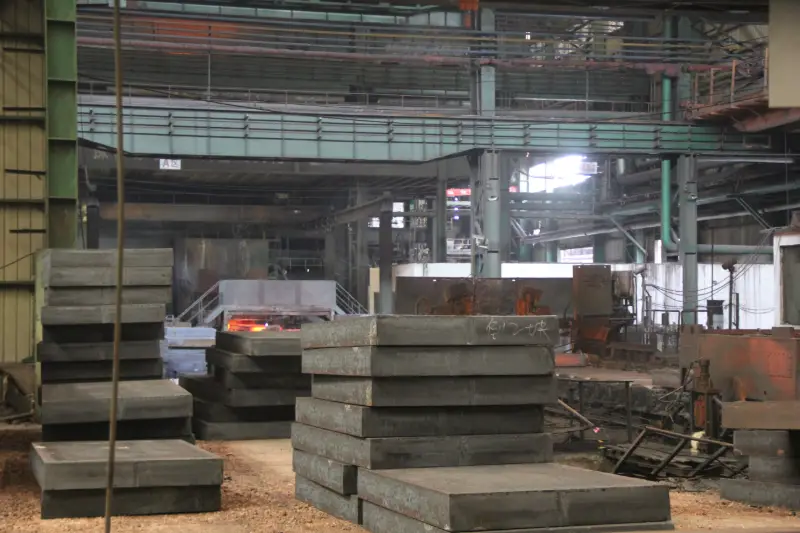
S235JR Carbon Structural Steel Plate per EN 10025-2
S235JR Carbon Structural Steel Plate per EN 10025-2 - Properties, Equivalents & Applications
Detailed material data for S235JR non-alloy structural steel according to EN 10025-2, including chemical composition, mechanical and physical properties, equivalent grades, and application guidance.
Hot rolling, normalizing rolling, cold forming, welding, cutting, bending, punching, machining
- Phone : +8618037372205
- Email : [email protected]
- WhatsApp: Contact via Whtsapp
- WeChat: +8618037372205
S235JR Carbon Structural Steel Plate per EN 10025-2 Introduction
S235JR is a weldable, non-alloy structural steel grade defined in the European standard EN 10025-2:2004 (and its later editions). It is the most commonly used hot rolled steel for general structural and engineering purposes. The designation 'S' indicates structural steel, '235' refers to the minimum yield strength of 235 MPa for thicknesses up to 16 mm, and 'JR' guarantees a minimum impact energy of 27 J at +20 °C. S235JR offers a good balance of strength, ductility, and weldability, making it suitable for a wide range of construction and machinery applications. It can be formed, bent, welded, and machined with conventional methods. The material is typically supplied in the hot rolled condition (as-rolled) unless otherwise specified. Typical thicknesses range from thin sheets to heavy plates, and the mechanical properties vary with product thickness as detailed in the standard.
S235JR Carbon Structural Steel Plate per EN 10025-2 Chemical Composition
The following limits apply to ladle analysis for S235JR according to EN 10025-2:2004, Table 2. Values are maximum unless otherwise stated. The composition is designed to provide good weldability and formability while meeting the specified strength level. Carbon equivalent (CEV) limits may apply depending on thickness and product type; typical CEV is ≤0.35 for this grade. For product analysis, slightly higher deviations are permitted as per the standard.
| Chemical Element | Standard Value (max %) | Remarks |
|---|---|---|
| Carbon (C) | 0.17 | Applies to nominal thickness ≤16 mm |
| Carbon (C) | 0.17 | Applies to nominal thickness 16 mm < t ≤ 40 mm |
| Carbon (C) | 0.20 | Applies to nominal thickness 40 mm < t ≤ 100 mm |
| Carbon (C) | 0.20 | Applies to nominal thickness 100 mm < t ≤ 150 mm |
| Carbon (C) | 0.22 | Applies to nominal thickness 150 mm < t ≤ 250 mm |
| Manganese (Mn) | 1.40 | Applies to all thicknesses |
| Phosphorus (P) | 0.035 | Maximum for all thicknesses |
| Sulfur (S) | 0.035 | Maximum for all thicknesses |
| Nitrogen (N) | 0.012 | Maximum for all thicknesses; higher nitrogen may be allowed if sufficient nitrogen-binding elements are present |
| Copper (Cu) | 0.55 | Maximum for all thicknesses |
S235JR Carbon Structural Steel Plate per EN 10025-2 Thermal and Electrical Physical Properties
The following values are typical for carbon structural steel and are not part of the EN 10025-2 specification requirements. They are provided for design guidance only. Actual values may vary slightly depending on the exact composition, manufacturing process, and temperature. All data refer to room temperature (20 °C) unless otherwise noted.
| Property | Typical Value | Unit | Test Conditions |
|---|---|---|---|
| Density (ρ) | 7.85 | g/cm³ | Room temperature |
| Elastic Modulus (E) | 210 | GPa | Room temperature; tension/compression |
| Shear Modulus (G) | 81 | GPa | Room temperature |
| Poisson's Ratio (ν) | 0.3 | – | Room temperature; within elastic range |
| Thermal Expansion Coefficient (α) | 11.7 | 10⁻⁶/K | 20 °C to 100 °C |
| Thermal Expansion Coefficient (α) | 12.5 | 10⁻⁶/K | 20 °C to 200 °C |
| Thermal Conductivity (λ) | 53 | W/(m·K) | Room temperature |
| Specific Heat Capacity | 460 | J/(kg·K) | Room temperature |
| Electrical Resistivity (ρₑ) | 0.20 | µΩ·m | Room temperature |
S235JR Carbon Structural Steel Plate per EN 10025-2 Mechanical Properties
Mechanical properties of S235JR are thickness-dependent as per EN 10025-2:2004, Tables 6, 7, and 8. Values apply to the longitudinal (rolling) direction for flat products; transverse values are slightly lower. The 'JR' designation requires a minimum Charpy-V impact energy of 27 J at +20 °C, tested on longitudinal specimens (10×10 mm, full-size). For sub-size specimens, the required energy is proportionally reduced. Bend test is performed with a mandrel diameter as listed, 180° bending angle. For thicknesses not covered by the table, refer to the standard.
| Property | Standard Value | Unit | Test Conditions / Remarks |
|---|---|---|---|
| Yield Strength (ReH) | ≥ 235 | MPa | Nominal thickness ≤ 16 mm |
| Yield Strength (ReH) | ≥ 225 | MPa | Nominal thickness 16 mm < t ≤ 40 mm |
| Yield Strength (ReH) | ≥ 215 | MPa | Nominal thickness 40 mm < t ≤ 63 mm |
| Yield Strength (ReH) | ≥ 215 | MPa | Nominal thickness 63 mm < t ≤ 80 mm |
| Yield Strength (ReH) | ≥ 215 | MPa | Nominal thickness 80 mm < t ≤ 100 mm |
| Yield Strength (ReH) | ≥ 195 | MPa | Nominal thickness 100 mm < t ≤ 150 mm |
| Yield Strength (ReH) | ≥ 185 | MPa | Nominal thickness 150 mm < t ≤ 200 mm |
| Yield Strength (ReH) | ≥ 175 | MPa | Nominal thickness 200 mm < t ≤ 250 mm |
| Tensile Strength (Rm) | 360 – 510 | MPa | Nominal thickness ≤ 3 mm |
| Tensile Strength (Rm) | 360 – 510 | MPa | Nominal thickness 3 mm < t ≤ 100 mm |
| Tensile Strength (Rm) | 350 – 500 | MPa | Nominal thickness 100 mm < t ≤ 150 mm |
| Tensile Strength (Rm) | 340 – 490 | MPa | Nominal thickness 150 mm < t ≤ 250 mm |
| Elongation (A) – longitudinal | ≥ 26 | % | Nominal thickness 3 mm < t ≤ 40 mm; gauge length L₀ = 5.65√S₀ |
| Elongation (A) – longitudinal | ≥ 25 | % | Nominal thickness 40 mm < t ≤ 63 mm |
| Elongation (A) – longitudinal | ≥ 24 | % | Nominal thickness 63 mm < t ≤ 100 mm |
| Elongation (A) – longitudinal | ≥ 22 | % | Nominal thickness 100 mm < t ≤ 150 mm |
| Elongation (A) – longitudinal | ≥ 22 | % | Nominal thickness 150 mm < t ≤ 250 mm |
| Impact Energy (KV₂) – longitudinal | ≥ 27 | J | At +20 °C; full-size (10×10 mm) Charpy V-notch specimen |
| Bend Test (mandrel diameter) | 0.5 × a | – | Bending angle 180°; nominal thickness ≤ 16 mm |
| Bend Test (mandrel diameter) | 1.0 × a | – | Bending angle 180°; nominal thickness 16 mm < t ≤ 100 mm |
| Bend Test (mandrel diameter) | 1.5 × a | – | Bending angle 180°; nominal thickness 100 mm < t ≤ 150 mm |
S235JR Carbon Structural Steel Plate per EN 10025-2 Fully Equivalent Grades
In many countries, S235JR is adopted under national standards that are identical to EN 10025-2. The following designations are technically identical and can be used interchangeably in terms of chemical composition, mechanical properties, and delivery conditions. Note that additional requirements (e.g., surface condition, tolerances) should be confirmed against the relevant national standard.
| Country / Region | Standard | Grade / Designation | Remarks |
|---|---|---|---|
| European Union | EN 10025-2 | S235JR | Baseline European standard |
| Germany | DIN EN 10025-2 | S235JR | Identical to EN 10025-2 |
| United Kingdom | BS EN 10025-2 | S235JR | Identical to EN 10025-2 |
| France | NF EN 10025-2 | S235JR | Identical to EN 10025-2 |
| Italy | UNI EN 10025-2 | S235JR | Identical to EN 10025-2 |
| Spain | UNE EN 10025-2 | S235JR | Identical to EN 10025-2 |
| Poland | PN-EN 10025-2 | S235JR | Identical to EN 10025-2 |
| Czech Republic | ČSN EN 10025-2 | S235JR | Identical to EN 10025-2 |
| Sweden | SS-EN 10025-2 | S235JR | Identical to EN 10025-2 |
| Austria | ÖNORM EN 10025-2 | S235JR | Identical to EN 10025-2 |
| Netherlands | NEN-EN 10025-2 | S235JR | Identical to EN 10025-2 |
S235JR Carbon Structural Steel Plate per EN 10025-2 Application Introduction
Thanks to its balanced combination of moderate strength, excellent weldability, and good ductility, S235JR is one of the most widely used structural steels globally. It can be processed by almost all common fabrication methods. Typical design codes for steel structures (like Eurocode 3) fully cover this grade. Its low cost and wide availability make it the material of choice for a vast range of conventional construction and mechanical engineering projects.
Product Applications: Structural steel frameworks and skeletons, Welded H-beams, I-beams, channels, and angles, Steel grating and handrails, Floor plates and base plates, Welded pipes and hollow sections, Storage silos and water tanks, Agricultural tractors and trailers (chassis), Simple machine frames and supports, Guard rails and road furniture, Non-pressurized vessels and containers
Processed into products: Steel columns and beams, Structural bracing members, Base plates and anchor plates, Brackets, gussets, and cleats, Flanges for structural connections, Welded tubular trusses, Frames for industrial machinery, Excavator and loader arms (light duty), Trailer chassis and drawbars, Sheet metal enclosures and housings
Application industries: Building and Construction, Bridge Engineering, Infrastructure and Civil Works, General Mechanical Engineering, Agricultural Machinery, Automotive Components (sub-frames, brackets), Storage Tank Manufacturing, Pipe and Tube Production, Mining and Earthmoving Equipment (light to medium duty), Railway Structures (footbridges, gantries)
S235JR Carbon Structural Steel Plate per EN 10025-2 Similar / Comparable Grades from Other Standards
The grades listed below are not identical but are frequently considered as substitutes for S235JR in many applications. Differences exist in chemical composition limits, tensile requirements, and impact testing conditions. When substituting, a detailed comparison of the specific product requirements (strength, impact, formability, etc.) is essential. The closest international equivalent in terms of yield strength and impact properties is ISO 630-2 E235B.
| Country / Region | Standard | Grade | Remarks |
|---|---|---|---|
| International (ISO) | ISO 630-2:2011 | E235B | Very close match; yield 235 MPa, impact 27 J at +20 °C. Minor differences in Mn and other elements. |
| China | GB/T 700 | Q235B | Similar strength and impact (Q235B: impact 27 J at +20 °C). Slightly higher Mn allowed. Welding and forming characteristics comparable. |
| United States | ASTM A36 / A36M | A36 | Minimum yield strength 250 MPa (36 ksi), no mandatory impact requirement. Commonly used for structural shapes and plates; slightly higher strength but not directly equivalent. |
| Japan | JIS G3101 | SS400 | Yield strength typically ≥245 MPa; no impact energy guaranteed. Broader compositional limits. Often used as a substitute for general structures but lacks the temperature-specific toughness guarantee. |
| Russia | GOST 380 | St3sp / St3ps (Ст3сп/Ст3пс) | Similar carbon–manganese structural steel; impact properties may differ; careful verification required. |
| India | IS 2062 | E250 BR / Fe 410 WA | E250 BR has 250 MPa yield, 27 J at +20 °C; slightly higher strength but comparable chemistry. Often used interchangeably in fabrication. |
Notes:
- Surface condition: S235JR is typically supplied with a mill scale finish (hot rolled). Further surface treatment (pickled/oiled, blasted, painted) may be agreed upon.
- Weldability: Excellent with all common arc welding processes; preheating is generally not required for thicknesses below 30 mm. CEV limits should be observed for critical applications.
- Formability: Suitable for cold bending, roll forming, and light deep-drawing operations; minimum bend radii should follow the recommendations of EN 10025-2.
- Fracture toughness: The JR quality guarantees only 27 J at +20 °C. For lower temperatures or higher toughness requirements, consider J0 (0 °C) or J2 (-20 °C) options.
- Limiting thickness: The maximum thickness covered by the standard mechanical properties is 250 mm. For thicker products, special agreements or alternative grades are needed.
- Share



