
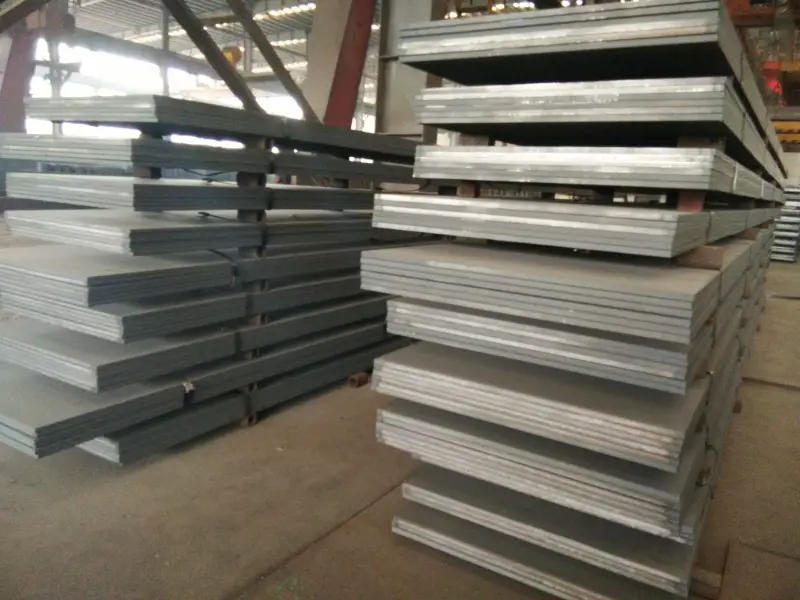
EN 10025-6 S460QL1 High-Strength Quenched & Tempered Steel Plate
S460QL1 High-Strength Quenched & Tempered Steel Plate per EN 10025-6
Detailed material data for S460QL1 steel plate: a high-yield-strength, quenched and tempered structural steel with excellent toughness and weldability for heavy-duty applications per EN 10025-6.
Hot rolling, quenching and tempering (Q+T), cold forming, thermal cutting, welding, machining
- Phone : +8618037372205
- Email : [email protected]
- WhatsApp: Contact via Whtsapp
- WeChat: +8618037372205
EN 10025-6 S460QL1 High-Strength Quenched & Tempered Steel Plate Introduction
S460QL1 is a high-strength, quenched and tempered structural steel plate defined by EN 10025-6, a European harmonized standard for flat products of high yield strength structural steels in the quenched and tempered condition. This grade, part of the 'Quality L1' subset, guarantees a minimum yield strength of 460 MPa for thicknesses up to 50 mm. It is characterized by a fine-grained microstructure, excellent low-temperature impact toughness (down to -60 °C), and good weldability due to its specific low-carbon equivalent formulation. S460QL1 is widely chosen for reducing structural weight while maintaining extreme load-bearing capacity, making it a cornerstone material in modern, demanding engineering projects.
EN 10025-6 S460QL1 High-Strength Quenched & Tempered Steel Plate Chemical Composition
The chemical composition of S460QL1 is carefully controlled to ensure deep hardenability, high strength, and excellent weldability. Alloying elements like Manganese, Chromium, and Molybdenum provide solid-solution strengthening and enhance hardenability, while micro-alloying elements like Niobium, Vanadium, and Titanium refine the grain structure. Boron is optionally added to further boost hardenability. The low Carbon Equivalent Value (CEV) is critical for preventing cold cracking during welding.
| Element | Standard Value (%) | Remarks |
|---|---|---|
| Carbon (C) | ≤ 0.20 | Max. |
| Silicon (Si) | ≤ 0.80 | Max. |
| Manganese (Mn) | ≤ 1.70 | Max. |
| Phosphorus (P) | ≤ 0.020 | Max. |
| Sulfur (S) | ≤ 0.010 | Max. |
| Chromium (Cr) | ≤ 1.50 | Max. |
| Nickel (Ni) | ≤ 2.0 | Max. |
| Molybdenum (Mo) | ≤ 0.70 | Max. |
| Copper (Cu) | ≤ 0.50 | Max. |
| Niobium (Nb) | ≤ 0.06 | Max. |
| Vanadium (V) | ≤ 0.12 | Max. |
| Titanium (Ti) | ≤ 0.05 | Max. |
| Boron (B) | ≤ 0.005 | Max., optional addition |
| Zirconium (Zr) | ≤ 0.15 | Max. |
| Nitrogen (N) | ≤ 0.015 | Max. |
| Aluminium (Al) | ≥ 0.015 | Minimum total aluminium content |
EN 10025-6 S460QL1 High-Strength Quenched & Tempered Steel Plate Thermal and Electrical Physical Properties
The physical properties provided are typical values for quenched and tempered structural steels. These properties govern the material's behavior under thermal and electrical loads. The density is standard for steel, and the modulus of elasticity is vital for stiffness calculations. The thermal expansion coefficient is crucial for design where dimensional changes with temperature must be considered, such as in welded structures or machinery subject to thermal cycling. These values can vary slightly with the exact tempering temperature and chemical composition.
| Property | Typical Value | Unit | Test Condition |
|---|---|---|---|
| Density (ρ) | 7.85 | g/cm³ | At 20 °C |
| Modulus of elasticity (E) | 210 | GPa | At 20 °C |
| Shear modulus (G) | 810 | GPa | At 20 °C |
| Poisson's ratio (ν) | 0.3 | — | At 20 °C |
| Thermal expansion coefficient (α) | 11.7 × 10⁻⁶ | K⁻¹ | Range: 20 °C to 100 °C |
| Thermal expansion coefficient (α) | 12.6 × 10⁻⁶ | K⁻¹ | Range: 20 °C to 200 °C |
| Thermal expansion coefficient (α) | 13.5 × 10⁻⁶ | K⁻¹ | Range: 20 °C to 400 °C |
| Thermal expansion coefficient (α) | 14.4 × 10⁻⁶ | K⁻¹ | Range: 20 °C to 600 °C |
| Thermal conductivity (λ) | 44.7 | W/(m·K) | At 20 °C |
| Thermal conductivity (λ) | 40.7 | W/(m·K) | At 200 °C |
| Thermal conductivity (λ) | 36.3 | W/(m·K) | At 400 °C |
| Thermal conductivity (λ) | 31.0 | W/(m·K) | At 600 °C |
| Specific heat capacity | 460 | J/(kg·K) | At 20 °C |
| Electrical resistivity (ρ_e) | 0.23 × 10⁻⁶ | Ω·m | At 20 °C |
EN 10025-6 S460QL1 High-Strength Quenched & Tempered Steel Plate Mechanical Properties
The mechanical properties of S460QL1 are defined for the quenched and tempered delivery condition. The high minimum yield strength allows for lighter construction designs. A key differentiator for the 'L1' quality is its guaranteed minimum impact energy value of 27 Joules at the very low temperature of -60 °C, signifying excellent resistance to brittle fracture. Properties are valid for flat products, with yield strength decreasing as thickness increases.
| Property | Standard Requirement Value | Unit | Test Condition |
|---|---|---|---|
| Minimum yield strength (ReH) | 460 | MPa | Nominal thickness ≤ 50 mm |
| Minimum yield strength (ReH) | 440 | MPa | 50 mm < Nominal thickness ≤ 100 mm |
| Minimum yield strength (ReH) | 400 | MPa | 100 mm < Nominal thickness ≤ 150 mm |
| Tensile strength (Rm) | 550 - 720 | MPa | Nominal thickness ≤ 50 mm |
| Tensile strength (Rm) | 550 - 720 | MPa | 50 mm < Nominal thickness ≤ 100 mm |
| Tensile strength (Rm) | 500 - 670 | MPa | 100 mm < Nominal thickness ≤ 150 mm |
| Minimum elongation after fracture (A) | 17 | % | Longitudinal, nominal thickness ≤ 50 mm, gauge length L0=5.65√S0 |
| Minimum elongation after fracture (A) | 17 | % | Longitudinal, 50 mm < Nominal thickness ≤ 100 mm, gauge length L0=5.65√S0 |
| Minimum elongation after fracture (A) | 17 | % | Longitudinal, 100 mm < Nominal thickness ≤ 150 mm, gauge length L0=5.65√S0 |
| Minimum impact energy (KV) | 27 | J | Longitudinal, test temperature -60 °C |
EN 10025-6 S460QL1 High-Strength Quenched & Tempered Steel Plate Completely Equivalent Material Standards and Replaceable Grades
| Country/Region | Standard | Grade | Notes |
|---|---|---|---|
| European Union | EN 10025-6 | S460QL1 | Original designation, 'L' for low-temperature toughness, '1' for minus 60 °C impact test. |
| International (ISO) | ISO 4950-2 | E460 DD | Functionally equivalent high yield strength flat steel product with guaranteed impact at -50 °C; close but not identical to -60 °C requirement. |
EN 10025-6 S460QL1 High-Strength Quenched & Tempered Steel Plate Application Introduction
S460QL1 is an engineering material designed for extreme load-bearing structures operating in very cold climates. Its combination of minimum 460 MPa yield strength and guaranteed toughness down to -60 °C makes it an excellent choice for weight-sensitive, safety-critical applications. The Q+T condition provides a uniform and reliable microstructure. Typical high-quality thermal cutting and welding processes are fully applicable, though adherence to recommended pre-heating and heat input procedures is crucial to preserve properties in the heat-affected zone (HAZ).
Product Applications: Mobile cranes (LTM, LG lattice boom crawler cranes), Offshore jack-up drilling platforms, Heavy-duty modular trailers and SPMTs, Arctic-grade steel bridges, Large hydraulic excavators and wheel loaders, Wind turbine monopiles and jackets, Pressure vessels for low-temperature service
Processed into products: Crane telescopic boom sections and luffing jibs, Offshore structure rack and chord members, Welded box-girder chassis for mining trucks, Excavator upper and lower frames, stick and boom assemblies, Flange and web plates for bridge girders, Trunnion rings and slewing platforms, High-stress pins, shafts, and bolted joint plates
Application industries: Heavy mobile crane manufacturing (telescopic and lattice booms), Offshore engineering (jack-up rig legs, structural nodes, flare booms), Bridge building (long-span and orthotropic deck bridges in arctic regions), Transport and trailer engineering (high-capacity trailers, tipper bodies), Mining and earthmoving machinery (dump truck chassis, excavator booms and arms), Pressure vessel and penstock construction, Wind energy (tubular towers, transition pieces, offshore substructures)
EN 10025-6 S460QL1 High-Strength Quenched & Tempered Steel Plate Similar or Comparable Substitute Material Recommendations
| Country/Region | Standard | Grade | Notes |
|---|---|---|---|
| European Union | EN 10025-6 | S460QL | Similar high-strength Q+T grade but with impact testing at -40 °C (L quality). S460QL1 offers superior low-temperature toughness. |
| European Union | EN 10025-6 | S500QL1 | A higher strength grade (min yield 500 MPa) with similar toughness (-60 °C) for more weight reduction. |
| Germany | DIN EN 10025-6 | S460QL1 | Direct national adoption of the European standard, identical properties. |
| USA | ASTM A514/A514M | Grade B | A high-strength quenched and tempered alloy steel plate. Mechanical properties are roughly comparable, but chemical composition and testing standards differ. Direct substitution requires engineering assessment. |
| USA | ASTM A517/A517M | Grade B | Similar to ASTM A514 but for boiler and pressure vessel applications. Requires careful review of design standards for substitution. |
| China | GB/T 16270 | Q460E | Chinese standard for high-strength structural steel plates in the quenched and tempered condition. Impact temperature is -40 °C, making S460QL1 tougher at lower temperatures. |
Notes:
Welding Advice: Welding must be performed according to EN 1011-2, paying close attention to pre-heating temperature, inter-pass temperature, and heat input to avoid hydrogen-induced cracking and maintain HAZ toughness. Low-hydrogen welding consumables matched to the steel strength are mandatory.
Tolerances: Dimensional and shape tolerances for flat products comply with EN 10029 for plates and EN 10051 for strips/sheets.
Processing: This material is suitable for cold forming within the limits defined in the standard, considering its high strength. Hot forming above the original tempering temperature will alter the mechanical properties and requires a new Q+T heat treatment.
- Share



