
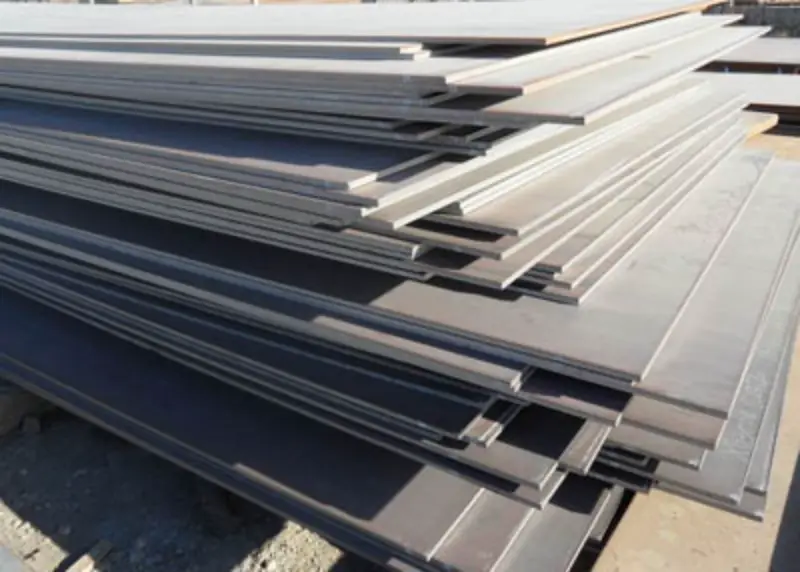
EN10025-6 S500Q Structural Steel Plate
EN10025-6 S500Q Quenched & Tempered High-Strength Structural Steel Plate
Comprehensive material data for S500Q steel plate according to EN 10025-6, including chemical composition, mechanical properties, thermal and electrical physical properties, international equivalents, and application guidance for structural engineering.
Quenched and tempered (Q&T); weldable; cold formable with appropriate bending radii; machinable in annealed or tempered state; cuttable by thermal or mechanical methods.
- Phone : +8618037372205
- Email : [email protected]
- WhatsApp: Contact via Whtsapp
- WeChat: +8618037372205
EN10025-6 S500Q Structural Steel Plate Introduction
S500Q is a quenched and tempered high-strength structural steel defined in EN 10025-6. It provides a minimum yield strength of 500 MPa in thicknesses up to 50 mm. The steel features good weldability, toughness at low temperatures (Charpy impact at -20°C), and high resistance to brittle fracture. Typical delivery condition is quenched and tempered (Q&T). Its high strength-to-weight ratio enables lighter and more economical designs for heavy-duty load-bearing structures.
- Minimum yield strength: 500 MPa (t ≤ 50 mm)
- Excellent toughness at -20°C (min. 27 J longitudinal)
- Good cold formability for a quenched and tempered steel
- Designed for welded structures with suitable precautions
EN10025-6 S500Q Structural Steel Plate Chemical Composition
The following chemical elements are controlled as per EN 10025-6. The limits are maximum values unless a range is given. Carbon equivalent (CEV) is an important measure for weldability: for product thickness ≤ 50 mm, CEV ≤ 0.47%; for thickness > 50 mm ≤ 100 mm, CEV ≤ 0.49%. CEV = C + Mn/6 + (Cr+Mo+V)/5 + (Ni+Cu)/15.
| Element | Maximum Value (or range) | Remarks |
|---|---|---|
| Carbon (C) | ≤ 0.20 | |
| Silicon (Si) | ≤ 0.80 | |
| Manganese (Mn) | ≤ 1.70 | |
| Phosphorus (P) | ≤ 0.025 | Ladle analysis; product analysis may be slightly higher |
| Sulfur (S) | ≤ 0.015 | |
| Nitrogen (N) | ≤ 0.015 | |
| Boron (B) | ≤ 0.005 | |
| Chromium (Cr) | ≤ 1.50 | |
| Copper (Cu) | ≤ 0.50 | |
| Molybdenum (Mo) | ≤ 0.70 | |
| Niobium (Nb) | ≤ 0.06 | |
| Nickel (Ni) | ≤ 2.0 | |
| Titanium (Ti) | ≤ 0.05 | |
| Vanadium (V) | ≤ 0.12 | |
| Zirconium (Zr) | ≤ 0.15 | |
| Aluminium (Al total) | ≥ 0.015 | Optional; can be used for grain refinement, but not mandatory in standard. Manufacturers often add. |
| Carbon Equivalent (CEV) | ≤ 0.47 (t ≤ 50 mm) ; ≤ 0.49 (50 < t ≤ 100 mm) | Calculated value, not an element |
EN10025-6 S500Q Structural Steel Plate Thermal and Electrical Physical Properties
The values listed below are typical for quenched and tempered high-strength low-alloy steels and serve as engineering estimates. Actual values can vary slightly depending on heat treatment and exact composition.
- Density is used for weight calculations.
- Thermal expansion influences design when wide temperature variations are expected.
- Thermal conductivity and electrical resistivity are relevant for heat transfer and electrical applications.
| Property | Typical Value | Unit | Condition / Notes |
|---|---|---|---|
| Density (ρ) | 7850 | kg/m³ | At 20°C |
| Elastic modulus (E) | 210 | GPa | At ambient temperature; decreases with increasing temperature |
| Shear modulus (G) | 81 | GPa | Approximate, derived from E and Poisson's ratio |
| Poisson's ratio (ν) | 0.3 | - | Elastic range, room temperature |
| Thermal expansion coefficient (α) | 12.0 × 10⁻⁶ | 1/K | Range 20°C to 100°C |
| Thermal expansion coefficient (α) | 13.6 × 10⁻⁶ | 1/K | Range 20°C to 400°C |
| Thermal conductivity (λ) | 42 | W/(m·K) | At 20°C |
| Specific heat capacity (cp) | 460 | J/(kg·K) | At 20°C |
| Electrical resistivity (ρₑ) | 0.25 × 10⁻⁶ | Ω·m | At 20°C, typical for low-alloy steel |
EN10025-6 S500Q Structural Steel Plate Mechanical Properties
The mechanical properties are guaranteed in the quenched and tempered delivery condition. Requirements depend on product thickness. Tensile testing is performed at room temperature.
- Yield strength (ReH): minimum values as listed for specified thickness ranges.
- Tensile strength (Rm): range applies for all thicknesses up to 100 mm.
- Elongation (A): gauge length L0 = 5.65√S0 (A5).
- Bend test: required; no cracks after bending around a mandrel of specified diameter.
- Impact test: Charpy V-notch, longitudinal direction, at -20°C; minimum absorbed energy 27 J. For transverse test pieces, minimum 20 J applies.
| Property | Minimum/Required Value | Unit | Test Condition / Remarks |
|---|---|---|---|
| Yield strength (ReH) | 500 | MPa | Thickness ≤ 50 mm |
| Yield strength (ReH) | 480 | MPa | Thickness > 50 mm ≤ 100 mm |
| Tensile strength (Rm) | 590 to 770 | MPa | Thickness ≤ 100 mm |
| Elongation (A5) | 17 | % | Longitudinal, thickness ≤ 100 mm |
| Elongation (A5, transverse) | 15 | % | Transverse direction (if required) |
| Bend test (mandrel diameter) | 2t | - | Thickness ≤ 16 mm, bending angle 180° |
| Bend test (mandrel diameter) | 3t | - | Thickness > 16 mm ≤ 50 mm, 180° |
| Bend test (mandrel diameter) | 4t | - | Thickness > 50 mm ≤ 100 mm, 180° |
| Charpy impact energy (KV, -20°C) | 27 | J | Longitudinal test piece, average of three tests (min. single value 19 J) |
| Charpy impact energy (KV, -20°C, transverse) | 20 | J | Transverse specimen (if agreed) |
EN10025-6 S500Q Structural Steel Plate Completely Equivalent Material Standards and Replaceable Grades
| Country/Region | Standard | Grade | Remark |
|---|---|---|---|
| International (ISO) | ISO 4950-2:1995 | E500D | Quenched and tempered; impact test at -20°C; directly equivalent to S500Q |
| China | GB/T 16270-2009 | Q500D | Quenched and tempered; impact -20°C; chemical and mechanical properties align with S500Q |
| European Union | EN 10025-6 | S500Q | The original grade under this data sheet |
EN10025-6 S500Q Structural Steel Plate Application Introduction
S500Q is designed for welded, heavy-duty structures where high strength and good low-temperature toughness are required. Typical applications include:
- Mobile crane telescopic booms and outrigger beams
- Heavy vehicle chassis and frames
- Bridge girders and large-span structures
- Offshore platform legs, nodes, and deck structures
- Pressure vessels and storage tanks (subject to additional requirements)
- Mining equipment bodies and structural components
Product Applications: Crane booms and lattice structures, Offshore platform superstructures, Heavy transport trailers, Bridge box girders, Pressure vessel shells, Hydraulic press frames, Industrial storage tanks, Heavy-duty structural columns and beams
Processed into products: Welded H-beams and stiffened plate girders, Crane telescopic section segments, Load-bearing nodes and gussets, Base frames for machinery, Rolled and welded cylinders, Reinforcement plates for joints, Cut and machined structural parts
Application industries: Heavy engineering and construction, Offshore and marine engineering, Mining and earthmoving equipment, Mobile crane and lifting equipment, Bridge building, Pressure vessel manufacturing (with appropriate toughness certification)
EN10025-6 S500Q Structural Steel Plate Similar or Approximate Substitute Grades
| Country/Region | Standard | Grade | Remark |
|---|---|---|---|
| European Union | EN 10025-6 | S460Q | Lower yield strength (460 MPa), same family, quenched and tempered |
| European Union | EN 10025-6 | S550Q | Higher strength (550 MPa), similar toughness, Q&T |
| European Union | EN 10025-6 | S620Q | Higher strength (620 MPa), may require adjusted welding procedures |
| China | GB/T 16270-2009 | Q460D | Slightly lower strength but similar impact class |
| USA | ASTM A514 / A517 | Grade B | 690 MPa class quenched and tempered high-strength steel; significantly higher strength, not a direct replacement but used in similar heavy structural applications |
Notes:
Welding: Preheating and interpass temperature control are recommended depending on thickness and hydrogen risk. Use low-hydrogen electrodes. Post-weld heat treatment generally not required but may be applied for stress relief with care not to degrade strength. Cold forming: Observe minimum bending radii per standard; for thicknesses up to 16 mm, typical inside radius ≥ 2t. Surface protection: Can be painted, thermal sprayed, or galvanized with suitable pre-treatment. Certification: EN 10204 inspection documents type 3.1 or 3.2 are commonly supplied. Supplementary requirements such as through-thickness properties (Z-plates) are available under EN 10164.
- Share



