
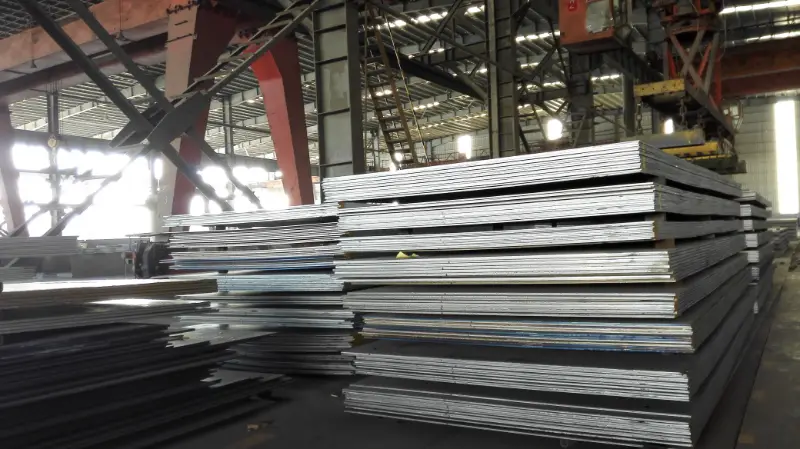
S500QL EN 10025-6 High Strength Q&T Steel Plate
S500QL EN 10025-6 High Strength Q&T Steel Plate: Composition, Properties & Equivalents
Complete material data for S500QL high-strength structural steel plate to EN 10025-6, covering chemical composition, mechanical and physical properties, international equivalents, and application guidance.
Welding (with preheat and low-hydrogen fillers), gas/plasma/laser cutting, cold forming (limited by strength), machining, drilling
- Phone : +8618037372205
- Email : [email protected]
- WhatsApp: Contact via Whtsapp
- WeChat: +8618037372205
S500QL EN 10025-6 High Strength Q&T Steel Plate Introduction
S500QL is a quenched and tempered, weldable fine-grain structural steel grade specified in EN 10025-6. It offers a minimum yield strength of 500 MPa and excellent low-temperature toughness down to -40 °C due to the 'L' designation. This high-strength low-alloy (HSLA) steel is designed for heavily loaded welded structures in construction, offshore, and heavy machinery. Its controlled chemical composition with micro-alloying elements (Nb, V, Ti) refines the grain structure, ensuring good formability and weldability. The 'Q' indicates a quenching and tempering delivery condition. S500QL is typically supplied as heavy plates and strips, and can be welded using common techniques with appropriate preheating and low-hydrogen consumables to avoid cold cracking. Carbon equivalent values (CEV) and low impurities give it reliable through-thickness properties and good resistance to brittle fracture.
S500QL EN 10025-6 High Strength Q&T Steel Plate Chemical Composition
The chemical composition of S500QL is based on ladle analysis limits according to EN 10025-6:2019, Table 2. Microalloying elements Nb, V, Ti are added singly or in combination for grain refinement. Aluminum is also necessary as a grain-refining element. Low sulfur and phosphorus contents enhance toughness and through-thickness properties. Carbon equivalent (CEV) is controlled to ensure good weldability, with maximum values depending on thickness.
| Element | Maximum/Nominal Value (wt%) | Remarks |
|---|---|---|
| C | ≤ 0.20 | Heat analysis, max |
| Si | ≤ 0.80 | Heat analysis, max |
| Mn | ≤ 1.70 | Heat analysis, max |
| P | ≤ 0.025 | Heat analysis, max |
| S | ≤ 0.015 | Heat analysis, max |
| Al (total) | ≥ 0.015 | Minimum when used as grain-refining element |
| N | ≤ 0.015 | Heat analysis, max |
| Cr | ≤ 1.50 | Heat analysis, max |
| Cu | ≤ 0.50 | Heat analysis, max |
| Mo | ≤ 0.70 | Heat analysis, max |
| Nb | ≤ 0.06 | Heat analysis, max |
| Ni | ≤ 2.0 | Heat analysis, max |
| Ti | ≤ 0.05 | Heat analysis, max |
| V | ≤ 0.12 | Heat analysis, max |
| Zr | ≤ 0.15 | Heat analysis, max |
| B | ≤ 0.0050 | Heat analysis, max |
S500QL EN 10025-6 High Strength Q&T Steel Plate Thermal & Electrical Physical Properties
The following physical properties are typical values for quenched and tempered low-alloy structural steel at room temperature unless otherwise stated. They are not part of the EN 10025-6 standard but serve as engineering reference data. S500QL exhibits characteristics similar to other carbon-manganese microalloyed steels. Slight variations can occur depending on exact heat treatment and composition.
| Property | Typical Value | Unit | Test Conditions / Remarks |
|---|---|---|---|
| Density (ρ) | ~ 7850 | kg/m³ | Ambient temperature |
| Elastic modulus (E) | ~ 205 | GPa | Ambient temperature |
| Shear modulus (G) | ~ 80 | GPa | Ambient temperature, calculated from E and ν |
| Poisson ratio (ν) | ~ 0.30 | - | Ambient temperature |
| Thermal expansion coefficient (α) | ~ 11.5 × 10⁻⁶ | 1/K | Between 20 °C and 100 °C |
| Thermal conductivity (λ) | ~ 45 | W/(m·K) | At 20 °C |
| Specific heat capacity (c) | ~ 470 | J/(kg·K) | At 20 °C |
| Electrical resistivity (ρₑ) | ~ 0.25 × 10⁻⁶ | Ω·m | At 20 °C |
S500QL EN 10025-6 High Strength Q&T Steel Plate Mechanical Properties
Mechanical properties specified in EN 10025-6:2019, Table 3 and Table 4. Values are valid for flat products in the quenched and tempered delivery condition. Yield strength (ReH) and tensile strength (Rm) depend on product thickness. The elongation A is measured on a gauge length L₀ = 5.65√S₀. Impact energy (KV₂) at -40 °C is for the 'L' quality and applies to thicknesses ≥ 10 mm. Transverse specimens are the default for plates.
| Property | Required Value | Unit | Test Conditions / Remarks |
|---|---|---|---|
| ReH (Yield strength) | ≥ 500 | MPa | Product thickness 3 – 50 mm, transverse |
| ReH (Yield strength) | ≥ 480 | MPa | Product thickness 50 – 100 mm, transverse |
| ReH (Yield strength) | ≥ 440 | MPa | Product thickness 100 – 150 mm, transverse |
| Rm (Tensile strength) | 590 – 770 | MPa | Product thickness 3 – 100 mm, transverse |
| Rm (Tensile strength) | 540 – 720 | MPa | Product thickness 100 – 150 mm, transverse |
| A (Elongation after fracture) | ≥ 17 | % | Gauge length L₀ = 5.65√S₀, all specified thicknesses |
| KV₂ (Impact energy) | ≥ 27 | J | At -40 °C (QL), longitudinal or transverse as ordered, applicable t ≥ 10 mm |
S500QL EN 10025-6 High Strength Q&T Steel Plate Completely Equivalent Material Standards & Replaceable Designations
| Country / Region | Standard | Designation | Remarks |
|---|---|---|---|
| European Union (CEN) | EN 10025-6:2019 | S500QL (1.8909) | Original specification; Q+T condition, -40 °C impact |
| ISO (International) | ISO 630-6:2023 | S500QL | Identical technical requirements |
| Germany | DIN EN 10025-6 | S500QL | Adopted EN standard |
| United Kingdom | BS EN 10025-6 | S500QL | Adopted EN standard |
| France | NF EN 10025-6 | S500QL | Adopted EN standard |
| Italy | UNI EN 10025-6 | S500QL | Adopted EN standard |
| Spain | UNE EN 10025-6 | S500QL | Adopted EN standard |
| Sweden | SS-EN 10025-6 | S500QL | Adopted EN standard |
S500QL EN 10025-6 High Strength Q&T Steel Plate Application Introduction
S500QL steel excels in applications requiring a combination of high strength, excellent low-temperature toughness, and good weldability. It is primarily used in heavy welded structures subjected to dynamic and static loads. The quenched and tempered condition provides high yield strength, allowing weight reduction in design. Typical processing includes flame cutting, cold forming (with limited radii), and welding with low-hydrogen practices. Preheating is recommended based on thickness and hydrogen level to avoid cold cracking. Post-weld heat treatment is normally not required, but stress relief may be performed if necessary.
Product Applications: Telescopic crane booms and outriggers, Bridge main girders and box sections, Offshore jacket legs and nodes, Heavy duty dump truck bodies and excavator buckets, Wind turbine tower sections (especially lower segments), Hydraulic cylinder housings and high-stress structural nodes, Military vehicle hulls and ballistic protection components
Processed into products: Welded I-beams and built-up box columns, Cut and bent brackets, gussets, and base plates, Machined hinge pins and welded attachments, Flame-cut ribs and stiffeners for heavy structures, Hydraulically pressed structural shells, Chassis frames and sub-frames for heavy transport
Application industries: Mobile crane and lifting equipment manufacturing, Bridge construction and infrastructure, Offshore and marine engineering (e.g., platform components, subsea frames), Heavy machinery and mining equipment (e.g., bulldozer blades, excavator arms), Wind energy (towers, foundations, transition pieces), Pressure vessels and storage tanks (subject to additional PWHT requirements), Railway vehicles and special-purpose transportation
S500QL EN 10025-6 High Strength Q&T Steel Plate Similar / Alternative Materials with Close Properties
| Country / Region | Standard | Designation | Remarks |
|---|---|---|---|
| EU | EN 10025-6 | S500Q | Same strength, impact at 0 °C; lower cost if low-temperature toughness not needed |
| EU | EN 10025-6 | S500QL1 | Same strength, impact at -20 °C; intermediate option |
| EU | EN 10025-6 | S460QL | Slightly lower strength (min 460 MPa), otherwise similar; good alternative when design allows |
| EU | EN 10025-3 | S460N / S460NL | Normalised fine-grain steel; lower strength and toughness, suitable where Q+T is not mandatory |
| USA | ASTM A572/A572M | Grade 65 [450] | Min yield 450 MPa; not quenched, but often used in similar structural applications |
| Japan | JIS G 3106 | SM570 | Min yield 450 MPa, tensile 570-720 MPa; weldable structural steel for bridges |
Notes:
- Welding must follow EN 1011-2 and manufacturer's recommendations; low-hydrogen consumables are mandatory.
- Preheating temperature depends on plate thickness, hydrogen scale, and heat input; typical range 100–175 °C.
- For through-thickness properties (Z-quality), higher grades such as Z25 or Z35 can be ordered according to EN 10164.
- Surface condition and internal soundness can be tested by ultrasonic examination to EN 10160.
- CEV (carbon equivalent) is restricted to guarantee weldability; maximum CEV is 0.58 for t ≤ 50 mm, and higher limits apply for thicker gauges as per EN 10025-6 Table 5.
- When cyclic loading is a concern, fatigue design can utilise the higher yield strength but must account for weld details.
- Share



