
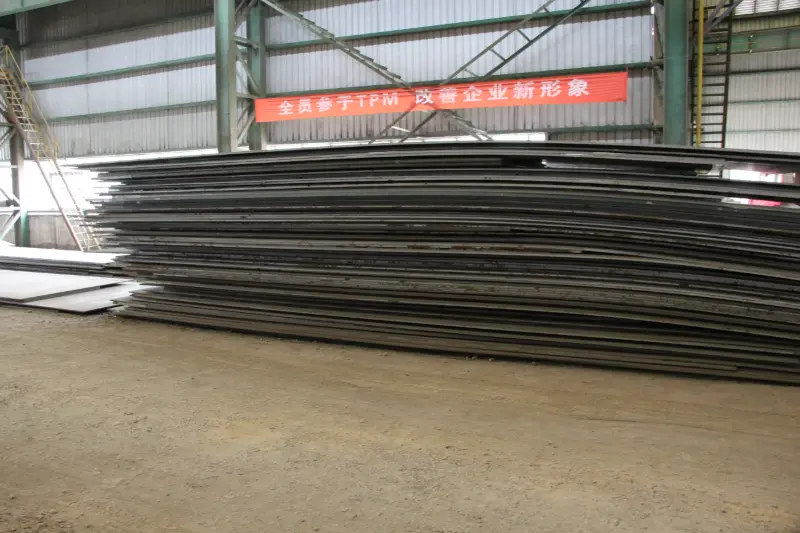
S500QL1 Quenched & Tempered High-Yield Steel Plate
S500QL1 Quenched & Tempered High-Yield Steel Plate for Extreme Load-Bearing Structures
Discover the advanced S500QL1 high-strength structural steel plate under EN 10025-6, offering 500 MPa yield strength, exceptional low-temperature toughness, and superior weldability for heavy engineering and construction.
Welding, Cutting, Cold Forming, Machining
- Phone : +8618037372205
- Email : [email protected]
- WhatsApp: Contact via Whtsapp
- WeChat: +8618037372205
S500QL1 Quenched & Tempered High-Yield Steel Plate Introduction
S500QL1 is a high-yield-strength, quenched and tempered structural steel grade defined in EN 10025-6. It is designed for applications requiring high strength, good formability, and excellent notch toughness at low temperatures (L1 quality ensures impact energy ≥27 J at -40°C). This steel provides a minimum yield strength of 500 MPa for thicknesses up to 50 mm, enabling weight savings and robust performance in welded structures such as cranes, bridges, offshore platforms, and heavy machinery. Its controlled composition and heat treatment result in a fine-grained microstructure with superior mechanical properties and weldability when proper procedures are followed.
S500QL1 Quenched & Tempered High-Yield Steel Plate Chemical Composition
The chemical composition of S500QL1 is controlled to achieve the required strength and toughness after quenching and tempering. The following limits apply to ladle analysis per EN 10025-6. Elements such as Cr, Ni, and Mo are added to enhance hardenability and strength, while microalloying elements (Nb, V, Ti) refine the grain and improve toughness. Phosphorus and sulfur are kept low for excellent weldability and low-temperature properties.
| Element | Max/Min Limit (%) | Remarks |
|---|---|---|
| Carbon (C) | ≤0.20 | Ladle analysis; key hardenability element |
| Silicon (Si) | ≤0.50 | Deoxidation and strength |
| Manganese (Mn) | ≤1.70 | Strength and hardenability |
| Phosphorus (P) | ≤0.020 | Controlled for toughness |
| Sulfur (S) | ≤0.010 | Controlled for weldability and impact properties |
| Nitrogen (N) | ≤0.015 | For grain size control |
| Boron (B) | ≤0.005 | Optional microalloying for hardenability |
| Chromium (Cr) | ≤0.70 | Hardenability element |
| Copper (Cu) | ≤0.50 | May be present from scrap; influences corrosion resistance |
| Molybdenum (Mo) | ≤0.50 | Hardenability and strength |
| Niobium (Nb) | ≤0.06 | Grain refinement |
| Nickel (Ni) | ≤1.50 | Toughness and hardenability |
| Titanium (Ti) | ≤0.05 | Grain refinement and nitrogen binding |
| Vanadium (V) | ≤0.08 | Precipitation strengthening |
| Zirconium (Zr) | ≤0.10 | Optional deoxidizer |
| Aluminium (Al, total) | ≥0.015 | Grain refinement (minimum) |
S500QL1 Quenched & Tempered High-Yield Steel Plate Thermal, Electrical & Physical Properties
These physical properties are typical for quenched and tempered low-alloy high-strength steels. They are not mandatory parts of EN 10025-6 but are useful for design calculations. Values may vary slightly depending on exact chemistry and heat treatment.
| Property | Typical Value | Unit | Test Conditions |
|---|---|---|---|
| Density (ρ) | 7.85 | g/cm³ | at 20°C |
| Elastic Modulus (E) | 210 | GPa | at 20°C |
| Shear Modulus (G) | 80 | GPa | at 20°C (calculated) |
| Poisson's Ratio (ν) | 0.30 | dimensionless | at 20°C |
| Thermal Expansion Coefficient (α) | 11.5 ×10⁻⁶ /K | 1/K | 20–200°C |
| Thermal Conductivity (λ) | 40–45 | W/(m·K) | at 20°C |
| Specific Heat Capacity (c) | 460–500 | J/(kg·K) | at 20°C |
| Electrical Resistivity (ρe) | 0.20 | µΩ·m | at 20°C |
S500QL1 Quenched & Tempered High-Yield Steel Plate Mechanical Properties
Mechanical properties depend on product thickness and test direction. The values below are transverse test piece properties (unless noted) as per EN 10025-6 for S500QL1. Impact energy is determined on longitudinal Charpy-V specimens at -40°C. The steel exhibits high yield and tensile strengths with adequate elongation for cold forming and structural safety.
| Property | Value | Unit | Condition / Thickness |
|---|---|---|---|
| Yield Strength (ReH) | ≥500 | MPa | t ≤ 50 mm, transverse |
| Yield Strength (ReH) | ≥480 | MPa | 50 < t ≤ 100 mm, transverse |
| Yield Strength (ReH) | ≥440 | MPa | 100 < t ≤ 150 mm, transverse |
| Tensile Strength (Rm) | 590–770 | MPa | t ≤ 50 mm, transverse |
| Tensile Strength (Rm) | 590–750 | MPa | 50 < t ≤ 100 mm, transverse |
| Tensile Strength (Rm) | 550–730 | MPa | 100 < t ≤ 150 mm, transverse |
| Elongation after fracture (A, L₀=5.65√S₀) | ≥17 | % | t ≤ 50 mm, transverse |
| Elongation after fracture (A, L₀=5.65√S₀) | ≥16 | % | 50 < t ≤ 100 mm, transverse |
| Elongation after fracture (A, L₀=5.65√S₀) | ≥15 | % | 100 < t ≤ 150 mm, transverse |
| Charpy V-notch Impact Energy (KV) | ≥27 | J | Longitudinal, -40°C |
S500QL1 Quenched & Tempered High-Yield Steel Plate Equivalent Standards and Alternative Grade Designations
| Country/Region | Standard | Grade | Remarks |
|---|---|---|---|
| Europe | EN 10025-6 | S500QL1 | Base standard; widely adopted across EU/EFTA |
| China | GB/T 16270-2009 | Q500E | Quenched & tempered; min. yield 500 MPa; impact ≥27 J at -40°C; verify specific limits |
| International (ISO) | ISO 630-6 (proposed) | S500QL | Proposed harmonized standard; check latest edition for alignment |
S500QL1 Quenched & Tempered High-Yield Steel Plate Application Introduction
S500QL1 steel excels in weight-critical, heavily loaded welded structures that must withstand dynamic loads and low ambient temperatures. Its combination of high strength, good ductility, and reliable impact resistance makes it a preferred material for heavy engineering sectors. Proper welding procedures, including preheat and interpass temperature control, are essential to maintain mechanical properties in the heat-affected zone.
Key benefits:
- High yield strength reduces weight and material costs.
- Excellent low-temperature toughness (L1 quality).
- Good weldability with appropriate filler metals and techniques.
- Uniform properties after quenching and tempering.
Product Applications: Mobile cranes and crawler cranes, Excavators and mining shovels, Heavy-duty truck chassis and dump bodies, Offshore platform structures and jack-up rigs, Bridge girders and structural frameworks, Wind turbine tower sections and foundations, Pressure vessels and storage tanks (subject to code approval)
Processed into products: Boom and jib sections for cranes, Bogie frames and suspension arms, Main frames and turntables for excavators, Welded box girders and I-beams, Fatigue-critical welded joints in bridges, Lifting lugs and pad eyes, Heavy-duty chain and lifting equipment
Application industries: Heavy Machinery & Equipment, Construction & Civil Engineering, Mining & Quarrying, Offshore & Marine, Transportation (Truck & Trailer), Renewable Energy (Wind Turbine Towers)
S500QL1 Quenched & Tempered High-Yield Steel Plate Similar Alternative Materials for Reference
| Country/Region | Standard / Brand | Grade | Remarks |
|---|---|---|---|
| Europe | EN 10025-6 | S460QL1 | Lower yield strength (460 MPa) with similar L1 toughness; suitable for less demanding strength applications |
| Europe | EN 10025-6 | S500QL2 | Same yield strength but higher toughness (-60°C); for severe cold environments |
| Europe | EN 10025-6 | S550QL1 | Higher yield strength (550 MPa); may require tighter welding control |
| Proprietary | SSAB | Strenx 500 | Commercial quenched & tempered steel with 500 MPa yield and good low-temperature toughness; functional equivalent, not a standard |
Notes:
The steel is delivered in the quenched and tempered condition with a surface quality suitable for painting, galvanizing, or other corrosion protection. When galvanizing, caution is needed due to possible liquid metal embrittlement; consult steel supplier for recommendations. The product is CE marked under the Construction Products Regulation (CPR) when intended for structural applications in the EU. Welding should follow EN 1011-2 and steel manufacturer guidelines, with filler metals matching the strength and toughness level (e.g., AWS E11018-M or equivalent). For thicknesses exceeding 50 mm, reduced strength values apply as noted.
- Share



