
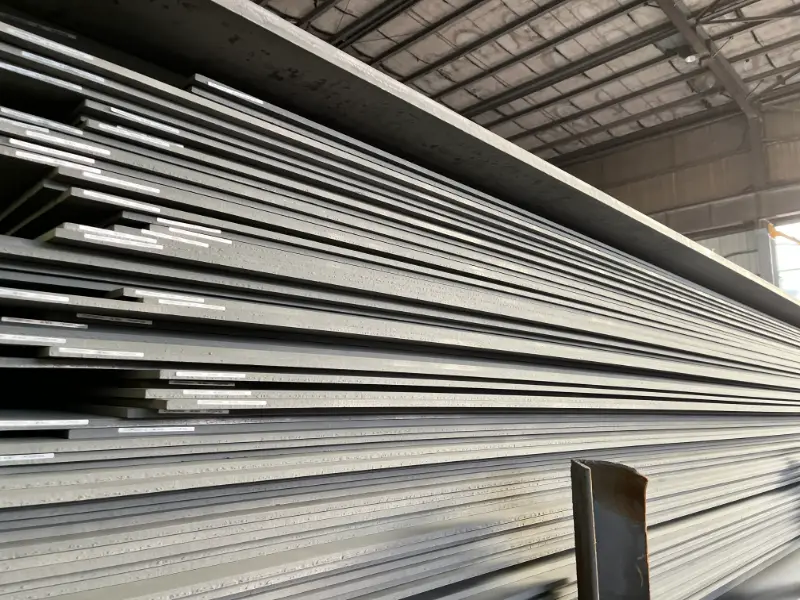
EN10025-6 S550Q Structural Steel Plate
EN10025-6 S550Q Quenched and Tempered High-Strength Structural Steel Plate
Full technical profile of S550Q steel according to EN 10025-6, including chemical composition, mechanical properties, physical data, and international equivalents.
Suitable processes include welding, thermal cutting, cold forming, bending, and machining (in the supplied quenched and tempered condition). Preheating and post-weld heat treatment may be required depending on thickness.
- Phone : +8618037372205
- Email : [email protected]
- WhatsApp: Contact via Whtsapp
- WeChat: +8618037372205
EN10025-6 S550Q Structural Steel Plate Introduction
S550Q is a high-strength structural steel grade specified in EN 10025-6, delivered in the quenched and tempered condition. It offers a minimum yield strength 550 MPa and good low-temperature impact toughness (27 J at -20°C). The steel is designed for heavy welded constructions requiring high strength, good formability, and reliable structural integrity.
This grade features a carefully controlled low alloy content with microalloying additions to achieve a fine grain structure and consistent mechanical properties across a range of plate thicknesses. Typical applications include mobile cranes, offshore platforms, bridges, and heavy mining equipment. Thanks to its high yield-to-tensile ratio, it allows weight reduction while maintaining safety factors.
EN10025-6 S550Q Structural Steel Plate Chemical Composition
The chemical composition complies with EN 10025-6:2004 + A1:2009. Values are given as maxima unless otherwise indicated. Fine grain practice is ensured through microalloying with Nb, V, Ti, and/or Al. The carbon equivalent value (CEV) is typically controlled to guarantee weldability.
| Chemical Element | Normative Range (wt.%) | Remarks |
|---|---|---|
| C (Carbon) | ≤0.20 | Maximum |
| Si (Silicon) | ≤0.80 | Maximum |
| Mn (Manganese) | ≤1.70 | Maximum |
| P (Phosphorus) | ≤0.025 | Maximum |
| S (Sulfur) | ≤0.015 | Maximum |
| Cr (Chromium) | ≤1.50 | Maximum |
| Mo (Molybdenum) | ≤0.70 | Maximum |
| Ni (Nickel) | ≤2.0 | Maximum |
| Cu (Copper) | ≤0.50 | Maximum |
| V (Vanadium) | ≤0.12 | Maximum |
| Nb (Niobium) | ≤0.06 | Maximum |
| Ti (Titanium) | ≤0.05 | Maximum |
| B (Boron) | ≤0.005 | Maximum |
| Zr (Zirconium) | ≤0.15 | Maximum |
| N (Nitrogen) | ≤0.015 | Maximum |
| Al (Aluminum) | ≥0.015 | Total aluminum, minimum for fine grain |
EN10025-6 S550Q Structural Steel Plate Thermal and Electrical Physical Properties
Typical physical properties for quenched and tempered high-strength low-alloy steels at room temperature. These values are indicative and may vary slightly depending on the exact composition and heat treatment condition. They are suitable for engineering calculations.
| Property | Typical Value | Unit | Test Condition |
|---|---|---|---|
| Density (ρ) | ~7.85 | g/cm³ | 20°C |
| Modulus of Elasticity (E) | ~210 | GPa | 20°C |
| Shear Modulus (G) | ~80 | GPa | 20°C (calculated) |
| Poisson's Ratio (ν) | ~0.3 | – | 20°C |
| Thermal Expansion Coefficient (α) | 11.1 | 10⁻⁶/K | 20 – 100°C |
| Thermal Expansion Coefficient (α) | 12.5 | 10⁻⁶/K | 20 – 200°C |
| Thermal Conductivity (λ) | ~46 | W/(m·K) | 20°C |
| Specific Heat Capacity (cp) | ~460 | J/(kg·K) | 20°C |
| Electrical Resistivity (ρe) | ~0.22 | 10⁻⁶ Ω·m | 20°C |
EN10025-6 S550Q Structural Steel Plate Mechanical Properties
The following mechanical properties are guaranteed by the standard for the quenched and tempered condition. Test specimens are taken in the longitudinal direction unless otherwise specified. Requirements depend on the nominal thickness of the product.
| Property | Normative Requirement | Unit | Test Condition / Thickness (t) |
|---|---|---|---|
| Yield Strength (ReH) | ≥550 | MPa | t ≤ 50 mm |
| Yield Strength (ReH) | ≥530 | MPa | 50 mm < t ≤ 100 mm |
| Yield Strength (ReH) | ≥490 | MPa | 100 mm < t ≤ 150 mm |
| Tensile Strength (Rm) | 640 – 820 | MPa | t ≤ 50 mm |
| Tensile Strength (Rm) | 590 – 770 | MPa | 50 mm < t ≤ 100 mm |
| Tensile Strength (Rm) | 580 – 750 | MPa | 100 mm < t ≤ 150 mm |
| Elongation (A) | ≥14 | % | t ≤ 50 mm, L₀=5.65√S₀ |
| Elongation (A) | ≥14 | % | 50 mm < t ≤ 100 mm, L₀=5.65√S₀ |
| Elongation (A) | ≥14 | % | 100 mm < t ≤ 150 mm, L₀=5.65√S₀ |
| Impact Energy (KV₂) | ≥27 | J | -20°C, longitudinal Charpy V-notch |
| Bend Test (180°) | d ≥ 3a | – | a = specimen thickness, no cracks |
EN10025-6 S550Q Structural Steel Plate Completely Equivalent Material Standards and Replaceable Grades
| Country / Region | Standard | Grade | Remarks |
|---|---|---|---|
| Europe | EN 10025-6 | S550Q | Base standard |
| Germany | DIN EN 10025-6 | S550Q | Identical national adoption |
| United Kingdom | BS EN 10025-6 | S550Q | Identical national adoption |
| France | NF EN 10025-6 | S550Q | Identical national adoption |
| Italy | UNI EN 10025-6 | S550Q | Identical national adoption |
| Spain | UNE EN 10025-6 | S550Q | Identical national adoption |
| Sweden | SS-EN 10025-6 | S550Q | Identical national adoption |
| Belgium | NBN EN 10025-6 | S550Q | Identical national adoption |
| Netherlands | NEN-EN 10025-6 | S550Q | Identical national adoption |
EN10025-6 S550Q Structural Steel Plate Application Introduction
S550Q is specifically designed for heavy-duty welded structures where a balance of high strength, good toughness, and workability is required. The quenched and tempered condition ensures a fine martensitic/bainitic microstructure that provides excellent yield strength while retaining sufficient ductility for forming and fabrication.
Product Applications: Crane booms and lattice structures, Offshore structural nodes and chords, Bridge girders and box sections, Haul truck bodies and excavator attachments, Wind turbine tower shell sections, Heavy-duty welded tubular structures, Industrial storage tanks and silos
Processed into products: Welded plates for boom segments, Cut and bent flanges and webs, Machined load-bearing pins and bushings, Bolted/welded connection plates, Stiffeners and brackets, Pressure vessel shell plates (with supplementary testing)
Application industries: Heavy construction and civil engineering, Offshore and marine structures (jack-up rigs, platform components), Mobile and crawler cranes, Mining and earthmoving machinery, Bridge building, Wind energy (tower and foundation components), Pressure vessel and boiler (subject to additional certifications), Shipbuilding (high-strength parts)
EN10025-6 S550Q Structural Steel Plate Similar / Closely Related Substitute Materials
| Country / Region | Standard | Grade | Remarks |
|---|---|---|---|
| International | ISO 4950-2 | E550DD | Yield strength 550 MPa min, -20°C impact, quenched and tempered; very similar concept but different alloy system allowed |
| China | GB/T 16270 | Q550D | Quenched and tempered high strength steel, 550 MPa yield, -20°C impact; similar mechanical properties, check composition and delivery condition |
| Europe | EN 10025-6 | S550QL | Same base chemistry, but with guaranteed impact at -40°C; can replace S550Q if higher toughness needed |
| Europe | EN 10025-6 | S550QL1 | Same base chemistry, but with guaranteed impact at -60°C; more demanding low-temperature toughness |
Notes:
Welding recommendations: Preheating is often required, especially for thicker sections, to avoid cold cracking. Typical preheat temperature ranges from 100 to 200°C depending on the combined thickness and hydrogen control. Post-weld heat treatment (stress relieving) may be applied at temperatures around 530–580°C, but care must be taken to avoid over-tempering and strength loss. Always follow the steel manufacturer's guidelines and welding consumable suppliers' recommendations.
Surface condition: The material can be supplied blast cleaned and shop primed if required for improved corrosion protection during fabrication.
- Share



