
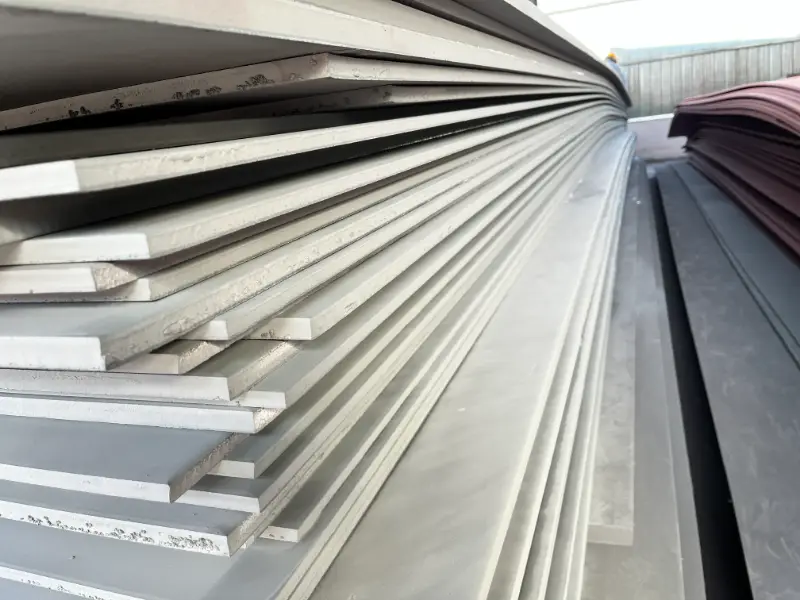
DIN 17102 WStE285 Steel
DIN 17102 WStE285 Steel: Weldable Fine-Grain Structural Steel for High-Strength Applications
Detailed material data for DIN 17102 WStE285, a normalized fine-grain structural steel. Includes chemical composition, mechanical properties, thermal and electrical physics, and international equivalents.
Normalizing, Hot Rolling, Cold Forming, Welding, Machining
- Phone : +8618037372205
- Email : [email protected]
- WhatsApp: Contact via Whtsapp
- WeChat: +8618037372205
DIN 17102 WStE285 Steel Introduction
DIN 17102 WStE285 is a weldable, normalized, fine-grain structural steel defined under the German standard DIN 17102. It is a carbon and low-alloy high-strength steel supplied primarily in coil form. The designation 'W' indicates weldable, 'St' stands for steel, 'E' denotes a fine-grain quality with a specified minimum yield strength, and '285' represents the minimum yield strength in MPa for thicknesses ≤ 16 mm.
This steel grade is characterized by its excellent combination of high strength, good toughness, and superior weldability due to its fine-grain microstructure. Normalizing heat treatment ensures uniform mechanical properties. It is widely utilized in structural engineering, construction, and machinery where high load-bearing capacity and reliable performance under dynamic stress are required. The fine-grain structure significantly improves toughness at low temperatures compared to conventional structural steels.
DIN 17102 WStE285 Steel Chemical Composition
The chemical composition of DIN 17102 WStE285 is precisely controlled to achieve the required mechanical properties and weldability. The maximum limits for key elements are defined to promote fine-grain strengthening and ensure toughness. Carbon content is kept low for excellent weldability, while manganese and grain-refining elements such as aluminum and niobium contribute to strength without significantly impairing toughness.
| Element | Standard Value (Max, %) | Notes |
|---|---|---|
| Carbon (C) | 0.18 | For thicknesses ≤ 16 mm |
| Carbon (C) | 0.20 | For thicknesses > 16 mm |
| Silicon (Si) | 0.50 | - |
| Manganese (Mn) | 1.70 | - |
| Phosphorus (P) | 0.030 | - |
| Sulfur (S) | 0.025 | - |
| Aluminum (Al, total) | ≥ 0.015 | Grain-refining element |
| Niobium (Nb) | 0.05 | Optional grain-refining element; typically present if no other element is specified for grain refinement. |
| Vanadium (V) | 0.10 | Optional; V + Nb + Ti ≤ 0.12% |
| Titanium (Ti) | 0.05 | Optional; V + Nb + Ti ≤ 0.12% |
| Nitrogen (N) | 0.012 | If sufficient N-binding elements (e.g., Al) are present, otherwise 0.009% |
DIN 17102 WStE285 Steel Physical Properties
The physical properties of DIN 17102 WStE285 are generally consistent with low-alloy carbon steels. These values are typical reference data for design calculations involving thermal loads, heat transfer, and electrical modeling. Slight variations can occur depending on specific production processes and precise chemical composition. The properties remain stable over a typical service range for structural applications.
| Property | Typical Value | Unit | Condition / Note |
|---|---|---|---|
| Density (ρ) | 7.85 | kg/dm³ | At 20 °C |
| Elastic Modulus (E) | 210 | GPa | At 20 °C |
| Shear Modulus (G) | 81 | GPa | At 20 °C, calculated from E and ν |
| Poisson's Ratio (ν) | 0.29 | - | At 20 °C, approximate value |
| Thermal Expansion Coefficient (α) | 12.0 | 10⁻⁶/K | 20 °C to 100 °C |
| Thermal Expansion Coefficient (α) | 12.8 | 10⁻⁶/K | 20 °C to 200 °C |
| Thermal Expansion Coefficient (α) | 14.0 | 10⁻⁶/K | 20 °C to 400 °C |
| Thermal Conductivity (λ) | 48 | W/(m·K) | At 20 °C |
| Specific Heat Capacity (c) | 460 | J/(kg·K) | At 20 °C |
| Electrical Resistivity (ρ_e) | 0.21 | µΩ·m | At 20 °C |
DIN 17102 WStE285 Steel Mechanical Properties at Room Temperature
The following mechanical properties are guaranteed for DIN 17102 WStE285 in the normalized delivery condition. The minimum yield strength decreases with increasing product thickness, a common characteristic for thermomechanically rolled or normalized structural steels. The high minimum elongation values ensure sufficient ductility for cold-forming processes. Impact toughness is verified through Charpy V-notch testing, confirming suitability for use at low temperatures.
| Property | Standard Requirement Value | Unit | Test Condition / Thickness Range |
|---|---|---|---|
| Minimum Yield Strength (ReH) | 285 | MPa | Nominal thickness ≤ 16 mm |
| Minimum Yield Strength (ReH) | 275 | MPa | 16 mm < Nominal thickness ≤ 35 mm |
| Minimum Yield Strength (ReH) | 265 | MPa | 35 mm < Nominal thickness ≤ 50 mm |
| Tensile Strength (Rm) | 410 - 540 | MPa | Nominal thickness ≤ 100 mm |
| Minimum Elongation (A80) | 18 | % | Nominal thickness < 3 mm, Gauge length 80 mm |
| Minimum Elongation (A5) | 21 | % | 3 mm ≤ Nominal thickness ≤ 63 mm, Gauge length 5.65√So |
| Minimum Elongation (A5) | 20 | % | 63 mm < Nominal thickness ≤ 100 mm, Gauge length 5.65√So |
| Minimum Impact Energy (KV2) | 27 | J | Longitudinal test at -20 °C |
| Minimum Impact Energy (KV2) | 27 | J | Longitudinal test at -30 °C (upon agreement) |
| Bend Test (Mandrel Diameter) | 1.5a | - | Bending angle 180°, a = thickness of test piece, for thicknesses ≤ 35 mm |
DIN 17102 WStE285 Steel Recommended Exact Equivalent Material Standards and Grades
| Country / Region | Standard | Grade / Designation | Notes |
|---|---|---|---|
| Europe | EN 10113-1: 1993 | S275N | Thermomechanically rolled, may be similar after normalization. This standard is superseded but the grade is an equivalent. |
| Europe | EN 10025-3: 2019 | S275N | Current European standard for normalized/normalized rolled fine-grain structural steel. S275N is a direct equivalent, though yield strength is 275 MPa. |
| United Kingdom | BS 4360: 1990 | 43EE | Superseded British Standard. This is a comparable weldable structural steel grade. |
| France | NF EN 10025-3 | S275N | French adoption of the European standard. |
| Japan | JIS G 3106: 2015 | SM490A | Offers comparable tensile strength (490-610 MPa) with a similar carbon and manganese base, but yield point is higher. Not a direct equivalent but functionally similar. |
DIN 17102 WStE285 Steel Application Introduction
DIN 17102 WStE285 is a versatile steel combining high strength, good toughness, and excellent weldability. Its fine grain structure guarantees reliable performance in demanding structural applications. It is primarily chosen for welded structures subjected to static and dynamic loads, where conventional structural steels like S235JR would be too thick and heavy. The normalized condition ensures good dimensional stability during processing, especially in flame cutting and welding.
Product Applications: Welded bridge girders and sections, Frames and booms for mobile and crawler cranes, Heavy-duty vehicle chassis and trailers, Columns and beams for high-rise buildings, Pylon and tower structures for wind turbines, Offshore platform support structures
Processed into products: Flanges and webs for welded beams, Swivel rings and slewing bearings, Brackets, gussets, and stiffeners, Bogie frames for railway rolling stock, Shovel arms and excavator buckets, Base plates and anchor plates for masts
Application industries: Construction and Civil Engineering, Heavy Machinery and Equipment Manufacturing, Shipbuilding and Marine Engineering, Automotive and Transportation (Truck frames, trailers), Renewable Energy (Wind turbine towers), Mining and Earth-moving Equipment
DIN 17102 WStE285 Steel Similar/Comparable Material Recommendations
| Country / Region | Standard | Grade / Designation | Analysis and Introduction |
|---|---|---|---|
| USA | ASTM A572/A572M | Grade 50 [345] | A higher-strength grade with a minimum yield strength of 345 MPa. It is a widely used HSLA steel with excellent weldability and toughness, suitable for structural applications requiring higher load capacities than WStE285. |
| USA | ASTM A656/A656M | Grade 50 | A high-strength low-alloy steel with improved formability. Its strength and chemical composition are closely aligned with WStE285, making it a good alternative for heavy vehicle frames and crane booms. |
| China | GB/T 1591-2018 | Q355D | A modern Chinese standard HSLA steel with high strength (ReH ≥ 345 MPa) and good low-temperature toughness (D-quality: -20 °C impact test). It offers superior strength and wide application in bridge and building structures. |
| Japan | JIS G 3135 | SPFC590 | A high-strength steel strip for cold forming with a minimum tensile strength of 590 MPa. When optimized for formability over strength-to-weight ratio, this can serve as an alternative in automotive and appliance applications. |
| India | IS 2062 E350 | E350 BR | A copper-bearing high-strength structural steel with a minimum yield strength of 350 MPa. It provides better atmospheric corrosion resistance, making it a suitable alternative for outdoor structures like bridges and transmission towers in corrosive environments. |
Notes:
Welding Precautions: Despite its excellent weldability, the specified minimum yield strength is only guaranteed in the normalized condition. High heat input during welding can locally degrade the grain structure. A welding procedure specification (WPS) considering preheat and interpass temperatures is recommended for thicker sections (>50 mm) to avoid cold cracking.
Cold Forming: For cold forming operations with large deformations, a subsequent stress-relief heat treatment might be necessary to restore the toughness properties, especially if the forming ratio exceeds 5%. Always adhere to the minimum bending radii recommended by the steel producer.
- Share



