
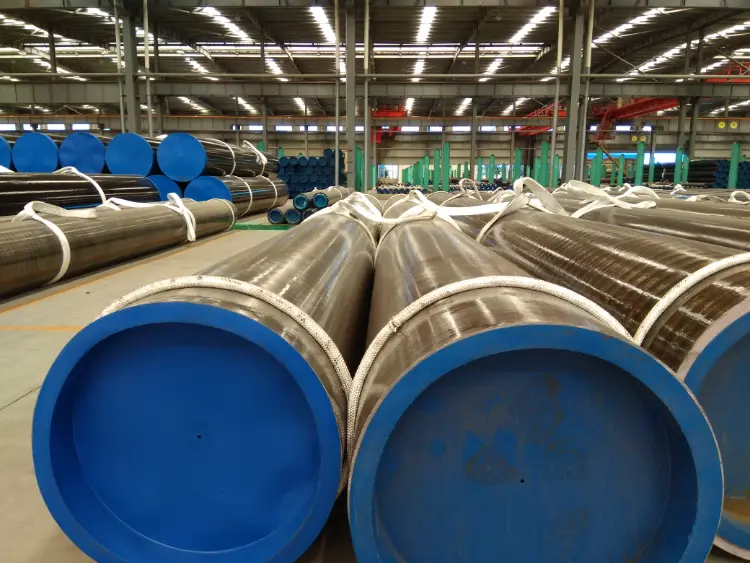
GB/T 9711-2011 PSL1 L320 LSAW Pipe
GB/T 9711-2011 PSL1 L320 LSAW Pipe: Properties, Chemical Composition & Global Equivalents
Complete technical data for L320 LSAW pipe according to GB/T 9711-2011 PSL1, covering chemical composition, mechanical and thermal properties, equivalent grades, and application guidance.
Thermomechanical control process (TMCP), hot rolling, normalising, welding (submerged arc)
- Phone : +8618037372205
- Email : [email protected]
- WhatsApp: Contact via Whtsapp
- WeChat: +8618037372205
GB/T 9711-2011 PSL1 L320 LSAW Pipe Introduction
L320 steel is a pipeline steel grade specified in GB/T 9711-2011 for longitudinally submerged arc welded (LSAW) pipes in PSL1 (Product Specification Level 1) delivery condition. It has a minimum yield strength of 320 MPa (46 ksi) and is primarily used for oil and natural gas transmission pipelines. L320 offers good weldability, adequate strength and toughness for moderate service conditions. Typical delivery condition is hot-rolled or normalised. PSL1 imposes less stringent requirements than PSL2, with no mandatory impact testing or NACE sour service certification. The material is fully killed and fine-grained, often microalloyed with Nb, V, or Ti to refine grain size and improve mechanical properties.
GB/T 9711-2011 PSL1 L320 LSAW Pipe Chemical Composition
Chemical composition limits according to GB/T 9711-2011 Table 5 for PSL1 L320. Carbon, manganese, phosphorus and sulphur are the only mandatory elements specified. Niobium, vanadium and titanium are optional; their addition is at the manufacturer's discretion to achieve the required mechanical properties, but the contents must be reported if requested.
| Element | Standard Value (max, wt%) | Remarks |
|---|---|---|
| C | 0.22 | Mandatory |
| Mn | 1.20 | Mandatory |
| P | 0.025 | Mandatory |
| S | 0.015 | Mandatory |
| Nb | 0.05 | Optional, by agreement; typically added for grain refinement |
| V | 0.05 | Optional, by agreement |
| Ti | 0.04 | Optional, by agreement |
GB/T 9711-2011 PSL1 L320 LSAW Pipe Thermal and Electrical Physical Properties
Typical physical properties for carbon-manganese pipeline steel such as L320. These values are not mandatory or guaranteed but represent expected behaviour for grade L320 in the as-hot-rolled or normalised condition. They can be used for engineering design and calculations.
| Property | Typical Value | Unit | Test Condition |
|---|---|---|---|
| Density, ρ | 7.85 | g/cm³ | At 20°C |
| Modulus of Elasticity, E | 205 | GPa | At 20°C |
| Shear Modulus, G | 80 | GPa | At 20°C |
| Poisson's Ratio, ν | 0.3 | – | At 20°C |
| Thermal Expansion Coefficient, α | 11.7 × 10⁻⁶ | 1/°C | 20°C – 100°C |
| Thermal Conductivity, λ | 51 | W/(m·K) | At 20°C |
| Specific Heat Capacity, cp | 470 | J/(kg·K) | At 20°C |
| Electrical Resistivity, ρe | 0.16 | μΩ·m | At 20°C |
GB/T 9711-2011 PSL1 L320 LSAW Pipe Mechanical Properties
Mechanical requirements for PSL1 L320 LSAW pipe as per GB/T 9711-2011 Table 7 and Table 8. Values apply to the pipe body longitudinal specimen at room temperature. Elongation is given for a 50 mm gauge length with wall thickness ≤ 25.4 mm; for thicker walls, the minimum elongation is calculated from the actual tensile strength using A = 1940 Axc0.2 / Rm0.9. No impact test requirements and no bend test for product analysis in PSL1.
| Property | Standard Requirement | Unit | Test Condition |
|---|---|---|---|
| Yield Strength, Rt0.5 | 320 (min) – 525 (max) | MPa | Pipe body longitudinal, room temperature |
| Tensile Strength, Rm | 435 (min) – 655 (max) | MPa | Pipe body longitudinal, room temperature |
| Elongation after fracture, A | 22 (min) | % | Longitudinal, gauge length 50 mm, wall thickness ≤25.4 mm |
GB/T 9711-2011 PSL1 L320 LSAW Pipe Fully Equivalent Material Standards and Substitution Grades
| Country/Region | Standard | Grade | Remarks |
|---|---|---|---|
| International | ISO 3183 | L320 | Identical technical delivery conditions |
| USA | API 5L | X46 PSL1 | Equivalent grade; same yield strength level |
| Europe | EN 10208-1 | L320GA / L320GB | PSL1 line pipe for oil and gas; GA = gas, GB = liquid |
| Canada | CSA Z245.1 | Grade 320 (Category I) | Corresponding strength and PSL1 requirements |
| Russia/CIS | GOST 31447 | K48 | K48 corresponds to minimum yield 320 MPa; PSL1 type |
GB/T 9711-2011 PSL1 L320 LSAW Pipe Application Introduction
L320 LSAW pipes under GB/T 9711-2011 PSL1 are mainly used in on-shore and off-shore oil and gas transportation systems where sour service and low-temperature requirements are not critical. Because PSL1 imposes no mandatory impact testing, these pipes are suitable for moderate temperature environments. Typical applications include:
Product Applications: Onshore pipeline systems (crude oil, natural gas, refined products), Offshore pipeline risers and flowlines (non-sour), Station piping (pump/compressor stations, metering stations), Water injection and disposal pipelines
Processed into products: Line pipe spools and prefabricated pipe segments, Bends, elbows, reducers, tees (manufactured from L320 base pipe or plate), Flanges and connectors (when compatible strength steel is used), Manifolds and headers for moderate-pressure service
Application industries: Oil & Gas (long-distance transmission pipelines, gathering lines), Water (water main pipelines, hydro-transport), Structural (piling, jacket legs, tubular structures), Mining (slurry transportation)
GB/T 9711-2011 PSL1 L320 LSAW Pipe Similar or Nearby Alternative Materials
| Country/Region | Standard | Grade | Remarks |
|---|---|---|---|
| China | GB/T 9711-2011 | L290 (X42) | Lower strength alternative; min YS 290 MPa |
| China | GB/T 9711-2011 | L360 (X52) | Higher strength alternative; min YS 360 MPa |
| USA | API 5L | X42 PSL1 | Lower strength; consult when lower strength is acceptable |
| USA | API 5L | X52 PSL1 | Higher strength; may require revised welding procedures |
Notes:
- The chemical composition limits refer to heat (ladle) analysis. Product analysis tolerances apply as per GB/T 9711-2011.
- Carbon equivalent (CEV) is not a mandatory requirement for PSL1; however, typical CEV ≤ 0.40% using the IIW formula is achieved by controlled rolling or normalising.
- Sour service (NACE MR0175/ISO 15156) is not covered by PSL1; additional testing and restricted chemistry are required for H₂S-containing environments.
- For applications requiring toughness testing, PSL2 or supplementary requirements should be specified.
- Typical NDT (non-destructive testing) of LSAW pipe includes ultrasonic testing of the weld seam and body; other methods per the standard.
- Share



