
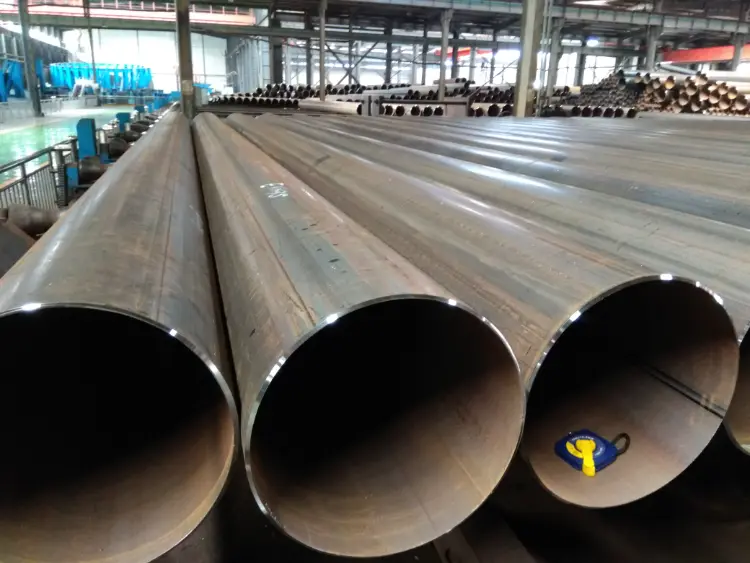
GB/T 9711-2011 PSL1 L290 LSAW Steel Pipe
GB/T 9711-2011 PSL1 L290 LSAW Steel Pipe: Chemical Composition, Mechanical & Physical Properties
Comprehensive technical data for L290 (X42) steel pipe manufactured according to GB/T 9711-2011 PSL1 for LSAW pipes, covering chemical composition, mechanical properties, thermal and electrical characteristics, international equivalents, and application guidance.
Suitable for cold forming, welding (ERW, SAW, LSAW), machining, and hot bending with proper post-weld heat treatment.
- Phone : +8618037372205
- Email : [email protected]
- WhatsApp: Contact via Whtsapp
- WeChat: +8618037372205
GB/T 9711-2011 PSL1 L290 LSAW Steel Pipe Introduction
L290 is a low-alloy structural steel grade defined in GB/T 9711-2011 (equivalent to ISO 3183:2007) for longitudinal submerged arc welded (LSAW) line pipes, PSL 1 quality level. It is designed for petroleum and natural gas transportation pipelines. The minimum yield strength is 290 MPa, with good weldability and toughness at ambient temperatures. Typical delivery condition is as-rolled or normalized, with the weld zone showing mechanical properties consistent with the base metal. It is widely adopted in onshore and offshore pipeline projects.
GB/T 9711-2011 PSL1 L290 LSAW Steel Pipe Chemical Composition
Chemical composition according to GB/T 9711-2011 PSL 1 for L290. The standard specifies maximum limits for C, Mn, P, S, and total Nb+V+Ti when applicable.
- For PSL 1, the carbon equivalent (CE_Pcm) is not mandatory unless agreed.
- Values are based on heat analysis; product analysis tolerances apply per standard.
| Element | Standard Value (max) | Remarks |
|---|---|---|
| C (Carbon) | 0.22% | Heat analysis, max |
| Mn (Manganese) | 1.20% | Max |
| P (Phosphorus) | 0.025% | Max |
| S (Sulfur) | 0.015% | Max |
| Nb (Niobium) | ≤0.060% | If added for grain refining; combined Nb+V+Ti ≤0.15% |
| V (Vanadium) | ≤0.080% | If added; part of combined limit |
| Ti (Titanium) | ≤0.060% | If added; part of combined limit |
| Al (Aluminum) | ≥0.020% (if used) | Minimum acid-soluble aluminum for fine grain practice, if agreed |
| N (Nitrogen) | ≤0.012% | Typically not specified in PSL 1 but controlled for fine grain steels |
| CE_Pcm | Typically ≤0.25% | Product analysis carbon equivalent for weldability; not mandatory for PSL 1 |
GB/T 9711-2011 PSL1 L290 LSAW Steel Pipe Thermal and Electrical Physical Properties
General physical properties for low-alloy structural steel similar to L290. These are not specific to GB/T 9711 but are typical for carbon-manganese steels. Values may vary slightly with exact composition and heat treatment.
- Density, elastic modulus, and Poisson's ratio are standard for steel.
- Thermal expansion and conductivity are temperature-dependent; values provided at reference temperatures.
| Property | Typical Value | Unit | Test Condition |
|---|---|---|---|
| Density (ρ) | 7.85 | g/cm³ | At 20°C |
| Elastic Modulus (E) | 205 – 210 | GPa | At 20°C, tension |
| Shear Modulus (G) | 80 | GPa | Calculated, at 20°C |
| Poisson's Ratio (ν) | 0.30 | At 20°C | |
| Thermal Expansion Coefficient (α) | 11.7 (20–100°C); 12.5 (20–200°C); 13.5 (20–300°C) | 10⁻⁶/°C | Mean coefficient |
| Thermal Conductivity (λ) | 52 (at 20°C); 48 (at 100°C); 42 (at 300°C) | W/(m·K) | Estimated for medium carbon-manganese steel |
| Specific Heat Capacity (c) | 0.49 (at 20°C); 0.52 (at 100°C); 0.57 (at 300°C) | kJ/(kg·K) | Typical values for steel |
| Electrical Resistivity (ρ_e) | 0.20 – 0.25 | μΩ·m | At 20°C, typical range |
GB/T 9711-2011 PSL1 L290 LSAW Steel Pipe Mechanical Properties
Mechanical properties for L290 PSL 1 LSAW pipe as per GB/T 9711-2011.
- Tests are performed on base metal transverse strip samples or full-section pipe specimens.
- Bend tests are required; impact tests are subject to supplementary requirements (e.g., SR1).
- For longitudinal direction, reduction in strength is not usually considered unless specified.
| Property | Standard Requirement | Unit | Test Condition |
|---|---|---|---|
| Yield Strength (ReH) | 290 – 495 | MPa | Transverse strip test, 0.5% total extension (Rt0.5), room temperature |
| Tensile Strength (Rm) | ≥415 | MPa | Transverse strip test, room temperature |
| Elongation (A) | See formula | % | Based on 50.8 mm gauge length or proportional; A ≥ (200000 * t / U) min, not less than 15% for pipe |
| Bend Test (180°) | No cracks | Bend diameter specified per standard, typically 3×t (t = wall thickness) for L290 | |
| Charpy Impact (KV) | As agreed (if SR1) | J | Normally not required for PSL 1; when specified, typical minimum 27 J at 0°C or -10°C |
| Weld Zone Hardness | ≤250 HV10 (typical) | Hardness test may be agreed upon |
GB/T 9711-2011 PSL1 L290 LSAW Steel Pipe Completely Equivalent Material Standards and Substitutable Grades
| Country/Region | Standard | Grade | Remarks |
|---|---|---|---|
| International (API) | API 5L (45th Ed.) PSL 1 | X42 | Chemically and mechanically equivalent; L290 is substituted by X42 in most projects |
| International (ISO) | ISO 3183:2007 (PSL 1) | L290 | Identical to GB/T 9711-2011 requirements |
| Europe | EN 10208-1 | L290GA | Similar base chemistry and properties, but delivery conditions may differ; acceptable for many applications |
| Russia/CIS | GOST 33068 | K42 | Close match in terms of strength; verify sulfur/phosphorus requirements |
| Brazil | NBR 12712 | L290 | Equivalent to ISO 3183 |
GB/T 9711-2011 PSL1 L290 LSAW Steel Pipe Application Introduction
L290 LSAW pipes are widely used in the construction of cross-country oil and gas pipelines. Due to good balance of strength and ductility, they are suitable for long-distance transmission under moderate pressures. The straight seam submerged arc welded pipe can be produced in large diameters and thick walls, allowing use in mainline pipe, distribution networks, and gathering systems. Key industries:
- Oil & Gas Onshore/Offshore
- Petrochemical
- Water and Wastewater Transportation
- Structural Engineering (piling, supports)
Product Applications: Long-distance pipelines (e.g., West-East Gas Pipeline), Subsea export lines, Station piping and flowlines, Water injection lines, Pipe coating systems (3LPE, FBE)
Processed into products: Straight pipe segments (12–24 m length), Bends and elbows (induction hot bends from L290 pipe), Tees and reducers, Flanges and fittings manufactured from L290 plate, Valves bodies (forged from L290 grade steel), Cap and end pieces
Application industries: Oil and gas transmission (upstream, midstream, downstream), Petrochemical plant piping, Water and slurry transportation, Structural supports and offshore jackets, Piling for ports and bridges
GB/T 9711-2011 PSL1 L290 LSAW Steel Pipe Approximate / Similar Alternative Material Recommendations
| Country/Region | Standard | Grade | Remarks |
|---|---|---|---|
| China | GB/T 9711-2011 | L245 | Lower yield strength (245 MPa), used for less demanding pressure pipelines |
| China | GB/T 9711-2011 | L320 | Higher strength (320 MPa yield), may need adjusted welding procedures |
| International | API 5L PSL1 | X46 | Next grade above X42; slightly stronger, may increase pipe weight reduction |
| Europe | EN 10208-1 | L245GA | Mild pipeline steel, similar chemistry but lower strength |
| International | ISO 3183 | L245NB | Normalized grade with improved toughness, used for low-temperature service |
Notes:
Note: All data are based on GB/T 9711-2011 PSL 1 requirements. In case of supplementary requirements (SR), additional tests like HIC (hydrogen induced cracking) or SSC (sulfide stress cracking) may be specified for sour service. PSL 1 pipes do not mandate non-destructive testing of the weld unless agreed. For critical applications, verify with the actual mill test certificate (MTC) and project-specific specifications.
- Share



