
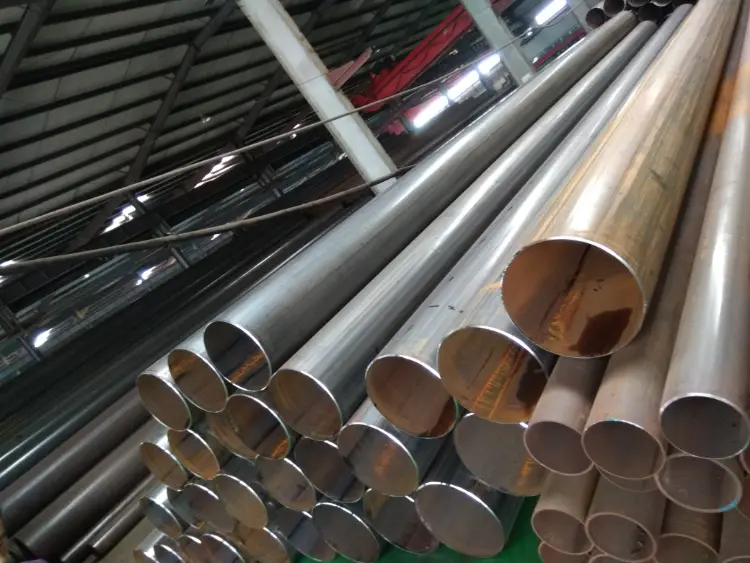
GB/T 9711-2011 PSL1 L245 LSAW Pipe
GB/T 9711-2011 PSL1 L245 LSAW Pipe - Comprehensive Material Data & Properties
Detailed technical data for GB/T 9711-2011 PSL1 L245 LSAW pipe, including chemical composition, mechanical and physical properties, international equivalents, similar materials, and application guidance.
Welding (SAW), hot rolling or normalising rolling of plate/strip, cold forming of pipe
- Phone : +8618037372205
- Email : [email protected]
- WhatsApp: Contact via Whtsapp
- WeChat: +8618037372205
GB/T 9711-2011 PSL1 L245 LSAW Pipe Introduction
L245 under GB/T 9711-2011 PSL1 is a carbon‑manganese steel grade primarily used for longitudinally submerged arc welded (LSAW) line pipes for transporting oil, gas and water under moderate pressure. It is a lower‑strength grade in the standard family, with a specified minimum yield strength of 245 MPa and excellent weldability and formability.
- Designed for general fluid transmission and structural applications
- PSL 1 base quality level without mandatory toughness requirements (unless by agreement)
- Suitable for large‑diameter pipelines manufactured by the JCOE/UOE process
GB/T 9711-2011 PSL1 L245 LSAW Pipe Chemical Composition
Chemical limits according to GB/T 9711‑2011 Table 5, PSL 1 L245 (excluding L245N/BN). Microalloying elements V, Nb and Ti may be added singly or in combination; their sum shall not exceed 0.15 %. Cu, Ni, Cr and Mo are residual elements restricted to 0.50 % each unless agreed otherwise.
| Element | Standard Value (max, unless range) | Remarks |
|---|---|---|
| Carbon (C) | 0.22 % | Product analysis tolerance +0.02 % |
| Manganese (Mn) | 1.20 % | For welded pipe derived from plate/coil |
| Phosphorus (P) | 0.025 % | PSL 1 requirement |
| Sulfur (S) | 0.015 % | PSL 1 requirement |
| Vanadium (V) | ≤ 0.15 % (sum V+Nb+Ti) | Sum of V, Nb and Ti not exceeding 0.15 % |
| Niobium (Nb) | ≤ 0.15 % (sum V+Nb+Ti) | See sum rule |
| Titanium (Ti) | ≤ 0.15 % (sum V+Nb+Ti) | See sum rule |
| Copper (Cu) (residual) | 0.50 % | Unless otherwise agreed |
| Nickel (Ni) (residual) | 0.50 % | Unless otherwise agreed |
| Chromium (Cr) (residual) | 0.50 % | Unless otherwise agreed |
| Molybdenum (Mo) (residual) | 0.50 % | Unless otherwise agreed |
GB/T 9711-2011 PSL1 L245 LSAW Pipe Thermal and Electrical Physical Properties
The values below represent typical ambient‑temperature properties for a low‑carbon steel similar to L245. They are not standard‑specified minima or maxima but are widely used for engineering design. Variations may occur depending on exact composition and manufacturing route.
| Property | Standard Typical Value | Unit | Test Condition |
|---|---|---|---|
| Density (ρ) | 7.85 | g/cm³ | Room temperature |
| Elastic modulus (E) | 200 – 210 | GPa | Room temperature, tension |
| Shear modulus (G) | 79 – 81 | GPa | Calculated from E and ν |
| Poisson's ratio (ν) | 0.27 – 0.30 | – | Elastic range |
| Thermal expansion coefficient (α) | 11.1 × 10⁻⁶ | K⁻¹ | 20 °C to 100 °C |
| Thermal conductivity (λ) | 50 – 52 | W/(m·K) | Room temperature |
| Specific heat capacity (cp) | 450 – 470 | J/(kg·K) | Room temperature |
| Electrical resistivity (ρe) | 0.17 – 0.22 × 10⁻⁶ | Ω·m | Room temperature |
GB/T 9711-2011 PSL1 L245 LSAW Pipe Mechanical Properties
Transverse tensile properties apply to the base metal. The minimum elongation values are based on rectangular proportional test pieces (38 mm wide strip) with a gauge length of 50 mm and a minimum tensile strength of 415 MPa. If Rm is higher, the required elongation may be calculated per GB/T 9711‑2011 formula. PSL 1 does not require Charpy impact testing unless specified by supplementary requirement (e.g. SR5). The bend test is a guided bend (face & root) for LSAW pipe.
| Property | Standard Required Value | Unit | Test Condition |
|---|---|---|---|
| Yield Strength (ReH) | ≥ 245 | MPa | Base metal, transverse, room temperature; all wall thicknesses |
| Tensile Strength (Rm) | 415 – 655 | MPa | Base metal, transverse, room temperature |
| Elongation after fracture (A) | ≥ 20 | % | Transverse, wall thickness ≤ 5.0 mm, 50 mm gauge |
| Elongation after fracture (A) | ≥ 21 | % | Transverse, wall thickness > 5.0 to 10.0 mm, 50 mm gauge |
| Elongation after fracture (A) | ≥ 23 | % | Transverse, wall thickness > 10.0 to 15.0 mm, 50 mm gauge |
| Elongation after fracture (A) | ≥ 24 | % | Transverse, wall thickness > 15.0 to 20.0 mm, 50 mm gauge |
| Elongation after fracture (A) | ≥ 25 | % | Transverse, wall thickness > 20.0 mm, 50 mm gauge |
| Guided Bend Test (bend angle 180°) | 6 t (t = wall thickness) | – | Transverse, face and root bends; LSAW pipe; all t ≤ 12.7 mm |
| Guided Bend Test (bend angle 180°) | 6 t | – | Transverse, wall thickness > 12.7 mm (according to API 5L 46th Ed. Table 17 for grade ≤ L290/X42) |
GB/T 9711-2011 PSL1 L245 LSAW Pipe Fully Equivalent Material Standards & Substitutable Grades
| Country/Region | Standard | Grade | Remarks |
|---|---|---|---|
| International | ISO 3183:2012 | L245 (PSL 1) | Identical technical content to GB/T 9711‑2011 for L245 PSL 1 |
| USA / International | API Spec 5L (46th Ed.) | Grade B (PSL 1) | Fully interchangeable with L245 PSL 1 in terms of strength and chemistry |
| European Union | EN 10208‑1 | L245GA | Equivalent for welded line pipe; minor differences in supplementary requirements |
GB/T 9711-2011 PSL1 L245 LSAW Pipe Application Introduction
L245 PSL 1 LSAW pipe is widely used in industries where moderate pressure and non‑sour service conditions allow standard quality line pipe. Typical applications include:
Product Applications: LSAW large‑diameter pipes (OD 406 mm to 1626 mm), Spiral‑welded pipes (when produced from the same steel grade), Pipeline fittings: elbows, tees, reducers and caps, Tubular piles for marine and civil structures, Casing and conductor pipes for wells
Processed into products: Long‑distance onshore/offshore pipeline segments, Pipeline transition pieces and spools, Pipe‑to‑pipe connectors and flanged joints, Buried water mains and penstocks, Structural columns and bracing members in modular frames
Application industries: Oil and gas transmission (onshore gathering lines, main cross‑country pipelines), Water supply and irrigation projects, Structural engineering (piling, bridge foundations, offshore jackets), Slurry and mineral transportation piping, Low‑pressure boiler and pressure vessel connections (if allowed by code)
GB/T 9711-2011 PSL1 L245 LSAW Pipe Similar / Near‑equivalent Materials for Reference
| Country/Region | Standard | Grade | Remarks |
|---|---|---|---|
| International | ISO 3183:2012 | L245N / L245Q (PSL 2) | Same strength level, but PSL 2 adds impact requirements and tighter chemistry; may be used as a higher‑quality substitute |
| USA / International | API Spec 5L | Grade B (PSL 2) | Similar strength, with mandatory toughness and stricter PM controls |
| China | GB/T 9711‑2011 | L245N / L245Q | Higher quality levels of the same base grade; suitable when PSL 1 is not sufficient |
| International | ISO 3183:2012 / API 5L | L290 / X42 (PSL 1) | Higher yield strength (290 MPa). Acceptable for upgrading; verify if higher strength may require design changes |
| European Union | EN 10219‑1 | S235JRH | Structural hollow section with comparable strength; not intended for pressure fluids but may be used in non‑critical conveyance |
Notes:
PSL 1 products do not have mandatory fracture toughness requirements, therefore they are not intended for severe low‑temperature or sour service. Additional testing (e.g., Charpy impact, hardness) can be agreed at the time of order. Surface inspection and non‑destructive testing (NDT) of the weld seam are performed per the standard. LSAW pipes may be supplied with mill varnish or temporary protective coating.
- Share



