
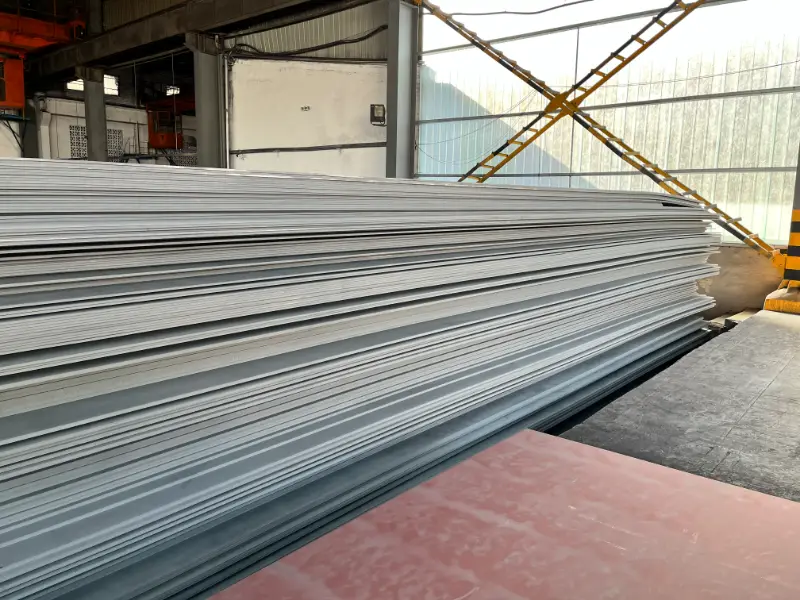
JIS G3101 SS400 Carbon Structural Steel
JIS G3101 SS400 Carbon Structural Steel Coil – Properties, Equivalents & Applications
Full technical data for JIS G3101 SS400 steel coil: chemical composition, mechanical properties, thermal and electrical characteristics, international equivalents, and application guidance.
Welding, cutting, forming, drilling, machining, hot-dip galvanizing
- Phone : +8618037372205
- Email : [email protected]
- WhatsApp: Contact via Whtsapp
- WeChat: +8618037372205
JIS G3101 SS400 Carbon Structural Steel Introduction
JIS G3101 SS400 is a general-purpose carbon structural steel supplied as hot-rolled coil, plate, strip, and sections. It is one of the most widely used steel grades in construction, machinery, shipbuilding, and bridge engineering. SS400 is characterized by a tensile strength range of 400–510 MPa and yield strength that depends on thickness. The steel is typically used in the as-rolled condition without subsequent heat treatment. It exhibits good weldability, formability, and machinability, making it suitable for bolted, riveted, and welded structures. No impact toughness requirements are specified unless agreed at the time of ordering, so it is primarily applied in static loading environments. The grade does not contain deliberate additions of alloying elements, and its chemical composition is controlled mainly for carbon, manganese, phosphorus, and sulfur. International equivalents such as ASTM A36 and EN S235JR allow seamless substitution in global projects.
JIS G3101 SS400 Carbon Structural Steel Chemical Composition
Chemical composition limits according to JIS G3101 for ladle analysis. Only carbon, manganese, phosphorus, and sulfur are specified. Silicon is not intentionally controlled or reported for SS400. Trace elements such as chromium, nickel, copper, and molybdenum are not specified and are only present as residuals.
- Carbon (C) influences strength and weldability – kept below 0.20% to maintain good toughness and weldability.
- Manganese (Mn) provides solid-solution strengthening, with maximum 1.00%.
- Phosphorus (P) and Sulfur (S) are impurities limited to 0.050% each to avoid embrittlement and hot shortness.
| Chemical Element | Standard Value | Unit | Remarks |
|---|---|---|---|
| Carbon, C | ≤0.20 | % | Ladle analysis |
| Manganese, Mn | ≤1.00 | % | Ladle analysis |
| Phosphorus, P | ≤0.050 | % | Ladle analysis |
| Sulfur, S | ≤0.050 | % | Ladle analysis |
JIS G3101 SS400 Carbon Structural Steel Thermal and Electrical Physical Properties
The following physical properties are typical for plain carbon steel of this type and are provided for engineering reference only. They are not mandatory requirements of JIS G3101. Values are given at room temperature unless otherwise noted. Thermal conductivity and electrical resistivity vary with composition and temperature; the figures below represent common literature data for low-carbon structural steel.
| Property | Typical Value | Unit | Test Condition / Remark |
|---|---|---|---|
| Density (ρ) | 7.85 | g/cm³ | At 20°C |
| Elastic Modulus (E) | 200 – 210 | GPa | Room temperature |
| Shear Modulus (G) | 80 | GPa | Room temperature |
| Poisson's Ratio (ν) | 0.30 | - | Room temperature |
| Thermal Expansion Coefficient (α) | 11.1 × 10⁻⁶ | K⁻¹ | 20°C – 100°C |
| Thermal Expansion Coefficient (α) | 12.5 × 10⁻⁶ | K⁻¹ | 20°C – 200°C |
| Thermal Conductivity (λ) | 53 | W/(m·K) | At 100°C |
| Thermal Conductivity (λ) | 51 | W/(m·K) | At 300°C |
| Specific Heat Capacity | 486 | J/(kg·K) | Room temperature |
| Electrical Resistivity (ρ_e) | 0.22 | μΩ·m | At 20°C, typical |
JIS G3101 SS400 Carbon Structural Steel Mechanical Properties
Mechanical properties depend on thickness and test piece orientation. Tensile properties are based on as-rolled longitudinal specimens. The bending test requires 180° bending around a mandrel without cracking. Impact toughness (KV) is not specified for SS400; it is not a requirement in JIS G3101 unless specially agreed upon. Therefore, no impact values are listed. Tensile properties display multiple rows corresponding to different thickness ranges.
| Property | Standard Requirement Value | Unit | Test Conditions |
|---|---|---|---|
| Yield Strength (ReH) | ≥245 | MPa | Thickness (t) ≤16 mm |
| Yield Strength (ReH) | ≥235 | MPa | 16 mm < t ≤ 40 mm |
| Yield Strength (ReH) | ≥215 | MPa | 40 mm < t ≤ 100 mm |
| Yield Strength (ReH) | ≥205 | MPa | t > 100 mm |
| Tensile Strength (Rm) | 400 – 510 | MPa | All thicknesses |
| Elongation (A) | ≥17 | % | No.5 test piece, t ≤5 mm |
| Elongation (A) | ≥21 | % | No.1A test piece, 5 mm < t ≤16 mm |
| Elongation (A) | ≥17 | % | No.1A test piece, 16 mm < t ≤50 mm |
| Elongation (A) | ≥21 | % | No.10 test piece, t >50 mm (or 23% for No.4) |
| Bending Test (Bend Angle 180°) | No cracks | - | Bend diameter 1.5 × t, t ≤16 mm |
| Bending Test (Bend Angle 180°) | No cracks | - | Bend diameter 1.5 × t, t >16 mm |
JIS G3101 SS400 Carbon Structural Steel Fully Equivalent Material Standards and Substitutable Grades
| Country/Region | Standard | Grade | Remarks |
|---|---|---|---|
| Japan | JIS G3101 | SS400 | Original specification |
| USA | ASTM A36/A36M | A36 | Equivalent carbon structural steel; yield strength 250 MPa, tensile 400–550 MPa |
| Europe | EN 10025-2 | S235JR | Similar structural grade; tensile 360–510 MPa, min. yield 235 MPa |
| International | ISO 630-2 | S235B | Structural steel with comparable strength and composition |
| China | GB/T 700 | Q235B | Direct parallel; tensile 375–500 MPa, yield 235 MPa (t ≤16 mm) |
JIS G3101 SS400 Carbon Structural Steel Application Introduction
SS400 is a versatile structural steel suitable for a wide range of applications where static loading is predominant and no special impact requirements exist. Its balance of strength, weldability, and formability makes it the material of choice for many general construction and mechanical engineering projects.
- Key advantages: Cost-effective, readily available worldwide, easy to weld and form.
- Typical usage: Structural frameworks, supports, machine bases, storage tanks, and agricultural equipment.
- Processing: Can be cut, drilled, bent, and hot-dip galvanized. Preheating is generally not required for welding thicknesses below 30 mm.
Product Applications: Structural beams, columns, and girders, Floor plates and decking, Prefabricated steel frames, Storage tanks and silos, Agricultural implements, Welded pipes and hollow sections
Processed into products: Brackets and supports, Machine bases and frames, Stiffeners and gusset plates, Railings and walkways, Conveyor components, Door and window frames for industrial buildings
Application industries: Building and construction, Bridge engineering, Shipbuilding and marine structures, General mechanical engineering, Agricultural machinery, Transportation and storage
JIS G3101 SS400 Carbon Structural Steel Similar / Alternative Material Recommendations
| Country/Region | Standard | Grade | Remarks |
|---|---|---|---|
| USA | ASTM A283/A283M | Grade C | Tensile 380–515 MPa, yield ≥205 MPa; slightly lower carbon, suitable substitution |
| Europe | EN 10025-2 | S275JR | Tensile 410–560 MPa, yield ≥275 MPa; higher strength, good weldability |
| China | GB/T 700 | Q275B | Tensile 410–560 MPa, yield ≥275 MPa; alternative for higher strength demand |
| International | ISO 630-2 | S275B | Comparable to EN S275JR, slightly higher strength than SS400 |
Notes:
- SS400 is supplied in the as-rolled condition with a dark mill scale surface. It is not intended for heat treatment, though normalizing may be applied if agreed.
- JIS G3101 does not require impact testing for SS400; therefore, the steel is not guaranteed for use at low-temperature or dynamic load applications unless supplementary requirements are included in the order.
- When ordering, the desired shape, dimensions, and any additional tests (e.g., ultrasonic testing, specific flatness tolerances) should be specified.
- For welded structures subject to fatigue or seismic loads, the engineer should evaluate the suitability of SS400 in relation to service conditions.
- Physical property values given are typical for carbon steel and may vary slightly between production batches. For critical design calculations, it is recommended to verify properties using material certificates.
- Share



