
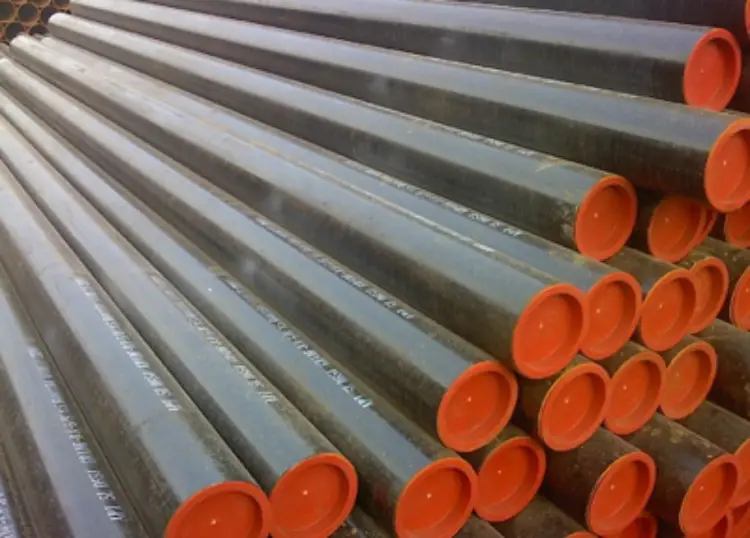
L210 PSL1 LSAW Line Pipe per GB/T 9711-2011
L210 PSL1 LSAW Line Pipe per GB/T 9711-2011: Low-Strength Carbon Steel for Oil & Gas Transport
Explore the complete material data of L210 grade steel according to GB/T 9711-2011 PSL1 for longitudinal submerged arc welded (LSAW) pipes, covering chemical composition, mechanical properties, thermal and electrical characteristics, equivalent grades, and application guidance.
Forming from hot-rolled steel plate/coil, followed by longitudinal submerged arc welding (LSAW). Suitable processes: cold forming, welding, hot rolling, normalizing (if required), and hydrostatic testing.
- Phone : +8618037372205
- Email : [email protected]
- WhatsApp: Contact via Whtsapp
- WeChat: +8618037372205
L210 PSL1 LSAW Line Pipe per GB/T 9711-2011 Introduction
L210 is a low-carbon steel grade specified in GB/T 9711-2011 under PSL1 (Product Specification Level 1) for longitudinal submerged arc welded (LSAW) line pipes. It is designed for non-sour, low-pressure petroleum, natural gas, and water transmission pipelines. The material offers a minimum yield strength of 210 MPa and good weldability due to its controlled carbon and manganese content. L210 represents a basic quality level with relaxed testing requirements compared to PSL2 grades, making it suitable for less demanding service conditions. Key features include:
- Low carbon content (≤0.22%) for excellent weldability and toughness
- Economical choice for standard low-pressure piping systems
- Guaranteed minimum Charpy impact energy of 27 J at 0°C for heavy-wall pipes when specified
- Available in large diameters and thick walls through LSAW manufacturing process
L210 PSL1 LSAW Line Pipe per GB/T 9711-2011 Chemical Composition
The chemical composition according to GB/T 9711-2011 PSL1 for L210 grade, based on heat analysis. Residual elements are limited to ensure good weldability and mechanical properties. For all PSL1 grades, additional limits apply to Cu, Ni, Cr, Mo, and total microalloying elements.
- Carbon content is kept low to guarantee toughness and field weldability.
- Manganese provides necessary strength without sacrificing ductility.
- Phosphorus and sulfur are strictly controlled to avoid brittleness.
| Element | Standard Value (max, %) | Remarks |
|---|---|---|
| Carbon (C) | 0.22 | Heat analysis |
| Manganese (Mn) | 0.90 | Heat analysis |
| Phosphorus (P) | 0.030 | Heat analysis |
| Sulfur (S) | 0.030 | Heat analysis |
| Copper (Cu) | 0.50 | Residual element maximum (by agreement) |
| Nickel (Ni) | 0.50 | Residual element maximum (by agreement) |
| Chromium (Cr) | 0.50 | Residual element maximum (by agreement) |
| Molybdenum (Mo) | 0.15 | Residual element maximum (by agreement) |
| V + Nb + Ti | 0.15 | Sum of microalloying elements, maximum (by agreement); individual limits: V ≤0.08, Nb ≤0.05, Ti ≤0.04 |
| Boron (B) | 0.0005 | Maximum for residual boron (by agreement) |
L210 PSL1 LSAW Line Pipe per GB/T 9711-2011 Thermal and Electrical Physical Properties
The following physical properties are typical for low-carbon steel of L210 type and are not mandated by the product standard. They are provided for general design and engineering purposes. Slight variations may occur depending on the exact chemical composition and manufacturing process.
- Density, elastic modulus, and Poisson's ratio are standard for carbon steel.
- Thermal expansion coefficient is given for the range 20–300°C.
- Thermal conductivity and specific heat capacity are at room temperature.
- Electrical resistivity is typical for mild steel.
| Property | Typical Value | Unit | Condition |
|---|---|---|---|
| Density (ρ) | 7.85 | g/cm³ | At 20°C |
| Elastic Modulus (E) | 207 | GPa | Ambient temperature |
| Shear Modulus (G) | 79 | GPa | Ambient temperature |
| Poisson's Ratio (ν) | 0.3 | - | Ambient temperature |
| Thermal Expansion Coeff. (α) | 11.7 | 10⁻⁶/K | 20–300°C average |
| Thermal Conductivity (λ) | 52 | W/(m·K) | At 20°C |
| Specific Heat Capacity (c) | 0.49 | kJ/(kg·K) | At 20°C |
| Electrical Resistivity (ρ_e) | 0.15 | μΩ·m | At 20°C |
L210 PSL1 LSAW Line Pipe per GB/T 9711-2011 Mechanical Properties
Tensile properties are required for the pipe body in transverse direction per GB/T 9711-2011 PSL1. Elongation is calculated according to a given formula; a typical value is shown for a common specimen. Bend test is mandatory for all PSL1 pipes; Charpy impact is required only for specified heavy-wall pipes at 0°C.
- Yield strength is the 0.5% total extension proof strength (Rt0.5).
- Elongation formula: A = 1940 · A_xc^0.2 / Rm^0.9, where A_xc is the initial cross-sectional area of the test specimen (mm²) and Rm the measured tensile strength (MPa).
- Bend test: full section or strip bend, 180° bend angle, no cracks.
- Impact test: full-size (10×10 mm) Charpy V-notch specimens, transverse orientation, average of three tests.
| Property | Standard Required Value | Unit | Test Condition |
|---|---|---|---|
| Yield Strength (Rt0.5) | ≥ 210 | MPa | Transverse, room temperature |
| Tensile Strength (Rm) | ≥ 335 | MPa | Transverse, room temperature |
| Elongation (A) | ≥ 23 (typical for 200 mm² specimen at min. Rm) | % | Calculated per standard formula; value depends on actual Rm and specimen area |
| Bend Test (180°) | No cracks after bending | - | Bend on mandrel diameter: 3T for t ≤ 12.7 mm, 4T for t > 12.7 mm (T = specimen thickness) |
| Charpy Impact (KV²) | ≥ 27 (average), ≥ 20 (individual) | J | 0°C, transverse, full-size specimen; required when specified for OD ≥508 mm and t ≥6.4 mm |
L210 PSL1 LSAW Line Pipe per GB/T 9711-2011 Fully Equivalent Material Standards and Substitutable Grades
| Country/Region | Standard | Grade | Remarks |
|---|---|---|---|
| International/API | API Spec 5L (46th Ed. or earlier) | A or L210 PSL1 | Most commonly used equivalent; requirements for chemistry and tensile properties are directly comparable. |
| International | ISO 3183:2012 | L210 PSL1 | ISO equivalent based on API 5L; interchangeable for international projects. |
| European | EN 10208-1:2009 | L210 | European standard for welded line pipe for combustible fluids; grade L210 corresponds to PSL1 quality level. |
| Russian | GOST R 52079-2003 | 17G1S (approximate) | Slightly different chemistry but similar strength; often used in CIS pipelines. |
L210 PSL1 LSAW Line Pipe per GB/T 9711-2011 Application Introduction
L210 PSL1 LSAW pipe is specifically designed for low-pressure transmission of oil, gas, and water in onshore pipelines. Its low carbon content ensures easy field welding and good resistance to brittle fracture under moderate working conditions. This grade is ideal for applications where cost efficiency is paramount and service conditions are not severe. Common usage includes gathering systems, distribution networks, and structural tubular components. It can be processed into various finished products with standard welding, cutting, and coating processes.
Product Applications: Long-distance oil/gas transmission pipelines (low pressure), Water main pipes and distribution networks, Sewer and drainage pipes, Offshore jacket leg casings (where low strength is adequate), Conductor pipes and pipe sleeves
Processed into products: Pipe spools and customized fittings (elbows, tees, reducers) welded from LSAW pipe segments, Flanged connectors and mechanical couplings, Structural columns and piles for platform supports, Manifolds and header pipes, Coated line pipe for buried or subsea applications (with 3LPE/3LPP coating), Vibration dampening piping systems
Application industries: Oil & Gas (onshore gathering and distribution lines), Water Treatment and Transmission, Construction and Civil Engineering (structural supports, piling pipes), Mining (slurry transport, dewatering pipes), Agriculture (irrigation main lines)
L210 PSL1 LSAW Line Pipe per GB/T 9711-2011 Similar or Alternative Materials with Close Properties
| Country/Region | Standard | Grade | Remarks |
|---|---|---|---|
| China | GB/T 9711-2011 | L245 PSL1 | Next higher strength grade with minimum yield 245 MPa; widely used where slightly higher pressure capacity is needed; chemistry and weldability similar. |
| International | API Spec 5L | B (L245) PSL1 | Analogous to L245; often substituted for L210 when strength is acceptable; better toughness guaranteed. |
| ISO | ISO 3183 | L245 PSL1 | Same as above; direct interchange with API 5L B. |
| European | EN 10208-1 | L245 | Higher strength pipe but can be used where L210 is not available; require check on weldability and mill capability. |
| Japan | JIS G 3454 | STPG 370 | Carbon steel pipe for pressure service with similar tensile strength (~370 MPa) and yield ~215 MPa; suitable for low-pressure applications but with different wall thickness design. |
Notes:
Additional Notes:
- PSL1 grades are not intended for sour service (H₂S-containing environments); for such conditions, PSL2 grades with stricter hardness and chemistry requirements should be selected.
- The impact test requirement (0°C, 27 J) is only mandatory when the outside diameter is ≥508 mm and wall thickness ≥6.4 mm, unless otherwise agreed.
- All pipes must undergo a hydrostatic test at a pressure corresponding to a hoop stress of either 60% of the specified minimum yield strength (for sizes ≤ 457 mm OD) or 75% (for larger sizes), or as agreed.
- Weldability: L210 exhibits excellent arc welding characteristics with all standard processes (SMAW, GMAW, SAW) and requires no preheat for wall thicknesses up to 25 mm under normal conditions.
- For precise elongation calculation, users should refer to the formula in GB/T 9711-2011 clause 9.2.2 and actual measured tensile strength.
- Share



