
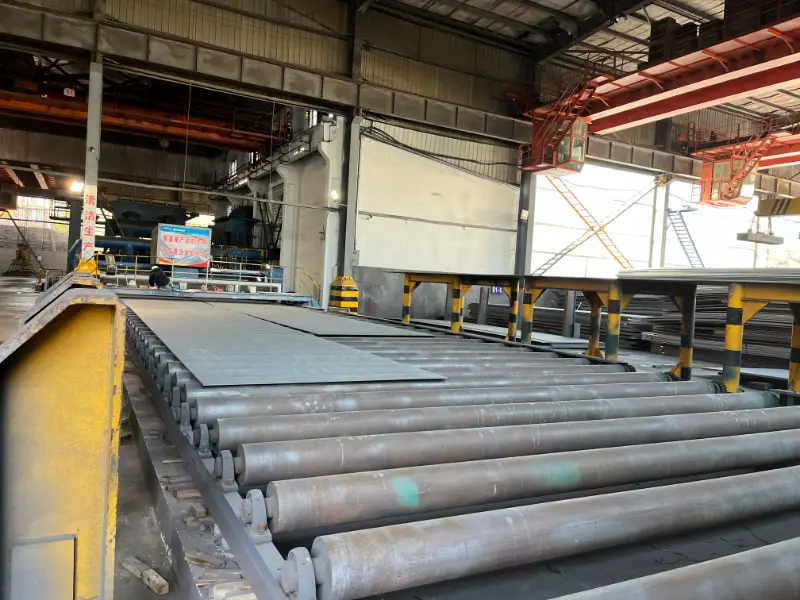
EN 10025-6 S690Q: High-Strength Quenched and Tempered Structural Steel
EN 10025-6 S690Q: High-Strength Quenched and Tempered Structural Steel - Properties & Equivalents
Complete material data for S690Q steel according to EN 10025-6, including chemical composition, mechanical properties, physical properties, equivalent grades, and application guidance. All data is based on the official European standard.
Welding (all common methods), hot and cold forming (limited cold bending due to high strength), machining
- Phone : +8618037372205
- Email : [email protected]
- WhatsApp: Contact via Whtsapp
- WeChat: +8618037372205
EN 10025-6 S690Q: High-Strength Quenched and Tempered Structural Steel Introduction
S690Q is a high-strength, quenched and tempered fine-grain structural steel defined in EN 10025-6. It offers a minimum yield strength of 690 MPa in thicknesses up to 50 mm and excellent weldability due to its low carbon content and controlled micro-alloying. The 'Q' designation indicates delivery in the quenched and tempered condition, providing an optimal combination of high strength, good toughness (impact tested at -20°C), and moderate formability.
- Excellent load-bearing capacity for weight-critical constructions
- Superior notch toughness even at low temperatures
- Good weldability using standard methods with appropriate heat input control
- Available in plates, wide flats, and long products
EN 10025-6 S690Q: High-Strength Quenched and Tempered Structural Steel Chemical Composition
The chemical composition complies with EN 10025-6. Limits are maximum values unless otherwise specified. Microalloying elements (Nb, V, Ti, B) are added to refine grain size and enhance strength after quenching and tempering.
| Element | Standard Value (max, %) | Remarks |
|---|---|---|
| Carbon (C) | 0.22 | Max; for t ≤ 50 mm; for t > 50 mm same limit |
| Silicon (Si) | 0.86 | Max |
| Manganese (Mn) | 1.80 | Max for t ≤ 50 mm; for t > 50 mm max 1.70 |
| Phosphorus (P) | 0.025 | Max |
| Sulfur (S) | 0.012 | Max |
| Nitrogen (N) | 0.015 | Max |
| Boron (B) | 0.005 | Max |
| Chromium (Cr) | 1.50 | Max |
| Copper (Cu) | 0.50 | Max |
| Molybdenum (Mo) | 0.70 | Max |
| Niobium (Nb) | 0.06 | Max |
| Nickel (Ni) | 2.0 | Max |
| Titanium (Ti) | 0.05 | Max |
| Vanadium (V) | 0.12 | Max |
| Zirconium (Zr) | 0.17 | Max |
| Aluminium (Al total) | 0.015 min | Minimum when used for grain refinement; otherwise not specified |
| Ceq (CEV) | 0.65 typical | Carbon equivalent value based on typical composition; for welding assessment |
EN 10025-6 S690Q: High-Strength Quenched and Tempered Structural Steel Thermal and Electrical Physical Properties
Values are typical for quenched and tempered high-strength steel at room temperature unless otherwise noted. Data may vary with actual manufacturing route and test conditions.
- Density: standard value for steel.
- Elastic moduli: characteristic for steel.
- Thermal expansion and conductivity: approximate values for low-alloy structural steel.
| Property | Standard Value | Unit | Test Condition |
|---|---|---|---|
| Density (ρ) | 7.85 | g/cm³ | At 20°C |
| Elastic modulus (E) | 210 | GPa | Tension, room temperature |
| Shear modulus (G) | 80 | GPa | Calculated from E and Poisson's ratio |
| Poisson's ratio (ν) | 0.3 | – | Within elastic range |
| Thermal expansion coefficient (α) | 11.1 × 10⁻⁶ | K⁻¹ | Between 20°C and 100°C |
| Thermal expansion coefficient (α) | 11.9 × 10⁻⁶ | K⁻¹ | Between 20°C and 200°C |
| Thermal expansion coefficient (α) | 12.5 × 10⁻⁶ | K⁻¹ | Between 20°C and 300°C |
| Thermal expansion coefficient (α) | 13.0 × 10⁻⁶ | K⁻¹ | Between 20°C and 400°C |
| Thermal expansion coefficient (α) | 13.5 × 10⁻⁶ | K⁻¹ | Between 20°C and 500°C |
| Thermal conductivity (λ) | 30 | W/(m·K) | At 20°C (typical for QT steel) |
| Specific heat capacity | 460 – 500 | J/(kg·K) | At 20-100°C |
| Electrical resistivity (ρ_e) | 0.25 × 10⁻⁶ | Ω·m | At 20°C (approximate) |
EN 10025-6 S690Q: High-Strength Quenched and Tempered Structural Steel Mechanical Properties
Properties are valid for flat and long products in quenched and tempered condition. Test direction is transverse for plate and wide flats (unless otherwise agreed).
- ReH: Upper yield strength (or ReL/Rp0.2).
- A: Elongation after fracture, gauge length L0=5.65√S0.
- KV: Charpy V-notch impact energy, transverse test piece.
- Bend test: 180° bending according to EN ISO 7438.
| Property | Standard Value | Unit | Test Condition |
|---|---|---|---|
| Yield strength (ReH) | 690 | MPa | Thickness ≤ 50 mm, transverse |
| Yield strength (ReH) | 650 | MPa | 50 < thickness ≤ 100 mm, transverse |
| Yield strength (ReH) | 630 | MPa | 100 < thickness ≤ 150 mm, transverse |
| Tensile strength (Rm) | 770 – 940 | MPa | Thickness ≤ 50 mm, transverse |
| Tensile strength (Rm) | 760 – 930 | MPa | 50 < thickness ≤ 100 mm, transverse |
| Tensile strength (Rm) | 710 – 900 | MPa | 100 < thickness ≤ 150 mm, transverse |
| Elongation (A) | 14 | % | Thickness ≤ 100 mm, longitudinal (L0=5.65√S0) |
| Elongation (A) | 12 | % | 100 < thickness ≤ 150 mm, longitudinal (L0=5.65√S0) |
| Impact energy (KV) at -20°C | 27 (min) | J | Thickness ≤ 150 mm, transverse; average of 3 specimens, single min 19 J |
| Bend test (180°) – bending pin diameter | 4a | – | Thickness ≤ 16 mm |
| Bend test (180°) – bending pin diameter | 5a | – | 16 < thickness ≤ 40 mm |
| Bend test (180°) – bending pin diameter | 6a | – | 40 < thickness ≤ 63 mm |
| Bend test (180°) – bending pin diameter | 7a | – | 63 < thickness ≤ 100 mm |
| Bend test (180°) – bending pin diameter | 8a | – | 100 < thickness ≤ 150 mm |
EN 10025-6 S690Q: High-Strength Quenched and Tempered Structural Steel Exact Equivalent Standards and Replaceable Grades
| Country/Region | Standard | Grade | Remarks |
|---|---|---|---|
| International (ISO) | ISO 4950-2 | S690Q | Quenched and tempered high yield strength structural steel – identical technical requirements |
| European Union | EN 10025-6 | S690Q | Original standard; implemented as national standards (DIN, BS, NF, UNI, etc.) |
| Germany | DIN EN 10025-6 | S690Q | Direct adoption of EN |
| United Kingdom | BS EN 10025-6 | S690Q | Direct adoption of EN |
| France | NF EN 10025-6 | S690Q | Direct adoption of EN |
| Italy | UNI EN 10025-6 | S690Q | Direct adoption of EN |
EN 10025-6 S690Q: High-Strength Quenched and Tempered Structural Steel Application Introduction
S690Q is designed for weight-optimized, heavily loaded welded structures. Its excellent combination of high strength, sufficient ductility, and reliable low-temperature toughness makes it suitable for dynamic and static load-bearing applications. It can be cold formed to limited radii and is fully weldable with low-hydrogen procedures.
Product Applications: Telescopic crane booms and lattice structures, Offshore platform components (jack-up legs, deck structures), Bridge girders and trusses, Mining dump truck bodies and excavator arms, High-pressure pipelines and storage tanks, Reinforcement of concrete structures
Processed into products: Crane boom sections and connection plates, Welded box girders and I-beams, Load-bearing brackets, hinges, and pin assemblies, Cut-to-shape flanges and structural nodes, Heavy-duty welded shafts and housings, Fatigue-resistant structural members in bridges
Application industries: Mobile crane and lifting equipment manufacturing, Heavy transport and trailer engineering, Bridge building (orthotropic decks, main girders), Offshore and marine engineering, Mining and earth-moving machinery, Pressure vessel and penstock construction
EN 10025-6 S690Q: High-Strength Quenched and Tempered Structural Steel Similar / Comparable Material Recommendations
| Country/Region | Standard | Grade | Remarks |
|---|---|---|---|
| European Union | EN 10025-6 | S690QL | Impact tested at -40°C; otherwise mechanical properties identical to S690Q |
| European Union | EN 10025-6 | S690QL1 | Impact tested at -60°C; for extreme low-temperature service |
| China | GB/T 16270 | Q690D | Quenched and tempered high strength steel; minimum yield 690 MPa, -20°C impact; chemical composition may differ |
| United States | ASTM A514 / A514M | Grade S | High-yield-strength quenched and tempered alloy steel plate; typical yield ≥ 690 MPa, tensile 780-895 MPa; often used interchangeably with S690Q |
| Japan | JIS G 3128 | SHY685 | High yield strength steel plate for welded structures; yield 685 MPa; close to S690Q |
Notes:
- Welding: Use low-hydrogen consumables and preheat as necessary (typically 100-150°C depending on thickness and combined CEV). Control interpass temperature and apply post-weld heat treatment only if absolutely necessary (tempering temperature must not exceed the last tempering temperature).
- Cold forming: Minimum bending radius approximately 3-4t for transverse direction; springback effect is significant.
- Surface condition: Usually supplied in blasted and primed condition if required.
- Certification: Inspection certificate EN 10204 type 3.1 or 3.2 is standard for this grade.
- Share



