
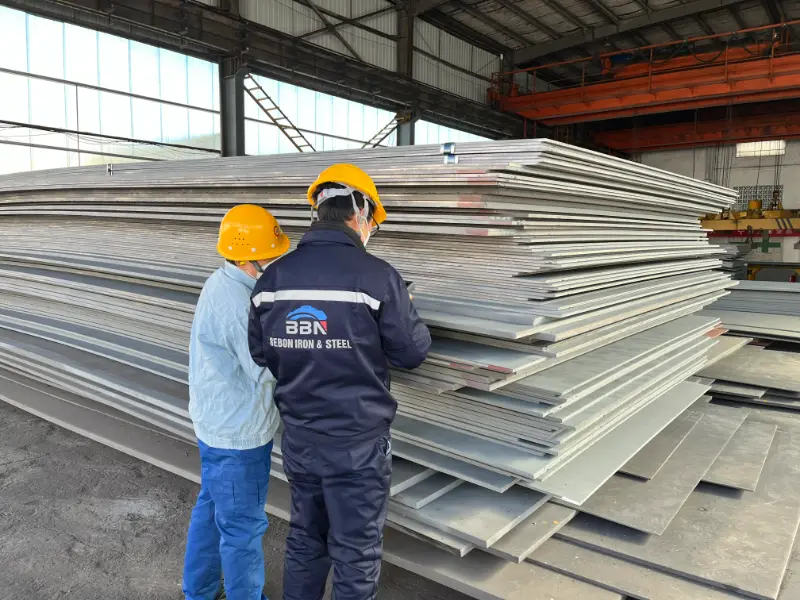
S620QL1 EN10025-6 High-Strength Quenched & Tempered Steel
S620QL1 EN10025-6 High-Strength Quenched & Tempered Steel: Full Data & Global Equivalents
Complete technical profile of EN10025-6 S620QL1 steel: chemical composition, mechanical & thermal properties, international equivalents, and industrial applications.
Hot rolling, quenching and tempering (Q+T), cutting, welding, cold forming (limited), machining
- Phone : +8618037372205
- Email : [email protected]
- WhatsApp: Contact via Whtsapp
- WeChat: +8618037372205
S620QL1 EN10025-6 High-Strength Quenched & Tempered Steel Introduction
S620QL1 is a high‑strength structural steel with a minimum yield strength of 620 MPa, supplied in the quenched and tempered condition. Defined by EN 10025‑6, it belongs to the family of fine‑grain weldable special steels. The grade offers an excellent balance of high strength, good toughness down to −40 °C, and reliable weldability, making it ideal for heavily loaded welded structures.
- Specified under European standard EN 10025‑6 for hot‑rolled structural steel products.
- Classification: low‑alloy, high‑strength, quenched and tempered steel.
- Available in plate, wide‑flat, and cut‑length forms, typically from 3 mm up to 150 mm thickness.
- Commonly used in mobile cranes, bridges, offshore structures, and heavy‑duty machinery.
S620QL1 EN10025-6 High-Strength Quenched & Tempered Steel Chemical composition
Mandatory elements and residual limits according to EN 10025‑6:2019, Table 3. Values are maxima except where a range is given. Carbon equivalent (CEV) limits apply for weldability control.
- Grain‑refining elements (Al, Nb, V, Ti) are added to ensure fine microstructure and low‑temperature toughness.
- Low sulfur and phosphorus contents guarantee high cleanliness.
| Element | Value (%) | Remarks |
|---|---|---|
| Carbon, C | ≤ 0.20 | Thickness ≤ 50 mm; CEV ≤ 0.47 |
| Silicon, Si | ≤ 0.80 | |
| Manganese, Mn | ≤ 1.70 | Mn used up to 1.70 % for strength |
| Phosphorus, P | ≤ 0.025 | Low P for toughness |
| Sulfur, S | ≤ 0.015 | Low S for cleavage resistance |
| Chromium, Cr | ≤ 1.50 | Enhances hardenability |
| Nickel, Ni | ≤ 2.0 | Improves low‑temperature toughness |
| Molybdenum, Mo | ≤ 0.70 | Secondary hardening element |
| Vanadium, V | ≤ 0.12 | Grain refinement and precipitation strengthening |
| Niobium (Columbium), Nb | ≤ 0.06 | Grain refiner |
| Titanium, Ti | ≤ 0.05 | Micro‑alloying for grain size control |
| Zirconium, Zr | ≤ 0.15 | May be added for sulphide shape control |
| Aluminium (total), Al | ≥ 0.015 | Al as deoxidizer and grain refiner |
| Nitrogen, N | ≤ 0.015 | Limited to avoid strain‑ageing |
| Boron, B | ≤ 0.005 | Optional for hardenability |
| CEV (t ≤ 50 mm) | ≤ 0.47 | Carbon equivalent, according to EN 10025‑1 |
| CEV (50 < t ≤ 100 mm) | ≤ 0.50 | |
| CEV (100 < t ≤ 150 mm) | ≤ 0.54 |
S620QL1 EN10025-6 High-Strength Quenched & Tempered Steel Thermal and electrical physical properties
Representative physical data for quenched and tempered low‑alloy steel similar to S620QL1. Exact values may vary slightly depending on heat treatment and composition. These values are provided for engineering calculations and are not part of the mandatory specification.
- Density is assumed constant over the usual temperature range.
- Thermal expansion and conductivity change with temperature; values shown are for 20 °C unless noted.
| Property | Value | Unit | Condition / Temperature |
|---|---|---|---|
| Density, ρ | 7850 | kg/m³ | ambient |
| Modulus of elasticity, E | 205 | GPa | ambient |
| Shear modulus, G | ∼80 | GPa | ambient |
| Poisson's ratio, ν | 0.3 | – | ambient |
| Thermal expansion coefficient, α | 12 × 10⁻⁶ | K⁻¹ | 20 – 200 °C |
| Thermal conductivity, λ | ∼35 | W /(m · K) | 20 °C |
| Specific heat capacity, cₚ | ∼460 | J /(kg · K) | 20 °C |
| Electrical resistivity, ρₑ | ∼0.25 × 10⁻⁶ | Ω · m | 20 °C |
S620QL1 EN10025-6 High-Strength Quenched & Tempered Steel Mechanical properties
Minimum specified properties according to EN 10025‑6:2019, Tables 4 and 5. Values apply to the as‑delivered quenched and tempered condition. Impact test temperature for QL1 grade is −40 °C.
- Yield strength and tensile strength depend on the nominal thickness.
- Elongation measured on a gauge length of 5.65 √ S₀.
- Impact energy is determined on ISO‑V specimens (10 × 10 mm cross‑section).
| Property | Value | Unit | Test condition / Thickness |
|---|---|---|---|
| Yield strength, RₑH | ≥ 620 | MPa | Nominal thickness ≤ 50 mm |
| Yield strength, RₑH | ≥ 580 | MPa | 50 mm < t ≤ 100 mm |
| Yield strength, RₑH | ≥ 560 | MPa | 100 mm < t ≤ 150 mm |
| Tensile strength, Rₘ | 700 – 890 | MPa | t ≤ 50 mm |
| Tensile strength, Rₘ | 650 – 830 | MPa | 50 < t ≤ 100 mm |
| Tensile strength, Rₘ | 620 – 800 | MPa | 100 < t ≤ 150 mm |
| Elongation after fracture, A₅ | ≥ 14 | % | t ≤ 50 mm, L₀=5.65 √ S₀ |
| Elongation after fracture, A₅ | ≥ 14 | % | 50 < t ≤ 100 mm |
| Elongation after fracture, A₅ | ≥ 14 | % | 100 < t ≤ 150 mm |
| Impact energy, KV₂ (−40 °C) | ≥ 27 | J | Longitudinal, average of 3 tests (single min. 19 J) |
S620QL1 EN10025-6 High-Strength Quenched & Tempered Steel Fully equivalent materials and direct substitute grades
| Region/Country | Standard | Designation | Remarks |
|---|---|---|---|
| Europe | EN 10025-6:2019 | S620QL1 | Original standard, current |
| International | ISO 630-6:2014 | S620QL1 | Technically identical to EN 10025-6 |
| Europe (obsolete) | ISO 4950-2:1995 | E620QL1 | Superseded; same base chemistry and mechanicals |
| Germany (historical) | DIN EN 10025-6 | S620QL1 | Identical to European designation since harmonisation |
S620QL1 EN10025-6 High-Strength Quenched & Tempered Steel Application Introduction
S620QL1 is designed for heavy‑duty welded fabrications where weight reduction, high strength, and reliable toughness are crucial. Its good weldability with low preheating requirements and consistent mechanical properties through‑thickness make it a preferred choice in demanding sectors.
- Mobile cranes and crawler crane booms.
- Bridge girders and orthotropic deck plates.
- Offshore platform components and ship lifting equipment.
- Mining and earth‑moving machinery frames.
- High‑pressure pipelines and penstocks.
- Transportation equipment requiring high payload‑to‑weight ratio.
Product Applications: Crane booms and lattice sections, Welded beams and columns, Load‑bearing plates and shells, Pressure vessel shells, Excavator and loader arms, Chassis frames for heavy vehicles
Processed into products: Boom segments and hinge brackets, Bridge bearing plates, Offshore node connectors, Mine truck frames, Hydraulic cylinder body parts, Cut‑ to‑length welded assemblies
Application industries: Lifting and material handling (cranes, reach stackers), Bridge and civil engineering, Offshore oil & gas, Mining and heavy machinery, Shipbuilding (special structures), Energy (hydroelectric penstocks, wind turbine towers)
S620QL1 EN10025-6 High-Strength Quenched & Tempered Steel Similar materials with comparable strength and processing
| Region/Country | Standard | Designation | Comparison |
|---|---|---|---|
| Europe | EN 10025-6 | S690QL1 | Higher strength (690 MPa yield), same toughness class |
| Europe | EN 10025-6 | S620Q | Same yield, but delivered in thermomechanical rolled condition (not Q&T) |
| Europe | EN 10025-6 | S550QL1 | Lower yield strength (550 MPa), Q&T |
| Europe | EN 10149-2 | S620MC | Thermomechanical high‑strength low‑alloy, thinner gauges |
| USA | ASTM A514/A514M | Grade Q | 690 MPa yield, Q&T; chemical composition differs, Ni up to 1.8 % |
| USA | ASTM A517/A517M | Grade Q | Quenched and tempered, similar to A514 Grade Q, for pressure vessels |
| International | ISO 630-6 | S690QL1 | ISO equivalent of S690QL1 |
Notes:
Processing and welding recommendations:
- Preheating is generally not required for moderate thicknesses; however, for sections above 30 mm an interpass temperature of 100–150 °C is advised.
- Low‑hydrogen welding consumables (AWS E11018‑M or equivalent) should be used.
- Post‑weld heat treatment (PWHT) is usually unnecessary but may be applied for stress relief if needed, carefully avoiding strength reduction.
- Hot forming must be followed by a new full quench‑and‑temper treatment to restore properties.
- Plate edges should be thoroughly inspected after thermal cutting; grinding of hardened zones may be required.
Delivery documentation: EN 10204 Type 3.1 inspection certificate is standard, with optional Type 3.2 upon agreement.
- Share



