
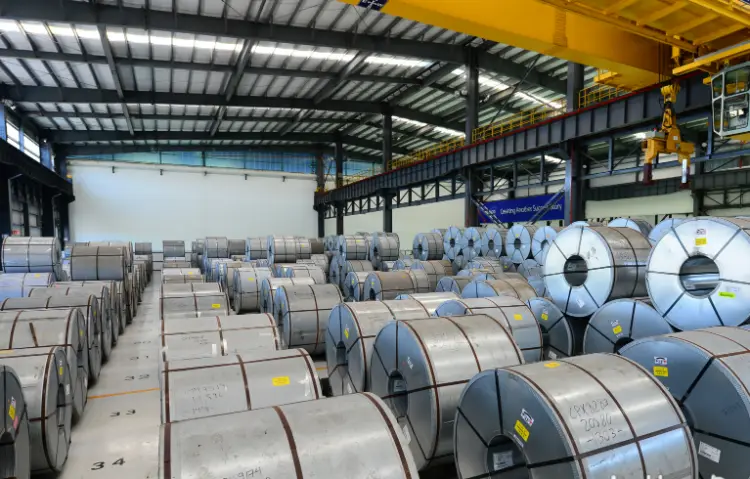
EN10025-6 S550QL1 Structural Steel Coil
EN10025-6 S550QL1 Quenched and Tempered High-Strength Structural Steel Coil Detailed Data
Comprehensive technical data sheet for S550QL1 (EN 10025-6) high-strength structural steel, including chemical composition, mechanical and physical properties, international equivalents, and application guidance.
Hot rolling, heat treatment (quenching and tempering), cold forming, machining, welding
- Phone : +8618037372205
- Email : [email protected]
- WhatsApp: Contact via Whtsapp
- WeChat: +8618037372205
EN10025-6 S550QL1 Structural Steel Coil Introduction
S550QL1 is a quenched and tempered fine-grain structural steel defined in European standard EN 10025-6. The designation indicates a minimum yield strength of 550 MPa (S550), delivery in quenched and tempered condition (Q), and guaranteed Charpy impact energy at -40°C (L1). It belongs to the high-strength low-alloy (HSLA) category and is supplied as plate or coil in thicknesses up to 150 mm.
The steel combines excellent tensile properties, good ductility, and adequate toughness at sub-zero temperatures, making it suitable for heavy-loaded structures operating under severe climatic conditions. Typical applications include mobile crane booms, bridge girders, offshore modules, and pressure vessels. The material offers good weldability provided low-hydrogen practices and appropriate preheat/interpass temperatures are followed. CEV values are tightly controlled to ensure consistent hardenability and mechanical properties cross the entire thickness.
EN10025-6 S550QL1 Structural Steel Coil Chemical Composition
The chemical composition of S550QL1 is carefully balanced to achieve high strength and toughness after quenching and tempering. Micro-alloying elements such as Nb, V, Ti, and Al provide grain refinement and precipitation hardening. Strict limits on P, S, and N ensure good ductility and resistance to brittle fracture. Carbon equivalent (CEV) maximum values apply depending on product thickness to maintain weldability.
| Element | Standard Value (max unless noted) | Remarks |
|---|---|---|
| C | ≤0.20 | Required for hardenability |
| Si | ≤0.80 | Deoxidizer |
| Mn | ≤1.70 | Grain refinement and strength |
| P | ≤0.020 | Maximum limit for toughness |
| S | ≤0.010 | Improved through-thickness properties |
| N | ≤0.015 | Maximum total nitrogen |
| B | ≤0.005 | Hardenability enhancement |
| Cr | ≤1.50 | Optional alloying |
| Cu | ≤0.50 | Weathering resistance residual |
| Mo | ≤0.70 | Optional for strength |
| Nb | ≤0.06 | Grain refiner |
| Ni | ≤2.0 | Optional for toughness |
| Ti | ≤0.05 | Deoxidation and grain size control |
| V | ≤0.12 | Optional precipitation hardening |
| Zr | ≤0.15 | Optional microalloying |
| Al (total) | ≥0.015 | Minimum for grain refinement |
| CEV | 0.47 (≤50 mm); 0.47 (>50–100 mm); 0.50 (>100–150 mm) | Carbon equivalent maximum per thickness |
EN10025-6 S550QL1 Structural Steel Coil Physical Properties
Physical property data are not part of the delivery specification but are typical values for quenched and tempered low-alloy steels of this strength class. These values serve as a guide for design calculations and may vary slightly with actual heat chemistry and tempering parameters.
| Property | Typical Value | Unit | Test Condition / References |
|---|---|---|---|
| Density (ρ) | 7850 | kg/m³ | 20°C |
| Modulus of elasticity (E) | 210 | GPa | 20°C, longitudinal |
| Shear modulus (G) | 81 | GPa | Calculated from E and ν |
| Poisson's ratio (ν) | 0.3 | — | Elastic range |
| Thermal expansion coefficient (α) | 11.1×10⁻⁶ | /K | Mean between 20°C and 100°C |
| Thermal expansion coefficient (α) | 12.1×10⁻⁶ | /K | Mean between 20°C and 200°C |
| Thermal expansion coefficient (α) | 12.9×10⁻⁶ | /K | Mean between 20°C and 300°C |
| Thermal conductivity (λ) | 42 | W/(m·K) | At 20°C |
| Specific heat capacity (cp) | 460 | J/(kg·K) | At 20°C |
| Electrical resistivity (ρe) | 0.23 | µΩ·m | At 20°C |
EN10025-6 S550QL1 Structural Steel Coil Mechanical Properties
Mechanical properties are verified on test specimens taken from as-delivered condition (+QT). Specified minimum values for yield strength, tensile strength, elongation, and impact energy depend on product thickness. Charpy V-notch impact tests are required at -40°C (longitudinal) as per L1 designation.
| Property | Specified Minimum / Range | Unit | Test Condition |
|---|---|---|---|
| Yield Strength (ReH) | ≥550 | MPa | Nominal thickness ≤50 mm |
| Yield Strength (ReH) | ≥530 | MPa | Nominal thickness >50–≤100 mm |
| Yield Strength (ReH) | ≥510 | MPa | Nominal thickness >100–≤150 mm |
| Tensile Strength (Rm) | 640–820 | MPa | Nominal thickness ≤50 mm |
| Tensile Strength (Rm) | 590–770 | MPa | Nominal thickness >50–≤100 mm |
| Tensile Strength (Rm) | 590–770 | MPa | Nominal thickness >100–≤150 mm |
| Elongation (A) on 5.65√S0 | ≥16 | % | Longitudinal, thickness ≤50 mm |
| Elongation (A) on 5.65√S0 | ≥14 | % | Longitudinal, thickness >50–≤100 mm |
| Elongation (A) on 5.65√S0 | ≥14 | % | Longitudinal, thickness >100–≤150 mm |
| Charpy Impact Energy (KV) at -40°C | ≥27 | J | Longitudinal, all thicknesses |
| Charpy Impact Energy (KV) at -40°C | ≥20 | J | Transverse, all thicknesses |
EN10025-6 S550QL1 Structural Steel Coil Exactly Equivalent Standards and Replaceable Grades
| Country / Region | Standard | Grade | Remarks |
|---|---|---|---|
| All European Union and EFTA countries | EN 10025-6:2019 | S550QL1 | Original European standard; identical designation used in national adoptions. |
| United Kingdom | BS EN 10025-6 | S550QL1 | British implementation of EN 10025-6. |
| Germany | DIN EN 10025-6 | S550QL1 | German version. |
| France | NF EN 10025-6 | S550QL1 | French version. |
| Italy | UNI EN 10025-6 | S550QL1 | Italian version. |
| Spain | UNE EN 10025-6 | S550QL1 | Spanish version. |
EN10025-6 S550QL1 Structural Steel Coil Application Introduction
S550QL1 is engineered for heavy-duty structural and mechanical engineering applications where high yield strength, good low-temperature toughness, and weldability are mandatory. Its typical strength-to-weight ratio allows for lighter designs without compromising safety. The material is supplied in the quenched and tempered condition, eliminating the need for post-fabrication heat treatment in many cases, provided welding procedures are strictly controlled.
Product Applications: Welded I-girders and box beams, Telescopic crane booms, Lattice mast sections, Heavy-lift spreader bars, Hydraulic cylinder bodies and brackets, Offshore platform structural nodes, Penstocks and spiral cases, Rock crusher housings, Reinforced blast-proof structures
Processed into products: Crane boom segments (plates and formed sections), Crane slewing platforms, Main bridge girder webs and flanges, Jack-up rig leg chords, High-pressure vessels and heat exchangers, Mining truck frames and dump bodies, Offshore wind turbine transition pieces, Turret structures for shipboard cranes
Application industries: Mobile crane manufacturing (telescopic booms, lattice booms), Heavy lifting and transport equipment, Bridge construction (girders, box sections), Offshore and marine structures (deck components, leg structures), Pressure vessel and penstock production, Mining and earthmoving machinery (structural frames, arm sections), Building and construction (trusses, columns under high load)
EN10025-6 S550QL1 Structural Steel Coil Similar / Alternative Grades with Comparable Performance
| Country / Region | Standard | Grade | Remarks |
|---|---|---|---|
| Europe | EN 10025-6 | S500QL1 | Lower minimum yield strength (500 MPa) but same toughness class. |
| Europe | EN 10025-6 | S620QL1 | Higher minimum yield strength (620 MPa) for demanding applications. |
| Europe | EN 10025-6 | S690QL1 | Substantially higher strength (690 MPa) for weight-critical designs. |
| Europe | EN 10025-4 | S550ML | Thermomechanically rolled instead of quenched & tempered; similar minimum yield strength but different toughness behavior and processing. |
| USA | ASTM A514/A514M | Grade F | Quenched and tempered alloy steel plate with minimum yield strength 690 MPa; higher strength but comparable toughness requirements (often tested at -34°C to -46°C depending on grade). |
Notes:
- Welding requires low-hydrogen consumables and controlled preheat/interpass temperature, typically 100–200°C depending on thickness and combined element content.
- Hot forming above 650°C must be followed by re-quenching and tempering to restore mechanical properties; cold forming with tight radii may require stress relief.
- CEV and Pcm limits in the standard are mandatory for guaranteeing weldability and must be reported on inspection certificates.
- Impact test temperature of -40°C (L1) makes this grade suitable for service in arctic and cold-climate environments.
- Through-thickness properties (Z-quality) can be ordered according to EN 10164 when plate is subject to tensile stress in thickness direction.
- Share



