
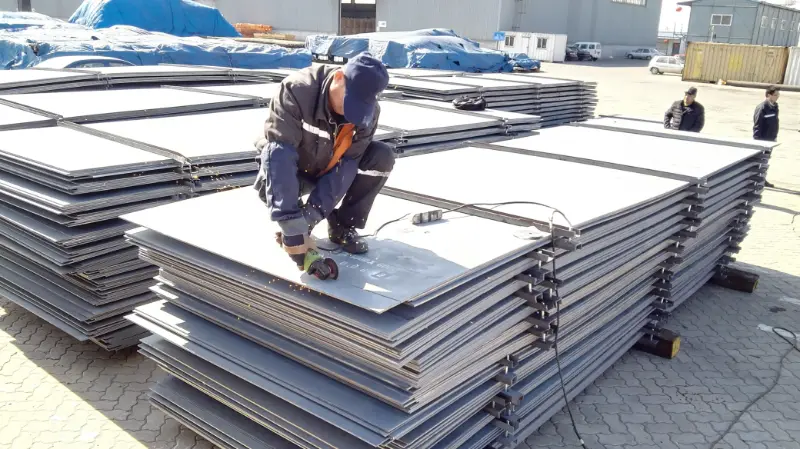
EN10025-6 S550QL
EN10025-6 S550QL: High-Strength Quenched & Tempered Structural Steel for Low-Temperature Service
Complete metallurgical profile of S550QL according to EN 10025-6. Covers chemical composition, mechanical properties, thermal/electrical data, international equivalents, similar grades, and application insights.
Hot rolling followed by quenching and tempering; suitable for welding, machining, cold forming (limited), and flame cutting
- Phone : +8618037372205
- Email : [email protected]
- WhatsApp: Contact via Whtsapp
- WeChat: +8618037372205
EN10025-6 S550QL Introduction
S550QL is a high-strength structural steel produced in accordance with EN 10025-6. It belongs to the group of quenched and tempered fine-grain steels with a minimum yield strength of 550 MPa (for thicknesses ≤ 50 mm). The designation 'S' indicates structural steel, '550' the minimum yield strength in MPa, 'Q' stands for quenched and tempered delivery condition, and 'L' guarantees low-temperature impact toughness at -50 °C (≥ 27 J). This grade combines high mechanical strength with good weldability and excellent notch toughness, making it ideal for demanding welded constructions subjected to high static and dynamic loads. It is widely used in
- mobile cranes
- heavy-duty bridges
- offshore structures
- pressure vessels
- mining equipment
S550QL is typically supplied in the quenched and tempered condition, ensuring a fine bainitic/martensitic microstructure and superior mechanical properties.
EN10025-6 S550QL Chemical Composition according to EN 10025-6
The chemical composition is based on ladle analysis and represents maximum values unless a range is specified. The steel is micro-alloyed with Nb, V, Ti, and Al to achieve fine grain size. Carbon equivalent (CEV) is controlled to ensure good weldability.
| Element | Standard Value | Remarks |
|---|---|---|
| Carbon (C) | ≤ 0.20 | Max. |
| Silicon (Si) | ≤ 0.80 | Max. |
| Manganese (Mn) | ≤ 1.70 | Max. |
| Phosphorus (P) | ≤ 0.025 | Max. |
| Sulfur (S) | ≤ 0.015 | Max. |
| Niobium (Nb) | ≤ 0.06 | Max. |
| Vanadium (V) | ≤ 0.12 | Max. |
| Titanium (Ti) | ≤ 0.05 | Max. |
| Aluminium total (Al) | ≥ 0.015 | Min. |
| Nitrogen (N) | ≤ 0.015 | Max. |
| Molybdenum (Mo) | ≤ 0.70 | Max. |
| Boron (B) | ≤ 0.005 | Max. |
| Chromium (Cr) | ≤ 1.00 | Max. |
| Nickel (Ni) | ≤ 1.00 | Max. |
| Copper (Cu) | ≤ 0.50 | Max. |
| Zirconium (Zr) | ≤ 0.15 | Max. |
| Carbon Equivalent (CEV) | Typically 0.45 – 0.55 | Depending on thickness |
EN10025-6 S550QL Thermal and Electrical Physical Properties
The following values are typical for quenched and tempered low-alloy structural steels and serve as engineering reference. Minor variations may occur depending on exact composition and heat treatment. These data are valid at ambient temperature unless otherwise noted.
| Property | Standard Typical Value | Unit | Test Condition |
|---|---|---|---|
| Density (ρ) | 7.85 | g/cm³ | at 20 °C |
| Modulus of Elasticity (E) | 205 – 210 | GPa | at 20 °C |
| Shear Modulus (G) | ~80 | GPa | at 20 °C |
| Poisson's Ratio (ν) | 0.3 | - | elastic range |
| Thermal Expansion Coefficient (α) | 12.0 × 10⁻⁶ | K⁻¹ | 20 – 100 °C |
| Thermal Expansion Coefficient (α) | 13.0 × 10⁻⁶ | K⁻¹ | 20 – 300 °C |
| Thermal Conductivity (λ) | 38 – 42 | W/(m·K) | at 20 °C |
| Specific Heat Capacity (cp) | 460 – 480 | J/(kg·K) | at 20 °C |
| Electrical Resistivity (ρe) | 0.20 – 0.25 | µΩ·m | at 20 °C |
EN10025-6 S550QL Mechanical Properties – EN 10025-6
Mechanical properties are guaranteed for the quenched and tempered delivery condition. Values vary with product thickness. Impact energy is measured on V-notch Charpy specimens in longitudinal direction at -50 °C. Bend test is normally carried out with a mandrel diameter of 3t (transverse) or 2t (longitudinal).
| Property | Standard Required Value | Unit | Test Condition |
|---|---|---|---|
| Yield Strength (ReH) | ≥ 550 | MPa | thickness ≤ 50 mm |
| Yield Strength (ReH) | ≥ 500 | MPa | thickness 50–100 mm |
| Tensile Strength (Rm) | 640 – 820 | MPa | thickness ≤ 50 mm |
| Tensile Strength (Rm) | 580 – 800 | MPa | thickness 50–100 mm |
| Elongation (A) | ≥ 16 | % | longitudinal, L0=5.65√S0 |
| Elongation (A) | ≥ 16 | % | transverse, thickness ≤ 50 mm |
| Elongation (A) | ≥ 14 | % | transverse, thickness 50–100 mm |
| Bend Test (Mandrel Diameter) | ≤ 3t (transverse) | - | 180° bending, t = specimen thickness |
| Bend Test (Mandrel Diameter) | ≤ 2t (longitudinal) | - | 180° bending, t = specimen thickness |
| Charpy Impact Energy (KV) | ≥ 27 | J | longitudinal, -50 °C |
| Charpy Impact Energy (KV) | ≥ 20 | J | transverse, -50 °C |
EN10025-6 S550QL Full Equivalent Standards and Replaceable Grades
| Country / Region | Standard | Designation | Remarks |
|---|---|---|---|
| Europe | EN 10025-6 | S550QL | Base standard, direct equivalent across EU/EFTA |
| Germany | DIN EN 10025-6 | S550QL | Adopted EN standard |
| United Kingdom | BS EN 10025-6 | S550QL | Adopted EN standard |
| France | NF EN 10025-6 | S550QL | Adopted EN standard |
| Italy | UNI EN 10025-6 | S550QL | Adopted EN standard |
| Spain | UNE EN 10025-6 | S550QL | Adopted EN standard |
| Sweden | SS EN 10025-6 | S550QL | Adopted EN standard |
| Poland | PN-EN 10025-6 | S550QL | Adopted EN standard |
| Netherlands | NEN-EN 10025-6 | S550QL | Adopted EN standard |
| Austria | ÖNORM EN 10025-6 | S550QL | Adopted EN standard |
| Belgium | NBN EN 10025-6 | S550QL | Adopted EN standard |
EN10025-6 S550QL Application Introduction
S550QL is specifically designed for heavy-loaded welded structures that must perform reliably at low ambient temperatures. It offers an excellent strength-to-weight ratio, enabling lighter constructions. Typical processing includes plasma/flame cutting, welding with low-hydrogen processes, and limited cold forming. Preheating and post-weld heat treatment procedures should follow established guidelines (e.g., EN 1011). The steel is not intended for hot forming above tempering temperature.
Product Applications: Crane booms (telescopic and lattice), Bridge structural members (long-span girders), Offshore platform legs and nodes, Mining dump truck bodies, Pressure vessel shells and heads, Wind turbine towers (internal stiffeners), Heavy-duty welded beams and columns
Processed into products: Welded box sections for crane jibs, Cut and machined flanges and stiffeners, Bent and welded hydraulic cylinder brackets, Flame-cut gusset plates, Machined bolted end connections, Weld-in anchor plates for post-tensioning, Profiled beams with longitudinal welds
Application industries: Construction machinery (mobile cranes, telescopic booms), Bridge building (girders, arches, orthotropic decks), Offshore and shipbuilding (jack-up rigs, hull reinforcement), Mining and earthmoving equipment (loaders, excavator arms), Pressure vessel and storage tank manufacturing (cryogenic conditions), Wind energy (tower sections, transition pieces), Transportation and lifting technology (spreader beams, heavy-duty axles)
EN10025-6 S550QL Similar / Comparable Material Recommendations
| Country / Region | Standard | Designation | Remarks |
|---|---|---|---|
| Europe | EN 10025-6 | S500Q/S500QL | Slightly lower strength (500 MPa yield), good alternative for less demanding sections |
| Europe | EN 10025-6 | S620Q/S620QL | Higher strength (620 MPa) quenched and tempered grade, can replace if higher strength needed |
| Europe | EN 10025-6 | S690Q/S690QL | Very high strength (690 MPa), suitable for weight-critical structures, requires stricter welding controls |
| USA | ASTM A514/A514M | Grade H / Grade S | Quenched & tempered alloy steel plate with 690 MPa yield, similar application but higher strength |
| USA | ASTM A572/A572M | Grade 55 / Grade 60 | HSLA steel, not quenched, lower strength and toughness; may be considered for static loading only |
| Japan | JIS G 3128 | SHY 685 / SHY 685N | High yield strength steel for welded structures, similar strength level, requires verification of low-temp toughness |
| China | GB/T 16270 | Q550D / Q550E | Quenched and tempered high-strength structural steel, Q550E provides -40 °C impact, close to S550QL but check CEV |
Notes:
Welding guidelines: Use low-hydrogen consumables (method 135, 136, 111, 121) with preheat typically 100–150 °C based on thickness and CEV. Interpass temperature should not exceed 250 °C. Post-weld stress relieving is generally not necessary but may be applied at 530–580 °C if required. Formability: Cold bending radii should be ≥ 4t for transverse bending and ≥ 3t for longitudinal bending; for tighter radii, warm forming or local stress relief is advised. Corrosion protection: The steel must be coated or painted for atmospheric exposure; it has no inherent weathering resistance. Certification: EN 10204 3.1 inspection certificate is standard for S550QL deliveries including chemical analysis, tensile, and impact test results.
- Share



