
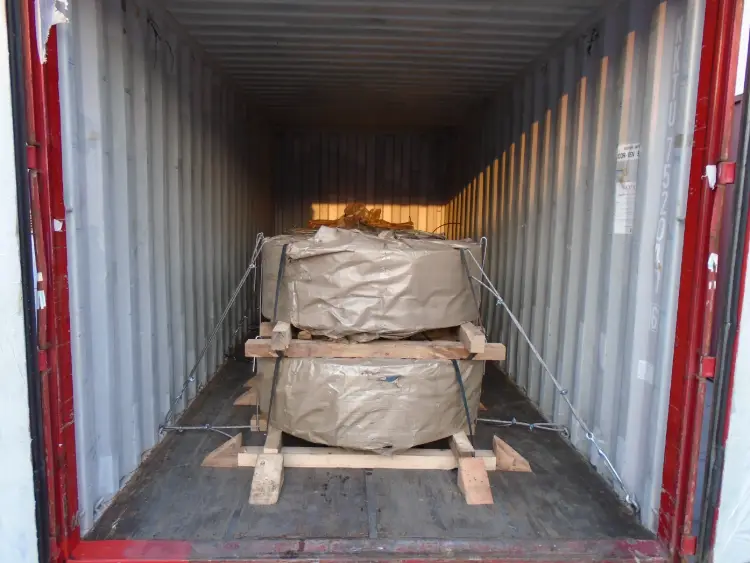
EN10025-6 S460QL1 High-Strength Quenched & Tempered Steel Coil
EN10025-6 S460QL1 High-Strength Quenched & Tempered Steel Coil - 460MPa Yield
Detailed material data for S460QL1 steel coil per EN 10025-6: minimum yield 460 MPa, excellent toughness at -40°C, used in heavy machinery and welded structures.
Welding, cold forming (bending, folding, limited flanging), machining (drilling, milling), thermal cutting (plasma, laser, oxy-fuel), hot-dip galvanizing with process adjustment
- Phone : +8618037372205
- Email : [email protected]
- WhatsApp: Contact via Whtsapp
- WeChat: +8618037372205
EN10025-6 S460QL1 High-Strength Quenched & Tempered Steel Coil Introduction
EN10025-6 S460QL1 is a high-strength, low-alloy structural steel delivered in the quenched and tempered condition. It offers a minimum yield strength of 460 MPa for thicknesses ≤ 50 mm and guaranteed Charpy V-notch impact energy of at least 27 J at -40 °C (longitudinal). The steel combines high strength, excellent weldability, and good cold formability, making it suitable for demanding welded constructions in mobile cranes, heavy equipment, and bridges. Its fine-grained microstructure ensures uniform mechanical properties and resistance to brittle fracture even under severe climatic conditions. S460QL1 is typically supplied as hot-rolled coils, cut-to-length sheets, or plates, with surface quality and dimensional tolerances according to EN 10029 and EN 10051.
EN10025-6 S460QL1 High-Strength Quenched & Tempered Steel Coil Chemical Composition
Chemical requirements according to EN 10025-6:2004, Table 2. Values are maximum unless a range is stated. Alloying elements contribute to hardenability and strength. The sum of elements such as Cr+Mo+Ni may be limited to achieve specified CEV.
| Element | Standard Value (max %) | Remarks |
|---|---|---|
| C | 0.20 | Strength and hardenability |
| Si | 0.80 | Deoxidizer, improves strength |
| Mn | 1.70 | Hardenability agent |
| P | 0.020 | Impurity, detrimental to toughness |
| S | 0.010 | Impurity, improves machinability but lowers toughness |
| N | 0.015 | Residual nitrogen, can form nitrides |
| B | 0.005 | Strong hardenability element |
| Cr | 1.50 | Corrosion resistance and hardenability |
| Cu | 0.50 | Corrosion resistance; may cause hot shortness if high |
| Mo | 0.70 | Increases hardenability and high-temperature strength |
| Nb | 0.06 | Grain refiner, precipitation strengthening |
| Ni | 2.0 | Toughness and hardenability |
| Ti | 0.05 | Grain refinement and nitrogen fixation |
| V | 0.12 | Precipitation strengthening |
| Zr | 0.15 | Grain refinement (optional) |
| CEV* | typically 0.47 – 0.50 (depending on thickness) | Carbon equivalent based on ladle analysis, formula in EN 10025-1 |
EN10025-6 S460QL1 High-Strength Quenched & Tempered Steel Coil Thermal and Electrical Physical Properties
These values are approximate for quenched and tempered low-alloy steel at ambient temperature and may vary slightly with exact chemical composition and heat treatment condition. They are suitable for thermal calculations, FE modelling, and process planning.
| Property | Typical Value | Unit | Test Condition / Remarks |
|---|---|---|---|
| Density (ρ) | 7.85 | g/cm³ | At 20 °C |
| Modulus of elasticity (E) | 210 | GPa | At 20 °C, static |
| Shear modulus (G) | ≈ 81 | GPa | Calculated from E and Poisson's ratio |
| Poisson's ratio (ν) | 0.3 | – | Elastic range, room temperature |
| Thermal expansion coefficient (α) | 11.5 | 10⁻⁶/K | Between 20 °C and 100 °C |
| Thermal expansion coefficient (α) | 12.3 | 10⁻⁶/K | Between 20 °C and 300 °C |
| Thermal conductivity (λ) | 40 – 45 | W/(m·K) | At 20 °C; decreases with rising temperature |
| Specific heat capacity (cp) | 460 | J/(kg·K) | At 20 °C |
| Electrical resistivity (ρe) | 0.20 – 0.25 | µΩ·m | At 20 °C |
EN10025-6 S460QL1 High-Strength Quenched & Tempered Steel Coil Mechanical Properties
Minimum values for longitudinal test pieces according to EN 10025-6. Properties apply to thickness ≤ 50 mm. For thicker sections, reduce yield strength by 20 MPa. Impact toughness at -40 °C is mandatory.
| Property | Standard Requirement | Unit | Test Condition |
|---|---|---|---|
| Yield strength (ReH) | 460 min. | MPa | t ≤ 50 mm; transverse values may differ |
| Tensile strength (Rm) | 550 – 720 | MPa | t ≤ 50 mm; transverse range may be modified by agreement |
| Elongation (A) | 17 min. | % | Longitudinal, gauge length L0 = 5.65√S0 (proportional test piece) |
| Bend test (bend diameter) | 3t (t ≤ 16 mm) | – | 180° bending; no cracks; specimen width b ≥ 30 mm |
| Bend test (bend diameter) | 4t (16 < t ≤ 40 mm) | – | 180° bending |
| Bend test (bend diameter) | 5t (40 < t ≤ 63 mm) | – | 180° bending |
| Bend test (bend diameter) | 6t (63 < t ≤ 80 mm) | – | 180° bending |
| Impact energy (KV2) at -40 °C | 27 min. | J | Longitudinal, Charpy V-notch, average of 3 tests; min. individual 19 J |
| Impact energy (KV2) at -40 °C | 16 min. | J | Transverse, Charpy V-notch, average of 3 tests; min. individual 11 J (optional) |
EN10025-6 S460QL1 High-Strength Quenched & Tempered Steel Coil Full Equivalent Material Standards and Grades
| Country / Region | Standard | Designation | Remarks |
|---|---|---|---|
| Europe | EN 10025-6 | S460QL1 | Original standard and grade, quenched & tempered, -40 °C impact |
| International | ISO 4951-2 | S460QL1 | Directly harmonized with EN 10025-6 |
| China | GB/T 16270 | Q460E | Quenched & tempered, min. 460 MPa, -40 °C impact (KV₂ ≥ 34 J); close chemical and mechanical match |
| Germany (withdrawn) | DIN EN 10025-6 | S460QL1 | Superseded but historically identical |
| United Kingdom | BS EN 10025-6 | S460QL1 | National adoption of European standard |
EN10025-6 S460QL1 High-Strength Quenched & Tempered Steel Coil Application Introduction
S460QL1 steel combines outstanding weldability and low-temperature toughness with a yield strength of 460 MPa, making it ideal for heavy fabrications that must withstand static and dynamic loads. Typical applications are found in mobile crane booms, heavy transport frames, offshore structures, and bridges. Components can be flame-cut, cold formed, machined, and welded using conventional procedures (preheating may be required for thicker sections). The steel is delivered in the Q+T condition and should not be hot worked above tempering temperature to maintain properties.
Product Applications: Welded structural sections and box beams, Cut-to-length plates for fabrication, Hot-rolled coils for further processing (e.g., roll-forming, strip cutting), Prefabricated components like boom segments and crane outriggers, Pressure vessel shells (under certain design codes), Repair and reinforcement plates
Processed into products: Telescopic crane boom sections and extending beams, Heavy-duty truck frame rails and crossmembers, Excavator and mining shovel arms, Offshore jacket braces and nodes, Bridge stiffening plates and orthotropic deck elements, Wind turbine tower door frames and internal platforms, Hydraulic press columns and cylinder mounts, Railway wagon centre sills and bolsters
Application industries: Heavy lifting and materials handling (mobile cranes, reach stackers), Transportation (heavy trucks, trailer chassis, railcar structural parts), Offshore and marine engineering (platform stiffeners, crane pedestals), Bridge construction (girder flanges, box sections), Mining and mineral processing (excavator booms, dump truck bodies), Renewable energy (wind turbine tower internals, foundation transition pieces), General mechanical engineering (press frames, hydraulic cylinder components)
EN10025-6 S460QL1 High-Strength Quenched & Tempered Steel Coil Similar / Alternative Materials with Proximate Properties
| Country / Region | Standard | Designation | Remarks |
|---|---|---|---|
| Europe | EN 10025-6 | S460Q | Quenched & tempered, no specified impact temperature (test at 0 °C or -20 °C by agreement); reduced toughness guarantee |
| Europe | EN 10025-6 | S460QL | Quenched & tempered, -20 °C impact energy ≥ 27 J; suitable for less severe cold conditions |
| Europe | EN 10025-3 | S460N / S460NL | Normalized or normalizing rolled, yield 460 MPa; NL has -50 °C impact toughness, but different weldability and delivery condition |
| Europe | EN 10025-4 | S460M / S460ML | Thermomechanically rolled (TMCP), yield 460 MPa; ML offers -50 °C toughness; no quench and temper treatment, often lower alloy costs |
| USA | ASTM A1011/A1011M | HSLAS-F Grade 70 | Hot-rolled, high-strength low-alloy sheet, min. yield 480 MPa (70 ksi), but impact toughness not mandated; compositional differences |
| USA | ASTM A514/A514M | Grade H | Quenched & tempered, min. yield 690 MPa; much higher strength, lower toughness at -40 °C in thinner gauges; not a direct substitute |
| Japan | JIS G 3128 | SHY685 | Quenched & tempered, yield ≥ 685 MPa, similar low-temperature toughness (Class E: -40 °C) but higher strength level |
| China | GB/T 16270 | Q500E | Quenched & tempered, min. yield 500 MPa, -40 °C impact; slightly higher strength and different chemistry |
Notes:
Welding: Preheating to 100–200 °C is recommended for thicknesses above 30 mm. Use low-hydrogen electrodes/wire. Post-weld heat treatment is generally not required but may be applied for stress relief (max. 550 °C, to avoid over-tempering).
Forming: Cold bending radii should comply with the minimum bend diameters given in the standard. For more severe forming, warm forming at 150–250 °C may be used; never heat above 600 °C.
Corrosion protection: The steel can be painted or hot-dip galvanized; when galvanizing, adjust the tempering treatment to avoid liquid metal embrittlement in highly stressed areas.
Traceability: Each coil or plate is marked according to EN 10025-1 and accompanied by an inspection certificate 3.1 per EN 10204, including chemical analysis, tensile, impact, and bend test results.
- Share



