
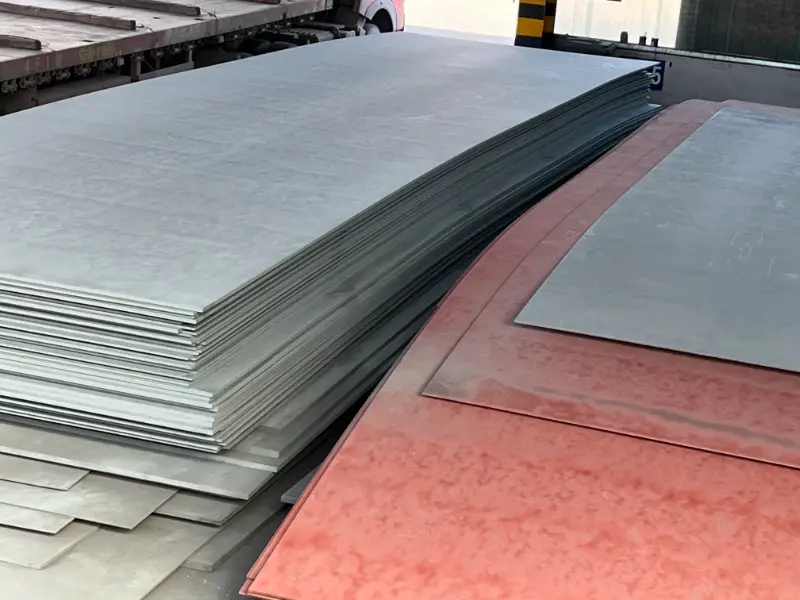
S500Q Quenched and Tempered High Strength Steel
S500Q Quenched and Tempered High Strength Steel | EN 10025-6 Grade S500Q Coil & Plate
S500Q is a quenched and tempered high strength structural steel defined in EN 10025-6, offering minimum 500 MPa yield strength with excellent weldability and toughness for heavy-duty applications.
Hot rolling followed by quenching and tempering; further processing by welding, bending, cutting, machining
- Phone : +8618037372205
- Email : [email protected]
- WhatsApp: Contact via Whtsapp
- WeChat: +8618037372205
S500Q Quenched and Tempered High Strength Steel Introduction
S500Q is a thermomechanically rolled or quenched and tempered fine grain structural steel according to EN 10025-6. It belongs to the group of weldable high strength low-alloy steels with a minimum yield strength of 500 MPa. The "Q" designation indicates a quenching and tempering heat treatment, which gives the material an excellent combination of high strength, good toughness, and satisfactory weldability. Typical applications include mobile crane booms, heavy transport equipment, and dynamically loaded structures. The steel is supplied in the quenched and tempered condition and is suitable for cold forming and welding under controlled conditions. Its low carbon equivalent ensures reliable joint performance after welding when proper preheating and interpass temperatures are observed.
S500Q Quenched and Tempered High Strength Steel Chemical Composition
The table below presents the maximum permissible contents for S500Q according to EN 10025-6:2004 (Table 1). For product thickness ≤50 mm, the following limits apply. Microalloying elements such as Nb, V, and Ti are added to achieve fine grain size and the required mechanical properties. The carbon equivalent value (CEV) is controlled to ensure weldability.
| Element | Content (%) | Remarks |
|---|---|---|
| C | ≤ 0.20 | Carbon |
| Si | ≤ 0.80 | Silicon |
| Mn | ≤ 1.70 | Manganese |
| P | ≤ 0.020 | Phosphorus |
| S | ≤ 0.010 | Sulfur |
| Cr | ≤ 1.50 | Chromium |
| Ni | ≤ 2.0 | Nickel |
| Mo | ≤ 0.70 | Molybdenum |
| Nb | ≤ 0.06 | Niobium |
| V | ≤ 0.12 | Vanadium |
| Ti | ≤ 0.05 | Titanium |
| Al (total) | ≥ 0.015 | Grain refining element |
| N | ≤ 0.015 | Nitrogen |
| B | ≤ 0.005 | Boron |
| Cu | ≤ 0.50 | Copper |
S500Q Quenched and Tempered High Strength Steel Physical Properties
The following physical properties are typical for quenched and tempered low-alloy steels at ambient temperature and may exhibit slight variations depending on exact chemical composition and heat treatment. These values are not part of the material standard but serve as engineering guidelines.
| Property | Typical Value | Unit | Test Condition |
|---|---|---|---|
| Density (ρ) | 7850 | kg/m³ | 20 °C |
| Elastic modulus (E) | 210 | GPa | 20 °C |
| Shear modulus (G) | 80 | GPa | 20 °C (estimated from E and ν) |
| Poisson's ratio (ν) | 0.3 | - | 20 °C |
| Thermal expansion coefficient (α) | 12.0 | 10⁻⁶/K | 20–100 °C |
| Thermal conductivity (λ) | 45 | W/(m·K) | 20 °C |
| Specific heat capacity | 460 | J/(kg·K) | 20 °C |
| Electrical resistivity (ρₑ) | 0.15 | 10⁻⁶ Ω·m | 20 °C |
S500Q Quenched and Tempered High Strength Steel Mechanical Properties
The mechanical properties are guaranteed in the longitudinal direction for quenched and tempered condition per EN 10025-6. Values may vary depending on product thickness and test direction. For thickness >50 mm, lower strength values may apply. Impact energy is measured on Charpy V-notch specimens at -20°C.
| Property | Specified Value | Unit | Test Condition |
|---|---|---|---|
| Yield strength (ReH) | ≥ 500 | MPa | t ≤ 50 mm |
| Tensile strength (Rm) | 590 - 770 | MPa | t ≤ 50 mm |
| Elongation after fracture (A) | ≥ 14 | % | L0 = 5.65√S0 (longitudinal) |
| Impact energy (KV2) | ≥ 27 | J | at -20 °C, longitudinal |
| Bend test (180°) | c = 3t (t ≤ 16 mm) | No cracks | |
| Bend test (180°) | c = 4t (16 < t ≤ 50 mm) | No cracks |
S500Q Quenched and Tempered High Strength Steel Exact Equivalent Material Standards and Replaceable Grades
| Country/Region | Standard | Grade | Remarks |
|---|---|---|---|
| Europe | EN 10025-6 | S500Q | Identical standard and grade |
| International (ISO) | ISO 4950-2 | E500Q | Equivalent quenched and tempered grade (historical designation) |
| United Kingdom | BS EN 10025-6 | S500Q | Adopted European standard |
S500Q Quenched and Tempered High Strength Steel Application Introduction
S500Q is designed for demanding structural applications where high strength and good weldability are required. Its balanced composition allows the production of heavy-duty components with reduced weight while maintaining safety and durability. The steel is supplied in the quenched and tempered condition and can be further processed by cold forming, welding, and cutting. Preheating and strict heat input control are recommended during welding to avoid hydrogen cracking.
Product Applications: Mobile crane telescopic booms, Truck frames and chassis components, Bridge girders and arch ribs, Heavy-duty structural supports, High-pressure storage tanks, Excavator arms and attachments
Processed into products: Welded box sections and beams, Pinned connections and lugs, Reinforcement plates, Hydraulic cylinder trunnions, Shear blades (with additional hardening)
Application industries: Construction and earthmoving machinery, Crane and lifting equipment manufacturing, Heavy transport and vehicle engineering, Bridge construction, Offshore and marine structures, Pressure vessel and storage tank fabrication
S500Q Quenched and Tempered High Strength Steel Similar and Alternative Material Recommendations
| Country/Region | Standard | Grade | Remarks |
|---|---|---|---|
| Europe | EN 10025-6 | S460Q | Lower strength grade (460 MPa yield); suitable if lower loads are expected |
| Europe | EN 10025-6 | S550Q | Higher strength grade with yield ≥ 550 MPa; increased toughness requirements |
| Europe | EN 10025-6 | S690Q | Very high strength grade; requires stricter welding conditions |
| USA | ASTM A514 | Grade S | Quenched & tempered steel with 690 MPa yield; not a direct substitute due to higher strength |
| Japan | JIS G3128 | SHY685 | High yield strength steel for welded structures; 685 MPa class |
Notes:
Welding considerations: Preheat and interpass temperatures must be selected based on the carbon equivalent and plate thickness. Typically, a minimum preheat of 100–150 °C is recommended for thicknesses above 20 mm. Low-hydrogen welding consumables should be used to prevent cold cracking. Forming: Cold bending with minimum radii of 2t (transverse) or 3t (longitudinal) is generally possible; hot forming should be followed by re-heat treatment. Corrosion protection: As a low-alloy steel, S500Q requires protective coatings when used in aggressive environments. The data provided are for reference and must be confirmed with the material certificate for the specific delivery condition.
- Share



