
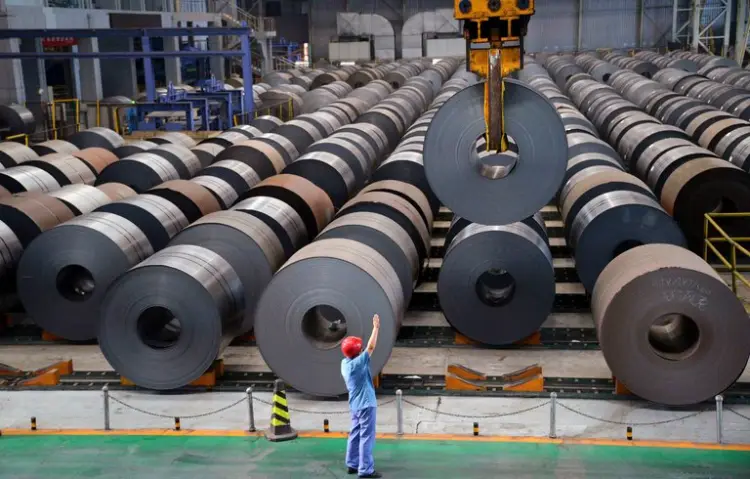
EN10025-6 S460Q Quenched & Tempered High-Strength Steel Coil
EN10025-6 S460Q Quenched & Tempered High-Strength Steel Coil - Data & Equivalents
In-depth material analysis of EN10025-6 S460Q low-alloy high-strength structural steel coil, featuring chemical composition, mechanical and thermal properties, global equivalents, and application guidance.
Welding, cutting, cold forming (limited), machining
- Phone : +8618037372205
- Email : [email protected]
- WhatsApp: Contact via Whtsapp
- WeChat: +8618037372205
EN10025-6 S460Q Quenched & Tempered High-Strength Steel Coil Introduction
S460Q is a low-alloy, high-strength structural steel defined in EN 10025-6, delivered in quenched and tempered condition. It guarantees a minimum yield strength of 460 MPa in thicknesses up to 50 mm, combined with excellent toughness at -20 °C (min. 27 J). This steel grade is widely used in welded structures subjected to high static and dynamic loads, such as mobile cranes, bridges, offshore platforms, and heavy machinery. Its fine-grain structure provides a good balance between strength, weldability, and brittle fracture resistance. The material is typically supplied as coils, plates, or wide flats and can be formed and welded using standard procedures when proper preheating and interpass temperatures are observed.
EN10025-6 S460Q Quenched & Tempered High-Strength Steel Coil Chemical Composition
The chemical composition of S460Q is carefully controlled to achieve the required mechanical properties after quenching and tempering. The table shows the maximum permissible values according to EN 10025-6. Low impurity levels (P, S) and addition of grain-refining elements (Al, Nb, V, Ti) ensure good toughness and weldability.
| Element | Standard Value (max %) | Remarks |
|---|---|---|
| C | 0.20 | ≤ |
| Si | 0.80 | ≤ |
| Mn | 1.70 | ≤ |
| P | 0.020 | ≤ |
| S | 0.010 | ≤ |
| Cr | 1.50 | ≤ |
| Ni | 2.0 | ≤ |
| Mo | 0.70 | ≤ |
| Cu | 0.50 | ≤, optional |
| V | 0.12 | ≤, optional grain refiner |
| Nb | 0.06 | ≤, optional grain refiner |
| Ti | 0.05 | ≤, optional grain refiner |
| Al (total) | 0.015 | ≤, minimum 0.015 if used for grain refining |
| N | 0.015 | ≤ |
| B | 0.005 | ≤, optional |
EN10025-6 S460Q Quenched & Tempered High-Strength Steel Coil Physical and Thermal Properties
The following physical and thermal properties are typical for S460Q low-alloy quenched and tempered steel at room temperature (unless otherwise specified). These values are not part of the delivery standard but are essential for design calculations involving thermal expansion, heat transfer, and electromagnetic compatibility.
| Property | Typical Value | Unit | Test Condition |
|---|---|---|---|
| Density (ρ) | 7850 | kg/m³ | at 20 °C |
| Modulus of elasticity (E) | 210 | GPa | at 20 °C |
| Shear modulus (G) | 81 | GPa | at 20 °C |
| Poisson's ratio (ν) | 0.3 | - | at 20 °C |
| Thermal expansion coefficient (α) | 11.1 × 10⁻⁶ | K⁻¹ | 20 – 100 °C |
| Thermal expansion coefficient (α) | 12.5 × 10⁻⁶ | K⁻¹ | 20 – 300 °C |
| Thermal conductivity (λ) | 50 | W/(m·K) | at 20 °C |
| Specific heat capacity (c) | 460 | J/(kg·K) | at 20 °C |
| Electrical resistivity (ρ_e) | 0.23 × 10⁻⁶ | Ω·m | at 20 °C |
EN10025-6 S460Q Quenched & Tempered High-Strength Steel Coil Mechanical Properties
The mechanical properties of S460Q are guaranteed for specified thickness ranges. The table lists the minimum yield strength (ReH), tensile strength (Rm), elongation (A), and Charpy impact energy (KV) according to EN 10025-6. The impact test temperature for the basic Q-grade is -20 °C. Bending test requirements depend on the thickness and application; typically, a mandrel diameter of 3.5×t is used for plates up to 50 mm.
| Property | Standard Value | Unit | Test Condition / Thickness |
|---|---|---|---|
| Yield strength (ReH) | 460 min | MPa | t ≤ 50 mm |
| Yield strength (ReH) | 440 min | MPa | 50 mm < t ≤ 100 mm |
| Yield strength (ReH) | 400 min | MPa | 100 mm < t ≤ 150 mm |
| Tensile strength (Rm) | 550 – 720 | MPa | t ≤ 100 mm |
| Tensile strength (Rm) | 500 – 670 | MPa | 100 mm < t ≤ 150 mm |
| Elongation after fracture (A) | 17 min | % | t ≤ 50 mm (gauge length L₀ = 5.65√S₀) |
| Elongation after fracture (A) | 16 min | % | 50 mm < t ≤ 100 mm |
| Elongation after fracture (A) | 15 min | % | 100 mm < t ≤ 150 mm |
| Charpy V-notch impact energy (KV) | 27 min | J | at -20 °C, longitudinal, t ≤ 150 mm |
| Bend test (mandrel diameter) | 3.5 × t (typical) | - | t ≤ 50 mm, 180° bending, no cracks |
EN10025-6 S460Q Quenched & Tempered High-Strength Steel Coil Complete Equivalents – Identical or Directly Adopted Standards
| Country / Region | Standard | Grade | Remarks |
|---|---|---|---|
| Europe (EU/EFTA) | EN 10025-6 | S460Q | Original standard |
| Germany | DIN EN 10025-6 | S460Q | Adopted EN standard |
| United Kingdom | BS EN 10025-6 | S460Q | Adopted EN standard |
| France | NF EN 10025-6 | S460Q | Adopted EN standard |
| Italy | UNI EN 10025-6 | S460Q | Adopted EN standard |
| Spain | UNE EN 10025-6 | S460Q | Adopted EN standard |
| International | ISO 4950-2 | E460 DD | Technically equivalent, quenched & tempered, -20 °C impact |
EN10025-6 S460Q Quenched & Tempered High-Strength Steel Coil Application Introduction
S460Q is engineered for highly stressed, welded constructions where weight reduction and high toughness are critical. It is suitable for both static and dynamic loading, and is frequently used in structural engineering, heavy transport, and offshore applications. Processing includes thermal cutting, welding (with low-hydrogen consumables and appropriate preheating), and limited cold forming. For optimal toughness, post-weld heat treatment should be avoided unless thoroughly qualified.
Product Applications: Welded bridge girders and box sections, Crane booms, lattice masts, and outriggers, Offshore platform legs, nodes, and helidecks, Excavator arms and buckets, Mining dump truck frames, High-load structural members in buildings, Penstocks and hydraulic steel structures
Processed into products: Welded plate girders, Box-section columns and beams, Crawler crane components (tracks, frames), Jack-up rig legs and spudcans, Heavy-duty gear rings (if forged from plate), Bearing piles and sheet piles, Large-diameter wind tower sections
Application industries: Construction and civil engineering, Heavy machinery and equipment manufacturing, Shipbuilding and offshore structures, Bridge building, Mining and earthmoving equipment, Mobile crane and lifting equipment, Pressure vessel and penstock fabrication
EN10025-6 S460Q Quenched & Tempered High-Strength Steel Coil Similar / Alternative Materials – Close in Strength and Application
| Country / Region | Standard | Grade | Remarks |
|---|---|---|---|
| China | GB/T 16270-2009 | Q460D (Q+T) | Yield strength 460 MPa, -20 °C impact ≥34 J, similar chemical concept. Delivery condition must be quenched and tempered to match S460Q exactly. |
| Japan | JIS G 3128 | SHY 685 (Q+T) | Higher strength grade (685 MPa). For 460 MPa, a customized JIS grade may be needed. Slightly different alloy balance. |
| USA | ASTM A514 / A514M | Grade E | Higher minimum yield (690 MPa), can be an alternative if design allows overmatching strength. Requires careful welding procedure. |
| USA | ASTM A709 / A709M | Grade HPS 50W or 70W | 50W yield 345 MPa, 70W yield 485 MPa. HPS 70W is closer but still not identical. Use after engineering assessment. |
| Russia | GOST 19281-2014 | 09G2S (quenched/tempered) | Yield ≥ 340–400 MPa, lower strength but similar weldability. A higher-strength variant may be needed. |
Notes:
Delivery conditions: S460Q is supplied in the quenched and tempered condition. The surface condition complies with EN 10163-2 class A or B. Weldability: Excellent when using low-hydrogen processes and consumables with a strength matching the base metal. Preheating and interpass temperatures depend on plate thickness and carbon equivalent (CEV typically ≤0.45). Corrosion resistance: Comparable to other carbon-manganese structural steels; atmospheric corrosion protection is required. Testing: Mechanical tests are performed on longitudinal specimens taken from the quarter-thickness location. Ultrasonic testing can be agreed upon at the time of order.
- Share



