
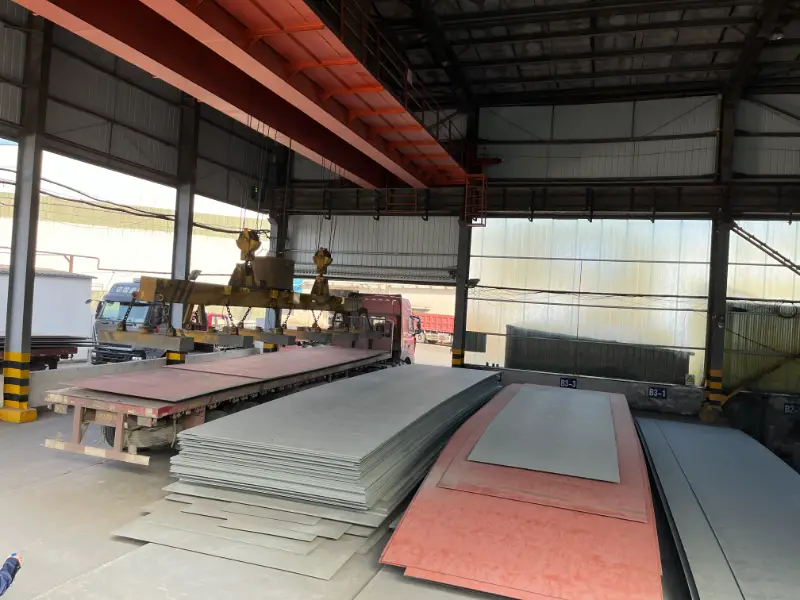
Alloy 800H (UNS N08810) Austenitic Stainless Steel Plate & Coil
Alloy 800H (UNS N08810) Austenitic Stainless Steel Plate & Coil - High-Temperature Strength & Oxidation Resistance
Comprehensive technical profile of Alloy 800H (UNS N08810) austenitic stainless steel plate/coil, featuring chemical composition, mechanical properties, thermal and electrical physical data, complete international equivalents, similar materials, and application guidance.
Hot rolling, cold rolling, solution annealing, welding, bending, machining, deep drawing
- Phone : +8618037372205
- Email : [email protected]
- WhatsApp: Contact via Whtsapp
- WeChat: +8618037372205
Alloy 800H Austenitic Stainless Steel Plate & Coil Introduction
Alloy 800H (UNS N08810) is a solid-solution strengthened, austenitic nickel-iron-chromium alloy with controlled carbon content (0.05–0.10%) and a balanced Al+Ti addition. It exhibits superior creep rupture strength and excellent resistance to oxidation, carburization, and sulfidation at elevated temperatures up to 1100°C (2000°F). In comparison to Alloy 800 (UNS N08800), the 800H grade ensures significantly higher stress-rupture properties through optimized solution annealing at approximately 1175°C (2150°F), resulting in a coarse grain structure (ASTM 5 or coarser). Typical applications include petrochemical furnace components, ethylene cracking tubes, power-generation superheaters, and heat-treating equipment. The alloy is readily formable and weldable, with stable austenitic microstructure preventing sigma phase embrittlement during service. Available in plate/coil form per ASTM B409.
Alloy 800H Austenitic Stainless Steel Plate & Coil Chemical Composition
The chemical composition conforms to ASTM B409 and ASME SB-409 for UNS N08810. The carbon content is strictly controlled within 0.05–0.10% to enhance high-temperature strength. Titanium and aluminum are co-added to ensure precipitation hardening capability, while residual elements like sulfur are minimized for optimal corrosion resistance.
| Element | Composition (%) | Remarks |
|---|---|---|
| Nickel (Ni) | 30.0 – 35.0 | Principal austenite stabilizer |
| Chromium (Cr) | 19.0 – 23.0 | Provides oxidation/carburization resistance |
| Iron (Fe) | ≥ 39.5 (balance) | Calculated as remainder |
| Carbon (C) | 0.05 – 0.10 | Controlled for high-temperature strength |
| Aluminum (Al) | 0.15 – 0.60 | Enhances oxidation resistance |
| Titanium (Ti) | 0.15 – 0.60 | Grain refinement and strength |
| Aluminum + Titanium (Al+Ti) | 0.30 – 1.20 | Essential for alloy stability |
| Manganese (Mn) | ≤ 1.50 | |
| Silicon (Si) | ≤ 1.00 | |
| Copper (Cu) | ≤ 0.75 | |
| Sulfur (S) | ≤ 0.015 | Low for weldability |
| Phosphorus (P) | ≤ 0.030 |
Alloy 800H Austenitic Stainless Steel Plate & Coil Thermal and Electrical Physical Properties
These properties are representative of solution-annealed Alloy 800H. Values are derived from ASME BPVC Section II Part D and published alloy datasheets. The low thermal expansion and stable physical properties make it suitable for cyclic thermal conditions.
| Property | Standard Value | Unit | Test Condition |
|---|---|---|---|
| Density (ρ) | 7.94 | g/cm³ | At 20°C |
| Melting Range | 1350 – 1400 | °C | Approximate solidus-liquidus |
| Specific Heat Capacity (cp) | 460 | J/(kg·K) | At 20°C |
| Thermal Conductivity (λ) | 11.5 | W/(m·K) | At 20°C |
| Thermal Conductivity (λ) | 13.4 | W/(m·K) | At 100°C |
| Thermal Conductivity (λ) | 19.5 | W/(m·K) | At 500°C |
| Thermal Expansion Coefficient (α) | 14.4 × 10⁻⁶ | K⁻¹ | 20–100°C |
| Thermal Expansion Coefficient (α) | 15.9 × 10⁻⁶ | K⁻¹ | 20–500°C |
| Thermal Expansion Coefficient (α) | 17.2 × 10⁻⁶ | K⁻¹ | 20–800°C |
| Electrical Resistivity (ρe) | 1.05 | µΩ·m | At 20°C |
| Elastic Modulus (E) | 196 | GPa | At 20°C, tension |
| Shear Modulus (G) | 75 | GPa | At 20°C |
| Poisson's Ratio (ν) | 0.31 | — | At 20°C |
Alloy 800H Austenitic Stainless Steel Plate & Coil Mechanical Properties at Room Temperature
The minimum mechanical properties specified in ASTM B409 for solution-annealed plate. The alloy achieves significant tensile strength and ductility; actual values depend on thickness and heat treatment. The coarse-grain structure of 800H (ASTM grain size 5 or coarser) is mandatory for annealed material to guarantee creep performance.
| Property | Standard Requirement | Unit | Test Condition |
|---|---|---|---|
| Yield Strength (Rp0.2) | ≥ 170 | MPa | Room temperature, plate ≤ 25 mm |
| Tensile Strength (Rm) | ≥ 450 | MPa | Room temperature, plate ≤ 25 mm |
| Elongation (A) | ≥ 30 | % | In 50 mm gauge length |
| Hardness (Brinell) | ≤ 179 | HBW | 3000 kgf load |
| Hardness (Rockwell B) | ≤ 86 | HRB | As annealed |
| Bend Test (transverse) | No cracks | — | 180° bend over diameter = 2T (T = plate thickness) |
| Grain Size | ASTM No. 5 or coarser | — | As per ASTM E112 |
Alloy 800H Austenitic Stainless Steel Plate & Coil Exact Equivalent Material Standards and Replaceable Grade Designations
| Country/Region | Standard | Grade | Remarks |
|---|---|---|---|
| Europe | EN 10095 | 1.4958 – X5NiCrAlTi31-20 | Identical chemistry and properties |
| Germany | DIN 17460 | X10NiCrAlTi32-20 (historical) | Closely equivalent, now superseded by EN 1.4958 |
| Japan | JIS G4902 | NCF 800H | Identical to UNS N08810 |
| China | GB/T 15014 | NS1102 (0Cr21Ni33AlTi) | UNS N08810 equivalent |
| International | ISO 9724 | FeNi30Cr21AlTi | UNS N08810 type alloy |
| USA | AMS 5871 | UNS N08810 | Aerospace plate specification |
Alloy 800H Austenitic Stainless Steel Plate & Coil Application Introduction
Alloy 800H is engineered for long-term service in high-temperature, corrosive environments. Its outstanding thermal stability and resistance to carburization, oxidation, and sulfidation make it a standard choice in chemical and petrochemical industries. The material is especially suited for applications requiring exposure to cyclic heating and cooling without embrittlement.
Product Applications: Furnace radiant tubes, muffles, and retorts, Ethylene cracking furnace tubes, Steam superheater and reheater tubing, Heat exchanger plates and tubesheets, Nuclear steam generator tubing, Pig tails and connectors in acid plants, High-temperature belt and mesh conveyor belts
Processed into products: Welded and seamless pipes and tubes, Custom-fabricated headers and manifolds, Plate heat exchanger channels, High-temperature fasteners (bolts, studs), Expansion bellows and compensators, Spinner discs and shaft sleeves in gas turbines, Hot gas filter components
Application industries: Petrochemical and refining (ethylene, steam reforming), Power generation (conventional and nuclear), Heat treatment (fixtures, baskets, radiant tubes), Chemical processing (nitric acid, chlorination), Automotive (exhaust system components, diesel glow plugs), Cement and lime kilns
Alloy 800H Austenitic Stainless Steel Plate & Coil Similar or Alternative Alloy Recommendations
| Country/Region | Standard | Grade | Remarks |
|---|---|---|---|
| USA | ASTM B409 | UNS N08800 (Alloy 800) | Lower carbon (≤0.10%, typically 0.05%) and may not guarantee coarse grain; lower creep strength but often interchangeable in low-stress high-temperature applications. |
| Europe | EN 10095 | 1.4876 – X10NiCrAlTi32-21 | Slightly higher nickel content; good alternative for oxidation resistance up to 1100°C, but different Al+Ti limits. |
| Japan | JIS G4902 | NCF 800 (UNS N08800) | Equivalent to Alloy 800, not 800H; requires careful evaluation for creep service. |
| Global | ASTM B409 | UNS N08811 (Alloy 800HT) | Similar to 800H but with additions of 0.6–1.2% Al+Ti, designed for higher temperature creep resistance; often a direct upgrade. |
| USA | ASME SB-167 | UNS N06600 (Inconel 600) | Higher nickel (≥72%), better corrosion resistance in some environments but lower strength at 600–900°C. |
Notes:
Welding: Alloy 800H is readily weldable using matching filler metal (ERNiCr-3, ERNiCrMo-3) or AWS A5.14 ERNiCr-3. Post-weld heat treatment is generally not required for service below 600°C, but solution annealing is recommended for critical creep applications to achieve grain coarsening and stress relief. Machining: Due to its nickel content, work hardening is moderate; use rigid setups, carbide tools, and adequate coolant. Stress rupture data: For design, consult ASME BPVC Section II Part D Tables 1B and U for allowable stresses up to 980°C. Environment limitations: Not recommended for concentrated molten caustic environments; for such conditions Alloy 600 is preferred.
- Share



