
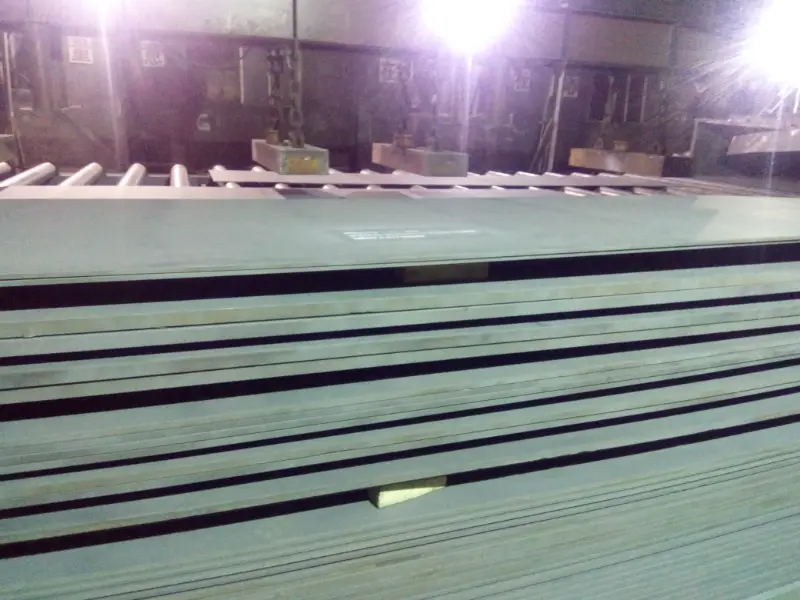
EN10025-4 S460ML High-Strength Thermo-Mechanical Steel
EN10025-4 S460ML High-Strength Thermo-Mechanical Steel - Properties, Equivalents & Application
Comprehensive material data for S460ML steel according to EN 10025-4: chemical composition, mechanical and physical properties, international equivalent standards, and application guide.
Thermomechanical rolling (TMCP). Subsequent processing: welding, bending, cutting, cold forming, drilling, and machining.
- Phone : +8618037372205
- Email : [email protected]
- WhatsApp: Contact via Whtsapp
- WeChat: +8618037372205
EN10025-4 S460ML High-Strength Thermo-Mechanical Steel Introduction
S460ML is a thermomechanically rolled fine-grain structural steel specified in EN 10025-4. It offers a minimum yield strength of 460 MPa and belongs to the high-strength low-alloy (HSLA) category. The 'M' indicates thermomechanical rolling (TMCP), while 'L' designates improved low-temperature toughness with guaranteed impact energy of 27 J at -50 °C (longitudinal).
- Excellent weldability due to low carbon equivalent (CEV)
- Superior toughness and cold-forming properties
- High strength-to-weight ratio enabling weight savings
Typical applications include steel structures, bridges, offshore platforms, and heavy machinery.
EN10025-4 S460ML High-Strength Thermo-Mechanical Steel Chemical Composition
The following table provides the maximum limits for alloying elements as per EN 10025-4:2019 for S460ML. The steel has a carefully controlled microalloying addition to achieve strength and toughness through grain refinement.
- Carbon equivalent (CEV) is limited to ensure weldability.
- Elements like Nb, V, and Ti are used to form fine precipitates.
- Low phosphorus and sulfur levels improve toughness and cleanliness.
| Element | Maximum Value (%) | Remarks |
|---|---|---|
| Carbon (C) | 0.16 | For thicknesses ≤ 40 mm; CEV limited |
| Silicon (Si) | 0.60 | |
| Manganese (Mn) | 1.70 | Higher Mn may be agreed |
| Phosphorus (P) | 0.030 | Strict control for toughness |
| Sulfur (S) | 0.025 | For improved formability |
| Niobium (Nb) | 0.05 | Grain refiner |
| Vanadium (V) | 0.12 | |
| Titanium (Ti) | 0.05 | |
| Aluminum (Al total) | ≥ 0.015 | Minimum for fine grain practice |
| Chromium (Cr) | 0.30 | |
| Nickel (Ni) | 0.80 | |
| Molybdenum (Mo) | 0.20 | |
| Copper (Cu) | 0.55 | |
| Nitrogen (N) | 0.015 | |
| Boron (B) | Not specified | Generally not added |
EN10025-4 S460ML High-Strength Thermo-Mechanical Steel Thermal and Electrical Physical Properties
The following physical properties are typical for microalloyed structural steels in the delivered condition. Actual values may vary slightly depending on composition and processing.
- Density is assumed constant for most engineering calculations.
- Thermal expansion and conductivity are important for welding and fire design.
- Electrical resistivity is useful for magnetic applications or electrical engineering.
| Property | Typical Value | Unit | Condition / Remarks |
|---|---|---|---|
| Density (ρ) | 7.85 | g/cm³ | At 20 °C |
| Modulus of Elasticity (E) | 210 | GPa | Tensile modulus, ambient temperature |
| Shear Modulus (G) | ≈ 81 | GPa | Calculated from E and Poisson's ratio |
| Poisson's Ratio (ν) | 0.3 | – | Elastic range |
| Thermal Expansion Coefficient (α) | 11.1 × 10⁻⁶ | K⁻¹ | Average value between 20 °C and 100 °C |
| Thermal Expansion Coefficient (α) | 12.5 × 10⁻⁶ | K⁻¹ | Between 20 °C and 200 °C |
| Thermal Expansion Coefficient (α) | 13.5 × 10⁻⁶ | K⁻¹ | Between 20 °C and 400 °C |
| Thermal Conductivity (λ) | 45 – 55 | W/(m·K) | At 20 °C; decreases with temperature |
| Specific Heat Capacity (cp) | 460 – 520 | J/(kg·K) | At 20–100 °C; increases with temperature |
| Electrical Resistivity (ρe) | 0.20 – 0.25 | μΩ·m | At 20 °C |
EN10025-4 S460ML High-Strength Thermo-Mechanical Steel Mechanical Properties
The mechanical properties are guaranteed in the as-delivered thermomechanically rolled condition for longitudinal test pieces unless otherwise noted. Yield strength is specified as upper yield strength (ReH) if a yield phenomenon occurs; otherwise 0.2% proof strength (Rp0.2) applies. Impact energy is tested on Charpy-V specimens.
- Elongation applies to a gauge length of 5.65√So (proportional test piece).
- Bend test is 180° and no cracks should appear.
| Property | Value | Unit | Test Condition |
|---|---|---|---|
| Yield Strength (ReH) | 460 (min) | MPa | Nominal thickness ≤ 16 mm |
| Yield Strength (ReH) | 440 (min) | MPa | Nominal thickness > 16 mm ≤ 40 mm |
| Yield Strength (ReH) | 430 (min) | MPa | Nominal thickness > 40 mm ≤ 63 mm |
| Yield Strength (ReH) | 410 (min) | MPa | Nominal thickness > 63 mm ≤ 80 mm |
| Yield Strength (ReH) | 400 (min) | MPa | Nominal thickness > 80 mm ≤ 100 mm |
| Tensile Strength (Rm) | 540 – 720 | MPa | Nominal thickness ≤ 40 mm |
| Tensile Strength (Rm) | 540 – 720 | MPa | Nominal thickness > 40 mm ≤ 63 mm |
| Tensile Strength (Rm) | 530 – 710 | MPa | Nominal thickness > 63 mm ≤ 100 mm |
| Elongation (A, Lo=5.65√So) | 17 (min) | % | Longitudinal, thickness ≤ 40 mm |
| Elongation (A, Lo=5.65√So) | 17 (min) | % | Longitudinal, thickness > 40 mm ≤ 63 mm |
| Elongation (A, Lo=5.65√So) | 17 (min) | % | Longitudinal, thickness > 63 mm ≤ 100 mm |
| Bend Test (180° bending, a=bend angle, d=madrel diameter, t=specimen thickness) | d = 3t (min) | Thickness ≤ 16 mm; no cracks | |
| Impact Energy (KV, Charpy V-notch) | 27 (min) / 16 (min) | J | Longitudinal/Transverse at -50 °C |
EN10025-4 S460ML High-Strength Thermo-Mechanical Steel Direct Equivalent Standards and Substitutable Grades
| Country/Region | Standard | Grade | Remarks |
|---|---|---|---|
| Europe | EN 10025-4 | S460ML | Original specification |
| International | ISO 4950-2 | E460 DD | Chemically similar, but must check impact temperature |
| Germany | DIN EN 10025-4 | S460ML | Adopts EN standard |
| United Kingdom | BS EN 10025-4 | S460ML | Adopts EN standard |
| France | NF EN 10025-4 | S460ML | Adopts EN standard |
| Italy | UNI EN 10025-4 | S460ML | Adopts EN standard |
| Spain | UNE EN 10025-4 | S460ML | Adopts EN standard |
| Sweden | SS EN 10025-4 | S460ML | Adopts EN standard |
| United States | ASTM A913/A913M | Grade 65 (450 MPa yield) | Comparable strength; impact temperature differs (tested at -18°C for Class 2) but can be ordered to meet -50°C if modified. Chemical composition differs slightly. |
| Japan | JIS G3106 | SM570 | High strength structural steel, 570 MPa tensile, -5°C impact typical, but low-temperature grade (SM570TMC) could be equivalent. |
EN10025-4 S460ML High-Strength Thermo-Mechanical Steel Application Introduction
S460ML is used where high strength, good weldability, and reliable low-temperature toughness are required. The thermomechanical rolling process delivers an excellent combination of properties, allowing designers to reduce section sizes and weight while maintaining structural integrity. Typical processing:
- Cold forming: suitable for bending and profiling within radius limits
- Welding: all conventional methods (SMAW, GMAW, FCAW, SAW) with low-hydrogen practices; CEV typically ≤0.45 ensures crack-resistant joints
- Hot-dip galvanizing: possible with proper design for venting
Product Applications: Welded I-beams and box girders, Trusses and space frames, Earth-moving and lifting equipment, Offshore platform legs and braces, Wind tower tubular and rolled sections, Crane booms and jibs, Mining dump truck bodies, Bridge deck plates, Storage containers and silos, Piling and sheet piles
Processed into products: Flanges and webs of plate girders, Boom and stick components for excavators, Tubular tower shells, Transition pieces in offshore wind foundations, Frames of heavy presses and injection molding machines, Support structures for conveyors, Brackets and stiffeners, End plates and splicing plates, Crane rail beams, Foundation anchors
Application industries: Civil engineering and construction, Bridge building, Offshore and marine engineering (jackets, topsides, decks), Renewable energy (wind turbine towers, foundations), Heavy machinery and mining equipment, Pressure vessel and storage tank fabrication, Shipbuilding (limited to non-marine classed applications), Automotive and transportation (heavy vehicles, trailers), Steel water gates and hydraulic structures
EN10025-4 S460ML High-Strength Thermo-Mechanical Steel Materials with Similar Properties
| Country/Region | Standard | Grade | Remarks | ||||||||||||||||||||
|---|---|---|---|---|---|---|---|---|---|---|---|---|---|---|---|---|---|---|---|---|---|---|---|
| United States | ASTM A572/A572M | Grade 65 | Yield strength 450 MPa; not normalized, impact generally not specified. Modified versions may approach S460ML. | Europe | EN 10025-6 | S460QL / S460QL1 | Quenched and tempered steel with 460 MPa yield; higher carbon equivalent and lower toughness than TMCP steel. | China | GB/T 1591 | Q460D | 460 MPa yield, -20°C impact 34J. Higher carbon and lower toughness; not TMCP. | International | ISO 4951-1 | S460M/ML | Same concept as EN but may have slight differences in thickness ranges. | Russia | GOST 19281 | 17G1S-U (improved) | Similar strength class, but chemical composition and impact properties differ. | India | IS 2062 | E450 BR / E450 C | Structural steel, 450 MPa yield; not TMCP. Impact properties vary. |
Notes:
Delivery conditions: S460ML is supplied in the thermomechanically rolled condition (+M). Upon agreement, the steel can be ordered with improved suitability for cold forming (e.g., tighter bend radii) or with special ultrasonic testing. Weldability: The maximum carbon equivalent value (CEV) must be calculated from the heat analysis according to the standard. CEV = C + Mn/6 + (Cr+Mo+V)/5 + (Ni+Cu)/15. For S460ML, CEV typically ≤ 0.41% for thicknesses up to 50 mm and ≤ 0.43% for thicker sections; this ensures good weldability without preheating under normal conditions. Corrosion resistance: As a carbon-manganese steel, S460ML requires protective coating (painting, galvanizing) in corrosive environments. Atmospheric corrosion resistance is similar to ordinary structural steel.
- Share



