
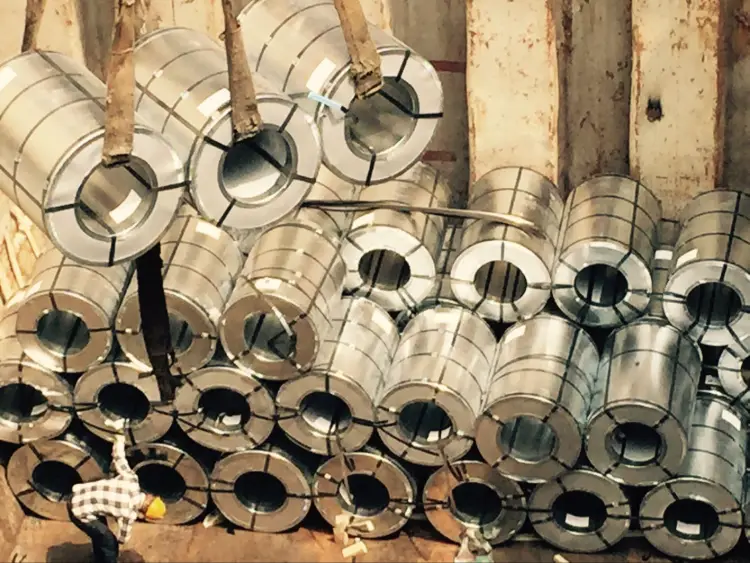
EN 10025-4 S460M Carbon and Low-alloy High-strength Steel Coil
EN 10025-4 S460M Carbon and Low-alloy High-strength Steel Coil - Expert Material Data Analysis
Comprehensive material data sheet for S460M steel according to EN 10025-4. Includes chemical composition, mechanical properties, thermal and electrical properties, international equivalents, and application guidance.
Thermomechanical rolling (M), normalizing rolling (+N) optional, hot forming, cold forming, welding, cutting, machining
- Phone : +8618037372205
- Email : [email protected]
- WhatsApp: Contact via Whtsapp
- WeChat: +8618037372205
EN 10025-4 S460M Carbon and Low-alloy High-strength Steel Coil Introduction
S460M is a high-strength structural steel grade according to EN 10025-4, produced by thermomechanical rolling. It features a minimum yield strength of 460 MPa and good weldability due to a low carbon equivalent.
- Excellent strength-to-weight ratio, enabling lightweight designs.
- Suited for heavy-duty structural applications in construction, bridges, and offshore engineering.
- Delivered in normalized or thermomechanically rolled condition; available as coils, plates, and sections.
- Typical thickness range up to 150 mm, with guaranteed impact toughness at -20 °C.
EN 10025-4 S460M Carbon and Low-alloy High-strength Steel Coil Chemical Composition
Maximum limits unless a range is indicated. The values are based on EN 10025-4:2019 for grade S460M. For product thicker than 30 mm, the carbon equivalent (CEV) shall not exceed 0.47% for ladle analysis. For thickness ≤ 30 mm, CEV ≤ 0.45%. Fine grain practice requires aluminium content and other grain-refining elements.
| Element | Standard Value (max, %) | Remarks |
|---|---|---|
| Carbon (C) | ≤ 0.16 | Deoxidized steel |
| Silicon (Si) | ≤ 0.60 | |
| Manganese (Mn) | ≤ 1.70 | For long products ≤ 1.80% |
| Phosphorus (P) | ≤ 0.030 | |
| Sulfur (S) | ≤ 0.025 | |
| Niobium (Nb) | ≤ 0.05 | Grain refinement |
| Vanadium (V) | ≤ 0.12 | Allowable for strength |
| Titanium (Ti) | ≤ 0.05 | Grain refinement |
| Aluminium (Al total) | ≥ 0.015 | Fine grain practice |
| Nitrogen (N) | ≤ 0.025 | |
| Copper (Cu) | ≤ 0.55 | Residual element |
| Molybdenum (Mo) | ≤ 0.20 | |
| Chromium (Cr) | ≤ 0.30 | Residual element |
| Nickel (Ni) | ≤ 0.80 | Residual element |
EN 10025-4 S460M Carbon and Low-alloy High-strength Steel Coil Thermal and Electrical Physical Properties
Physical properties at room temperature unless noted. These are typical for structural carbon-manganese steels and not guaranteed by EN 10025-4. Density, modulus of elasticity, thermal conductivity and specific heat capacity may slightly vary with temperature and composition.
| Property | Approximate Value | Unit | Condition |
|---|---|---|---|
| Density (ρ) | 7850 | kg/m³ | 20 °C |
| Modulus of elasticity (E) | 210 | GPa | 20 °C |
| Shear modulus (G) | 81 | GPa | 20 °C |
| Poisson's ratio (ν) | 0.3 | – | 20 °C |
| Thermal expansion coefficient (α) | 12.0 × 10⁻⁶ | K⁻¹ | 20–100 °C |
| Thermal expansion coefficient (α) | 12.7 × 10⁻⁶ | K⁻¹ | 20–200 °C |
| Thermal expansion coefficient (α) | 13.5 × 10⁻⁶ | K⁻¹ | 20–400 °C |
| Thermal conductivity (λ) | 50 | W/(m·K) | 20 °C |
| Thermal conductivity (λ) | 45 | W/(m·K) | 200 °C |
| Specific heat capacity (cₚ) | 460 | J/(kg·K) | 20 °C |
| Electrical resistivity (ρ_e) | 0.23 | µΩ·m | 20 °C |
EN 10025-4 S460M Carbon and Low-alloy High-strength Steel Coil Mechanical Properties
Mechanical properties according to EN 10025-4 at ambient temperature. Yield strength, tensile strength and elongation are guaranteed for longitudinal test pieces. Impact energy tested on Charpy-V specimens (KV2) at -20 °C. Bend test performed with given mandrel diameters for nominal thickness up to 150 mm.
| Property | Standard Requirement | Unit | Test Condition / Thickness |
|---|---|---|---|
| Yield strength (ReH) | ≥ 460 | MPa | Nominal thickness ≤ 16 mm |
| Yield strength (ReH) | ≥ 440 | MPa | 16 < thickness ≤ 40 mm |
| Yield strength (ReH) | ≥ 430 | MPa | 40 < thickness ≤ 63 mm |
| Yield strength (ReH) | ≥ 410 | MPa | 63 < thickness ≤ 80 mm |
| Yield strength (ReH) | ≥ 400 | MPa | 80 < thickness ≤ 100 mm |
| Yield strength (ReH) | ≥ 380 | MPa | 100 < thickness ≤ 150 mm |
| Tensile strength (Rm) | 540 - 720 | MPa | All thicknesses (≤150 mm) |
| Elongation (A5) | ≥ 17 | % | Longitudinal, proportional test piece, L0 = 5.65√S0, thickness ≤ 150 mm |
| Elongation (A80) | ≥ 15 | % | For thickness ≤ 3 mm (alternative) |
| Impact energy (KV2) | ≥ 27 | J | -20 °C, longitudinal, Charpy-V |
| Bend test (bend angle 180°) | mandrel diameter 0.5 a | – | Thickness ≤ 16 mm, a = specimen thickness |
| Bend test (bend angle 180°) | mandrel diameter 1.0 a | – | 16 < thickness ≤ 100 mm |
| Bend test (bend angle 180°) | mandrel diameter 2.0 a | – | 100 < thickness ≤ 150 mm |
EN 10025-4 S460M Carbon and Low-alloy High-strength Steel Coil Fully Equivalent Material Standards and Substitutable Grades
| Country/Region | Standard / Specification | Grade | Remarks |
|---|---|---|---|
| European Union | EN 10025-4:2019 | S460M | Original specification, thermomechanical rolled |
| Germany | DIN EN 10025-4 | S460M | Adopted as national standard |
| United Kingdom | BS EN 10025-4 | S460M | Identical to EN 10025-4 |
| France | NF EN 10025-4 | S460M | Identical to EN 10025-4 |
| Italy | UNI EN 10025-4 | S460M | Identical to EN 10025-4 |
| Japan | JIS G 3106 (as relevant) | SM490YA (modified) | Not identical; SM490YA has lower min YS (365 MPa). Chemical composition may be adjusted. |
| International | ISO 4950-2 | E460DD | Similar yield level; deoxidation method may differ. Check CEV. |
EN 10025-4 S460M Carbon and Low-alloy High-strength Steel Coil Application Introduction
S460M is predominantly used in welded steel structures where a high strength-to-weight ratio is crucial. Its excellent toughness at low temperatures allows for reliable performance in cold climates. Typical applications range from heavy building frameworks to dynamic crane structures.
Product Applications: Welded plate girders and box girders for bridges, Heavy structural columns and beams in high-rise buildings, Lattice towers and wind turbine towers, Crane booms and jib sections, Offshore platform decks and legs, Pressure vessel shells (when toughness requirements are met), Chassis frames for heavy-duty vehicles, High-strength tubular structures
Processed into products: Bridge main girders and diaphragms, Column base plates and stiffeners, Welded box sections for crane Runways, Lifting lugs and heavy shackles, Excavator arms and buckets, Ship deck hatches and hatch coamings, Flanges for wind turbine towers, Load-bearing nodes in space frames
Application industries: Civil engineering and construction, Bridge building, Offshore and marine engineering, Heavy machinery and crane manufacturing, Wind energy (tower structures), Shipbuilding (limited applications), Mining and earthmoving equipment, Railway vehicle construction
EN 10025-4 S460M Carbon and Low-alloy High-strength Steel Coil Similar / Comparable Material Recommendations
| Country/Region | Standard | Grade | Comments |
|---|---|---|---|
| USA | ASTM A572/A572M | Grade 65 | Min YS 450 MPa (65 ksi), min TS 550 MPa. Lacks -20 °C impact guarantee, but comparable strength. |
| USA | ASTM A913/A913M | Grade 65 | High-strength low-alloy structural steel, min YS 450 MPa, impact tested depending on grade. Typically delivered as Q&T, but similar structural use. |
| China | GB/T 1591-2018 | Q460D | Min YS 460 MPa, -20 °C impact. However, Q460D is not necessarily TMCP delivered; it may be normalized or quenched+tempered. Chemical composition slightly different. |
| China | GB/T 19879-2015 | Q460GJD | For building structures, min YS 460 MPa, -20 °C impact. Matches S460M in many respects. |
| Japan | JIS G 3136 | SN490B | Min YS 325-325 MPa (for plate <16 mm 325 MPa), lower strength but similar weldability and toughness. For stronger equivalent, SN490C (355 MPa) still lower than S460M. |
| Russia | GOST 19281-2014 | C390 (S390) | Min YS 390 MPa, lower strength. No direct 460 MPa TMCP equivalent in common GOST grades. |
Notes:
- For welding, preheating may be required depending on thickness and heat input. Use low-hydrogen processes and consumables to avoid cold cracking.
- CEV is controlled for weldability: ≤ 0.45% for thickness ≤ 30 mm, ≤ 0.47% for 30-150 mm.
- Available surface conditions: as-rolled (no treatment), blast-cleaned, or shop-primed. Dimensional tolerances according to EN 10029 (plates) and EN 10051 (strip/coil).
- Third-party inspection certificates (EN 10204 type 3.1 or 3.2) are usually provided.
- Share



