
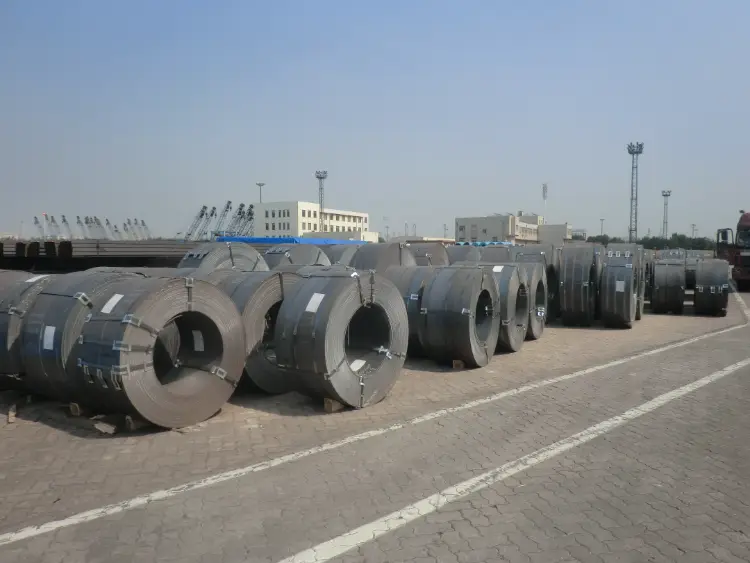
EN 10025-3 S460N Steel Coil
S460N Steel Coil: EN 10025-3 Normalized High-Strength Fine Grain Structural Steel for Heavy Engineering
Comprehensive technical data for EN 10025-3 S460N carbon and low-alloy high-strength steel coil, including chemical composition, mechanical properties, thermal/physical characteristics, equivalent grades, and application guidance for structural engineering.
Hot rolling, normalizing, cold forming, welding, flame cutting, machining
- Phone : +8618037372205
- Email : [email protected]
- WhatsApp: Contact via Whtsapp
- WeChat: +8618037372205
EN 10025-3 S460N Steel Coil Introduction
S460N is a weldable fine grain structural steel delivered in the normalized or normalized rolled condition, specified in EN 10025-3. It offers a minimum yield strength of 460 MPa for thicknesses up to 16 mm, combined with excellent toughness at low temperatures (Charpy impact energy ≥27 J at -20°C) and good weldability. The fine grain structure, achieved through microalloying with elements such as niobium, vanadium, and titanium, ensures consistent mechanical properties across a wide thickness range. This steel is predominantly used in heavy structural applications, including bridges, offshore platforms, cranes, and pressure vessels, where high strength, reliable notch toughness, and fabrication flexibility are required. The normalized condition guarantees uniform mechanical characteristics and enhanced resistance to brittle fracture, making S460N a preferred choice for safety-critical structures subject to dynamic loads and low ambient temperatures. Available forms include coils, plates, sections, and bars.
EN 10025-3 S460N Steel Coil Chemical Composition
The chemical composition limits for S460N according to EN 10025-3:2019 are designed to achieve fine grain structure, high strength, and good weldability. Maximum values are specified unless a range is given. The microalloying elements (Nb, V, Ti) are added singly or in combination to control grain size. The carbon equivalent (CEV) is typically limited to ensure adequate weldability, often ≤0.45 for thicknesses up to 100 mm.
| Element | Standard Value (max unless range given) | Remarks |
|---|---|---|
| Carbon (C) | ≤0.20 | For thickness ≤100 mm; may be adjusted for thicker products. |
| Silicon (Si) | ≤0.60 | Typical deoxidation element. |
| Manganese (Mn) | 1.00 – 1.70 | Contributes to strength and toughness. |
| Phosphorus (P) | ≤0.030 | Residual element; lower levels improve toughness. |
| Sulfur (S) | ≤0.025 | Controls inclusion shape. |
| Niobium (Nb) | ≤0.05 | Grain refiner; microalloying element. |
| Vanadium (V) | ≤0.20 | Precipitation strengthener. |
| Aluminium (Al total) | ≥0.020 | Minimum for fine grain practice. |
| Titanium (Ti) | ≤0.05 | Optional grain refiner. |
| Chromium (Cr) | ≤0.30 | Residual; contributes to hardenability. |
| Nickel (Ni) | ≤0.80 | Improves toughness; residual. |
| Molybdenum (Mo) | ≤0.10 | Residual; enhances hardenability. |
| Copper (Cu) | ≤0.55 | Residual; may be limited for certain services. |
| Nitrogen (N) | ≤0.015 | Bound by aluminium or titanium. |
EN 10025-3 S460N Steel Coil Thermal and Electrical Physical Properties
The following physical properties are typical for S460N type low-alloy structural steels at room temperature. These values are not part of the product standard but serve as engineering references for design calculations, heat treatment, and thermal analysis. Slight variations may occur depending on the exact composition and manufacturing route.
| Property | Typical Value | Unit | Conditions |
|---|---|---|---|
| Density (ρ) | 7.85 | g/cm³ | At 20°C |
| Modulus of elasticity (E) | 210 | GPa | At 20°C |
| Shear modulus (G) | 81 | GPa | At 20°C, approximated from E and ν |
| Poisson's ratio (ν) | 0.3 | – | At 20°C |
| Thermal expansion coefficient (α) | 12 | 10⁻⁶/K | 20°C to 100°C |
| Thermal conductivity (λ) | 50 | W/(m·K) | At 20°C |
| Specific heat capacity (cp) | 460 | J/(kg·K) | At 20°C |
| Electrical resistivity (ρe) | 0.20 | μΩ·m | At 20°C |
EN 10025-3 S460N Steel Coil Mechanical Properties
The mechanical properties of S460N are specified in EN 10025-3:2019 for the normalized delivery condition. Values depend on the product thickness and test direction (longitudinal or transverse). The minimum yield strength and tensile strength are guaranteed, along with elongation and impact energy at -20°C. The Charpy V-notch impact test ensures adequate notch toughness for structural applications in low-temperature environments. Properties stated below are for flat products tested in the longitudinal direction unless otherwise noted.
| Property | Standard Requirement | Unit | Test Condition / Thickness Range |
|---|---|---|---|
| Yield strength (ReH) | 460 min | MPa | t ≤ 16 mm |
| Yield strength (ReH) | 440 min | MPa | 16 mm < t ≤ 40 mm |
| Yield strength (ReH) | 430 min | MPa | 40 mm < t ≤ 63 mm |
| Yield strength (ReH) | 410 min | MPa | 63 mm < t ≤ 80 mm |
| Yield strength (ReH) | 400 min | MPa | 80 mm < t ≤ 100 mm |
| Yield strength (ReH) | 380 min | MPa | 100 mm < t ≤ 150 mm |
| Yield strength (ReH) | 370 min | MPa | 150 mm < t ≤ 200 mm |
| Tensile strength (Rm) | 540 – 720 | MPa | t ≤ 100 mm |
| Tensile strength (Rm) | 520 – 700 | MPa | 100 mm < t ≤ 150 mm |
| Tensile strength (Rm) | 500 – 680 | MPa | 150 mm < t ≤ 200 mm |
| Elongation (A, Lo=5.65√So) | 17 min | % | t ≤ 100 mm, longitudinal |
| Elongation (A, Lo=5.65√So) | 17 min | % | t > 100 mm, longitudinal |
| Charpy V-notch impact energy (KV) | 27 min | J | At -20°C, longitudinal |
EN 10025-3 S460N Steel Coil Completely Equivalent Material Standards and Substitutable Grades
The following standards define the identical grade S460N with the same technical delivery conditions as EN 10025-3. These are considered direct equivalents and are interchangeable without further qualification. The grade designation and the normalized (+N) condition remain consistent across these national adoptions.
| Country/Region | Standard | Grade | Remarks |
|---|---|---|---|
| Europe | EN 10025-3:2019 | S460N | Original European standard. |
| International (ISO) | ISO 630-3:2012 | S460N | Equivalent fine grain structural steel. |
| United Kingdom | BS EN 10025-3:2019 | S460N | British adoption of EN standard. |
| Germany | DIN EN 10025-3 | S460N | German edition identical to EN. |
| France | NF EN 10025-3 | S460N | French adoption. |
| Italy | UNI EN 10025-3 | S460N | Italian adoption. |
EN 10025-3 S460N Steel Coil Application Introduction
S460N steel is engineered for demanding structural applications where high load-bearing capacity, weldability, and low-temperature toughness are essential. Its normalized fine grain microstructure ensures consistent performance and facilitates fabrication. Typical uses span across civil engineering, heavy machinery, and offshore structures. The material is amenable to all common welding techniques (SMAW, GMAW, SAW) with appropriate preheating and consumables matching the strength and toughness requirements. The following are representative industries, end products, and specific components.
Product Applications: Welded steel bridges (box girders, truss members), Offshore platform topsides and jackets, Telescopic crane booms and lattice masts, Heavy-duty industrial frames and press columns, Shipbuilding stiffeners and hull plates (non-marine grade applications), Wind turbine towers and transition pieces, Mining dump truck chassis and booms
Processed into products: Main bridge girders and cross-beams, Flanges and webs of heavy welded sections, Column base plates and anchor boxes, Brake press bent structural brackets, Welded tubular structures for offshore, Bolted and welded connections, Machined bearing plates and cleats
Application industries: Bridge construction, Offshore and marine engineering, Heavy machinery and crane manufacturing, Building and civil engineering (high-rise, stadiums), Pressure vessel and boiler fabrication (non-pressure parts or secondary structures), Mining and earthmoving equipment, Renewable energy (wind turbine towers, substructures)
EN 10025-3 S460N Steel Coil Similar and Alternative Material Recommendations
The materials listed below are closely related in strength level and toughness requirements but may have different delivery conditions, chemical compositions, or testing regimes. They can serve as potential substitutes after careful evaluation of the specific project requirements and relevant standards. Full equivalency should be confirmed by the design engineer.
| Country/Region | Standard | Grade | Remarks |
|---|---|---|---|
| China | GB/T 1591-2018 | Q460D | High-strength low-alloy structural steel; impact at -20°C; normalization optional but often supplied in normalized condition. Slight differences in alloy limits. |
| USA | ASTM A572/A572M-21 | Grade 65 (Type 3 or normalized) | Yield strength 450 MPa (65 ksi); not always normalized; chemistry differs. Tougher variants may be ordered with supplementary requirements. |
| USA | ASTM A709/A709M-21 | Grade 50W (normalized optional) | Similar strength level for bridge construction; weathering steel option. |
| Japan | JIS G3106:2015 | SM570 | High-strength structural steel with tensile strength 570-720 MPa; controlled rolled or normalized. Impact energy specified at 0°C or -5°C, not at -20°C by default. |
| India | IS 2062:2011 | E450 (Fe 570) | High yield strength structural steel; normalized or controlled rolled; impact at -20°C available in D quality. |
Notes:
S460N steel exhibits good cold formability in the normalized condition, with a minimum internal bend radius typically 3t for thicknesses up to 12 mm and increasing for thicker materials. For hot forming, the normalizing temperature should be respected to preserve the fine grain structure. Welding consumables should be chosen to match the tensile strength and toughness requirements; low hydrogen processes are recommended to avoid cold cracking, with preheating suggested when the plate thickness exceeds 30 mm or when the carbon equivalent exceeds 0.43. Post-weld heat treatment is generally not required but may be applied at temperatures not exceeding 600°C without compromising the properties. The material is not intended for sour service or low-temperature service below -20°C without additional testing. When ordering, the purchaser should specify the required impact test temperature and Charpy energy absorption if different from the standard -20°C / 27 J.
- Share



