
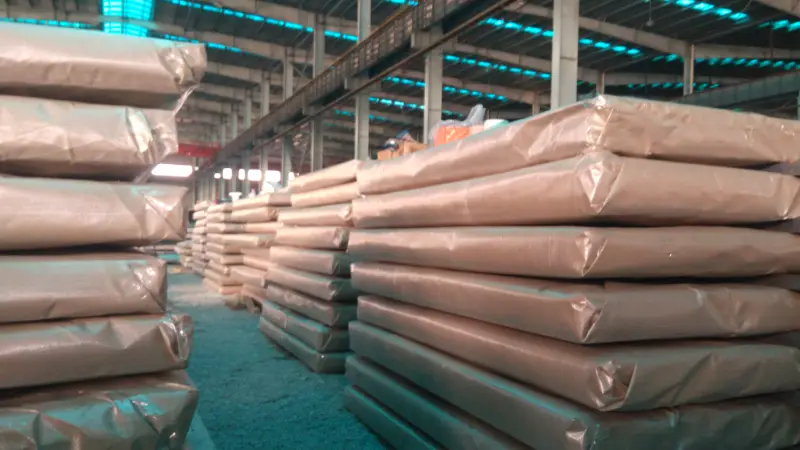
EN10025-3 S460NL
EN10025-3 S460NL: Low-Alloy High-Strength Steel with Outstanding Low-Temperature Toughness
Explore the properties, chemical composition, and applications of S460NL, a normalized fine-grain structural steel with minimum yield strength of 460 MPa and guaranteed impact energy at -50°C.
Hot rolling, normalizing rolling, normalizing, welding, bending, flanging, cutting
- Phone : +8618037372205
- Email : [email protected]
- WhatsApp: Contact via Whtsapp
- WeChat: +8618037372205
EN10025-3 S460NL Introduction
S460NL is a thermomechanically rolled or normalized fine-grain structural steel defined in EN 10025-3. It belongs to the family of carbon and low-alloy high-strength steels with a specified minimum yield strength of 460 MPa. The designation 'N' indicates that the steel is supplied in the normalized or normalized rolled condition, while 'L' denotes guaranteed low-temperature impact properties down to -50 °C (longitudinal Charpy V-notch energy ≥ 27 J). This grade combines high strength with excellent weldability, good formability, and superior toughness, making it suitable for heavy-duty welded structures exposed to low ambient temperatures. Typical applications include bridges, offshore structures, pressure vessels, and mobile machinery.
EN10025-3 S460NL Chemical Composition
The chemical composition of S460NL is designed to achieve high strength and excellent low-temperature toughness through controlled microalloying. Carbon is kept low for good weldability. Manganese provides solid-solution strengthening, while niobium, vanadium, and titanium contribute to grain refinement and precipitation hardening. Strict limits on phosphorus and sulfur ensure high cleanliness and ductility. The carbon equivalent value (CEV) is typically limited to ensure weldability. Values below are maximum unless a range is shown.
| Element | Standard Value (max, wt.%) | Remarks |
|---|---|---|
| Carbon (C) | ≤0.20 | Ladle analysis; product analysis ≤0.22 |
| Silicon (Si) | ≤0.60 | Product analysis ≤0.65 |
| Manganese (Mn) | 1.00 – 1.70 | Product analysis 0.90 – 1.80 |
| Phosphorus (P) | ≤0.025 | Product analysis ≤0.030 |
| Sulfur (S) | ≤0.015 | Product analysis ≤0.017 |
| Niobium (Nb) | ≤0.05 | Also known as columbium |
| Vanadium (V) | ≤0.12 | May be added singly or in combination |
| Aluminum (Al, total) | ≥0.015 | Minimum soluble aluminum for grain refinement |
| Titanium (Ti) | ≤0.05 | Optional microalloying element |
| Chromium (Cr) | ≤0.30 | Product analysis ≤0.33 |
| Nickel (Ni) | ≤0.80 | Product analysis ≤0.85 |
| Molybdenum (Mo) | ≤0.10 | Product analysis ≤0.13 |
| Copper (Cu) | ≤0.55 | Product analysis ≤0.60 |
| Nitrogen (N) | ≤0.015 | Higher nitrogen may be allowed if sufficient titanium is present |
| CEV (max) | Typically ≤0.43 – 0.45 | Depending on thickness; calculated as C+Mn/6+(Cr+Mo+V)/5+(Ni+Cu)/15 |
EN10025-3 S460NL Thermal and Electrical Physical Properties
The physical properties given below are typical for normalized low-alloy structural steels like S460NL at room temperature unless otherwise stated. These values can vary slightly with heat treatment and composition. They are useful for design calculations involving heat transfer, thermal expansion, and electrical conductivity.
| Property | Typical Value | Unit | Test Conditions / Remarks |
|---|---|---|---|
| Density (ρ) | 7.85 | g/cm³ | At 20 °C |
| Elastic modulus (E) | ~210 | GPa | At 20 °C; dynamic modulus may be slightly higher |
| Shear modulus (G) | ~81 | GPa | Calculated from E and Poisson's ratio |
| Poisson's ratio (ν) | 0.3 | - | Within elastic range |
| Thermal expansion coefficient (α) | 11.1 x 10⁻⁶ | K⁻¹ | Between 20 – 100 °C |
| Thermal expansion coefficient (α) | 11.9 x 10⁻⁶ | K⁻¹ | Between 20 – 200 °C |
| Thermal expansion coefficient (α) | 12.5 x 10⁻⁶ | K⁻¹ | Between 20 – 300 °C |
| Thermal expansion coefficient (α) | 13.0 x 10⁻⁶ | K⁻¹ | Between 20 – 400 °C |
| Thermal conductivity (λ) | 48 – 52 | W/(m·K) | At 20 °C; decreases with increasing temperature |
| Specific heat capacity (cₚ) | ~460 | J/(kg·K) | At 20 °C; increases with temperature |
| Electrical resistivity (ρₑ) | 0.22 – 0.25 | μΩ·m | At 20 °C |
EN10025-3 S460NL Mechanical Properties
The mechanical properties of S460NL are determined on test pieces taken in the transverse direction (tensile) and longitudinal direction (impact) unless otherwise agreed. The steel exhibits a minimum yield strength of 460 MPa for thicknesses up to 16 mm, with progressive reduction for thicker sections. High elongation values ensure good formability. Charpy V-notch impact energy is guaranteed at -50 °C, making it suitable for severe low-temperature service.
| Property | Standard Requirement | Unit | Test Conditions / Remarks |
|---|---|---|---|
| Yield strength (ReH, min) | 460 | MPa | Nominal thickness ≤16 mm |
| Yield strength (ReH, min) | 440 | MPa | 16 mm < t ≤ 40 mm |
| Yield strength (ReH, min) | 430 | MPa | 40 mm < t ≤ 63 mm |
| Yield strength (ReH, min) | 410 | MPa | 63 mm < t ≤ 80 mm |
| Yield strength (ReH, min) | 390 | MPa | 80 mm < t ≤ 100 mm |
| Yield strength (ReH, min) | 380 | MPa | 100 mm < t ≤ 150 mm |
| Tensile strength (Rm) | 540 – 720 | MPa | t ≤ 100 mm |
| Tensile strength (Rm) | 530 – 710 | MPa | 100 mm < t ≤ 150 mm |
| Elongation (A, min) | 17 | % | Gauge length 5.65√S₀, t ≤ 100 mm; transverse |
| Elongation (A, min) | 16 | % | 100 mm < t ≤ 150 mm |
| Bend test (mandrel diameter) | 3t (t ≤ 16 mm) | - | Bending angle 180�°; transverse test piece |
| Bend test (mandrel diameter) | 4t (16 mm < t ≤ 100 mm) | - | Bending angle 180° |
| Charpy V-notch impact (KV₂, min) | 27 | J | Longitudinal, at -50 °C; t ≤ 150 mm |
| Charpy V-notch impact (KV₂, min) | 40 | J | Average of three specimens; t ≤ 150 mm, optional higher requirement |
EN10025-3 S460NL Exact Equivalent Material Standards and Substitutable Grades
| Country/Region | Standard | Grade | Remarks |
|---|---|---|---|
| European Union | EN 10025-3 | S460NL | Original specification; normalized delivery with low-temperature toughness at -50 °C |
| International | ISO 630-3 | S460NL | Adopted from European standard; identical technical requirements |
| United Kingdom | BS EN 10025-3 | S460NL | Formerly BS 4360 Grade 50F (with limited equivalence) |
| Germany | DIN EN 10025-3 | S460NL | Replaces obsolete DIN 17102 StE 460 TM (close but not identical) |
| France | NF EN 10025-3 | S460NL | Identical to European standard |
| Italy | UNI EN 10025-3 | S460NL | Identical to European standard |
| Spain | UNE EN 10025-3 | S460NL | Identical to European standard |
EN10025-3 S460NL Application Introduction
S460NL is widely used in heavy structural applications where a combination of high strength, good weldability, and guaranteed low-temperature toughness is essential. Its normalized condition provides uniform mechanical properties and excellent resistance against brittle fracture. The steel is suitable for welded structures subjected to dynamic loads and severe environmental conditions.
Product Applications: Welded plate girders and box columns, Heavy-duty crane booms and lifting devices, Offshore platform decks and jackets, Steel bridge decks and trusses, Pressure vessel shells and heads, Welded pipes and hollow sections for structural use, Bull-dozer blades and excavator buckets
Processed into products: Welded bridge torsion boxes, Flanges and webs of heavy welded beams, Boom sections for mobile cranes, Offshore node cans and stiffeners, Wind turbine tower flanges and door frames, Storage tank bottom plates, Ship longitudinal and transverse frames
Application industries: Civil engineering and infrastructure, Bridge construction (road and railway bridges), Offshore and marine engineering (platforms, wind turbine foundations), Pressure vessel and storage tank fabrication, Heavy machinery and mining equipment, Shipbuilding (hulls and structural components for ice-class vessels), Building and construction (high-rise frames, long-span roofs), Renewable energy (wind towers, hydroelectric penstocks)
EN10025-3 S460NL Similar/Comparable Substitute Material Recommendations
| Country/Region | Standard | Grade | Remarks |
|---|---|---|---|
| USA | ASTM A572/A572M | Grade 65 (Type 7 with -50 °F toughness) | Yield strength 450 MPa (65 ksi); requires supplementary low-temperature requirements to approach S460NL toughness. |
| USA | ASTM A633/A633M | Grade E | Normalized high-strength low-alloy steel; minimum yield 380–415 MPa; Charpy at -50 °F; slightly lower strength. |
| China | GB/T 1591 | Q460NE / Q460NL | Q460NE requires -40 °C impact; for -50 °C a special agreement (Q460NL is not standard but can be negotiated). |
| Japan | JIS G3106 | SM570TMC | Thermo-mechanical controlled rolled; yield 420–460 MPa; impact -5 to -50 °C by agreement. |
| Japan | JIS G3106 | SM570 (normalized) | Normalized condition; minimum yield ~450 MPa; low-temperature grade needs supplementary specification. |
| Russia | GOST 19281 | 10G2S1D | Approximate equivalent; yield ≥ 420 MPa; Charpy -40 to -70 °C depending on category. |
| India | IS 2062 | E460 C | High strength structural steel; yield 460 MPa; Charpy at -20 to -40 °C; not exactly -50 °C. |
Notes:
S460NL is typically supplied in the normalized or normalized rolled condition (+N). For thicknesses above 100 mm, special agreement may be required for impact properties. Preheating before welding is generally not necessary for moderate thicknesses and low hydrogen processes, but recommendations depend on CEV and joint restraint. Post-weld heat treatment is usually not required. The steel can be hot-dip galvanized without liquid metal embrittlement risk. Ordering should specify EN 10025-3, grade S460NL, and if any additional testing (ultrasonic, Z-direction tensile) is needed. The steel fulfills requirements for CE marking under Construction Products Regulation (EU) No. 305/2011.
- Share



