
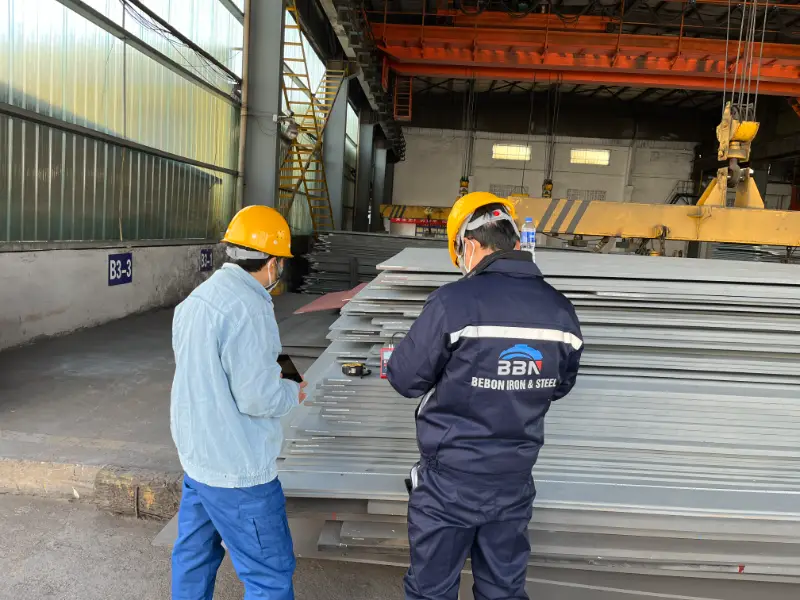
EN10084 20MnCr5 Case-Hardening Steel
EN10084 20MnCr5 Case-Hardening Steel - Automotive Gears, Shafts & Mechanical Components
Detailed material data for 20MnCr5 according to EN10084: chemical composition, mechanical properties, thermal and electrical properties, equivalent grades, and application guide for automotive and mechanical engineering.
Hot rolling, forging, cold drawing, peeling, grinding, carburizing, quenching, tempering
- Phone : +8618037372205
- Email : [email protected]
- WhatsApp: Contact via Whtsapp
- WeChat: +8618037372205
EN10084 20MnCr5 Case-Hardening Steel Introduction
20MnCr5 is a low-alloy case-hardening steel specified in EN 10084. It is characterized by a carbon content of approximately 0.17–0.22% and a chromium content of 1.00–1.30%, providing an optimal balance between core toughness and surface hardness after carburizing. The manganese content (1.10–1.40%) improves hardenability. This grade is widely used in the automotive and mechanical engineering industries for components requiring high wear resistance on the surface and good fatigue strength in the core, such as gears, shafts, and pinions. It is typically supplied in the annealed or rolled condition, and final heat treatment (carburizing, quenching, and tempering) is performed by the manufacturer of the finished parts.
EN10084 20MnCr5 Case-Hardening Steel Chemical Composition
Chemical composition according to EN 10084:2008 for 20MnCr5. All values are in weight percent. The steel exhibits strict limits on phosphorus and sulfur to enhance ductility and fatigue life. Chromium and manganese enhance hardenability for effective case hardening.
| Element | Standard Value | Remarks |
|---|---|---|
| Carbon (C) | 0.17 – 0.22 | Core carbon content for toughness after carburizing |
| Silicon (Si) | ≤ 0.40 | Usual residual; aids deoxidation |
| Manganese (Mn) | 1.10 – 1.40 | Increases hardenability |
| Phosphorus (P) | ≤ 0.025 | Maximum allowed |
| Sulfur (S) | ≤ 0.035 | Maximum allowed; for improved machinability up to 0.030 – 0.050 in controlled variants |
| Chromium (Cr) | 1.00 – 1.30 | Primary alloying element for hardenability and wear resistance |
| Molybdenum (Mo) | ≤ 0.10 (Residual) | Not intentionally added |
| Nickel (Ni) | ≤ 0.40 (Residual) | Not specified; typical residual |
| Copper (Cu) | ≤ 0.30 (Residual) | Not specified; typical residual |
| Aluminium (Al) | ≤ 0.050 (Total) | Grain refining element; may be added |
| Nitrogen (N) | ≤ 0.020 | Not specified; typical residual |
EN10084 20MnCr5 Case-Hardening Steel Thermal and Electrical Physical Properties
The physical properties of 20MnCr5 are typical of low-alloy chromium-manganese steels. Values are given for the annealed condition at room temperature unless otherwise indicated. Thermal expansion, thermal conductivity, and electrical resistivity are essential for heat treatment simulation and engineering design.
| Property | Typical Value | Unit | Test Condition |
|---|---|---|---|
| Density (ρ) | 7.85 | g/cm³ | At 20 °C |
| Elastic modulus (E) | 210 | GPa | At 20 °C, longitudinal |
| Shear modulus (G) | 81 | GPa | At 20 °C, calculated |
| Poisson's ratio (ν) | 0.29 – 0.30 | — | At 20 °C, elastic range |
| Thermal expansion coefficient (α) | 12.0 | 10⁻⁶/K | 20–100 °C |
| Thermal expansion coefficient (α) | 12.8 | 10⁻⁶/K | 20–200 °C |
| Thermal expansion coefficient (α) | 13.6 | 10⁻⁶/K | 20–300 °C |
| Thermal conductivity (λ) | 42.0 | W/(m·K) | At 20 °C |
| Thermal conductivity (λ) | 40.0 | W/(m·K) | At 100 °C |
| Specific heat capacity (cp) | 460 | J/(kg·K) | At 20 °C |
| Electrical resistivity (ρ_e) | 0.23 | µΩ·m | At 20 °C |
EN10084 20MnCr5 Case-Hardening Steel Mechanical Properties
Mechanical properties of 20MnCr5 depend strongly on heat treatment condition. In the annealed (+A) delivery condition, hardness is limited to ensure good machinability. After carburizing, quenching, and low-temperature tempering, the surface hardness reaches 58–62 HRC while the core retains adequate strength and toughness. The following values are representative for the annealed condition, as specified in EN 10084, and for the quenched and tempered condition using a Jominy specimen (core properties).
| Property | Standard Value / Requirement | Unit | Test Condition |
|---|---|---|---|
| Brinell Hardness (HBW) | ≤ 217 | HBW | Annealed (+A) condition, typical at room temperature |
| Tensile Strength (Rm) | 550 – 800 (after quenching and tempering at 150–200°C) | MPa | Core property after carburizing, quenching and tempering; dependent on section size |
| Yield Strength (ReH/Rp0.2) | ≥ 350 (typical, after QT) | MPa | Core property; depends on tempering temperature |
| Elongation after fracture (A5) | ≥ 14 (after QT) | % | Gauge length L0=5·d; core property |
| Reduction of area (Z) | ≥ 35 (after QT) | % | Core property |
| Impact energy (KV) | ≥ 34 (longitudinal, after QT) | J | Charpy-V at +20 °C, typical for core |
| Surface hardness after carburizing | 58 – 62 | HRC | Case depth 0.3–1.2 mm depending on component; after carburizing, direct quenching, tempering at 150–180°C |
| Core hardness after carburizing | 30 – 45 | HRC | Core; determined by carbon content and section size |
EN10084 20MnCr5 Case-Hardening Steel Equivalent Material Standards and Corresponding Grades
| Country/Region | Standard | Grade | Remarks |
|---|---|---|---|
| Germany / EU | EN 10084 | 20MnCr5 (1.7147) | Original specification; widely used |
| ISO | ISO 683-11:2014 | 20MnCr5 | International equivalent for case-hardening steels |
| China | GB/T 3077 | 20CrMn | Closest Chinese equivalent; 1.10–1.40% Mn, 0.90–1.20% Cr; similar carburizing behavior |
| China | JIS G 4052 | SCM420H (approximate) | Japanese equivalent has Mo addition; hardenability differs |
| USA | SAE / AISI | 5120H | H-band steel with similar hardenability; Cr content slightly lower (0.70–0.90% Cr) but Mn comparable; considered equivalent for many applications |
| France | NF A 35-551 | 20MC5 | Previous French designation, included in EN 10084 |
| UK | BS 970 | 527M20 (obsolete) | Former British grade, replaced by EN designation |
EN10084 20MnCr5 Case-Hardening Steel Application Introduction
20MnCr5 is primarily designed for components that undergo carburizing, carbonitriding, or induction hardening. The combination of excellent case wear resistance and a tough core makes it ideal for highly stressed parts in power transmission systems. Typical processing involves soft machining in the annealed state, case hardening, and final grinding. Its balanced alloy content allows for reliable batch carburizing with minimal distortion.
Product Applications: Passenger car and truck gearboxes, Differential gear sets and ring gears, Axle shafts and drive shafts, Constant velocity joint cages and inner races, Starter motor pinions and ring gears, Hydraulic pump gears and wobble plates, Transmission shafts and splined shafts
Processed into products: Helical and spur gears, Pinion shafts, Dog clutches and synchronizer hubs, Camshafts (carburized), Steering knuckles and pivot pins, Universal joint crosses, Gearbox selector forks, Heavy-duty chains and sprockets
Application industries: Automotive manufacturing (powertrain, drivetrain), Mechanical engineering (gear boxes, transmissions), Heavy vehicle and off-highway equipment, Agricultural machinery, Power generation (wind turbine gearboxes), Railway components
EN10084 20MnCr5 Case-Hardening Steel Materials with Similar Chemical Composition and Properties
| Country/Region | Standard | Grade | Remarks |
|---|---|---|---|
| EU | EN 10084 | 16MnCr5 (1.7131) | Lower carbon (0.14–0.19%), slightly lower hardenability; suitable for smaller components or when higher toughness is needed |
| EU | EN 10084 | 20MnCrS5 (1.7139) | Contains 0.030–0.050% S for improved machinability; mechanical properties similar to 20MnCr5 |
| EU | EN 10084 | 25MnCr5 (1.7150) | Higher carbon (0.22–0.28%), providing higher core strength; used for components requiring increased tooth root strength |
| China | GB/T 3077 | 20CrMnTi (obsolete in new trans) | Ti addition refines grain and improves case depth uniformity; widely used in China for automotive gears as alternative to 20MnCr5 |
Notes:
Heat treatment guidelines: Carburizing at 880–930°C, direct or single quenching in oil, tempering at 150–180°C for surface hardness 58–62 HRC.
Machinability: In the annealed condition, the material has fair to good machinability. For high-volume production, the controlled sulfur version (20MnCrS5) is recommended.
Welding: Not generally recommended due to high carbon equivalent; if necessary, preheating and stress-relief treatment are required.
Availability: Readily available in round, flat, and wire forms from European and Asian mills.
- Share



