
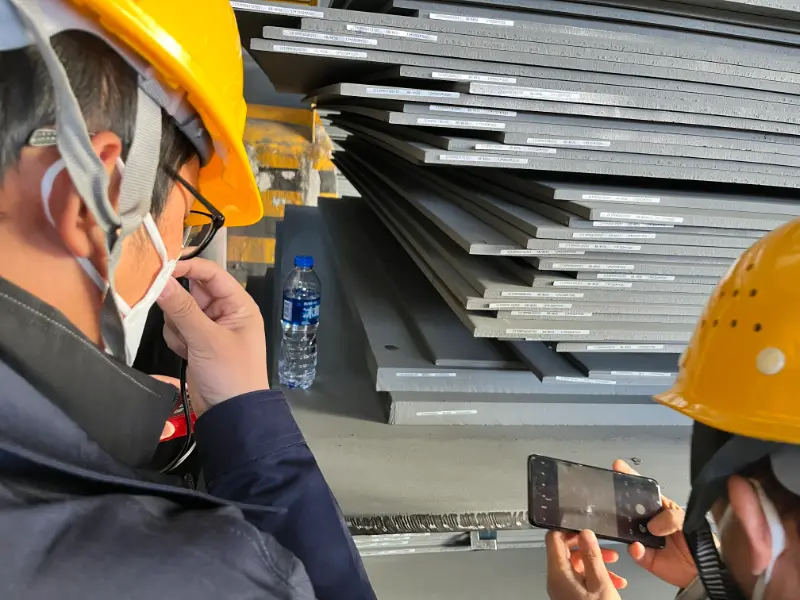
S420J0 Carbon & Low-Alloy High-Strength Steel
EN10025-2 S420J0 Carbon and Low-alloy High-strength Steel Coil - Technical Data
Detailed material data for EN10025-2 S420J0 steel coil: chemical composition, mechanical and physical properties, international equivalents, applications, and processing guide. Suitable for welded structures requiring 420 MPa minimum yield strength and 0°C impact toughness.
Suitable for cold forming, welding (MAG, SAW, SMAW), machining, punching, and hot-dip galvanizing
- Phone : +8618037372205
- Email : [email protected]
- WhatsApp: Contact via Whtsapp
- WeChat: +8618037372205
S420J0 Carbon & Low-Alloy High-Strength Steel Introduction
S420J0 is a hot-rolled, weldable fine-grain structural steel defined in EN 10025-2. It belongs to the carbon and low-alloy high-strength steel category and is supplied in the as-rolled or normalized-rolled condition. The grade designation indicates a minimum yield strength of 420 MPa for thicknesses up to 16 mm, and a guaranteed impact energy of at least 27 J at 0 °C (J0). Its balanced chemical composition with microalloying elements such as niobium, vanadium, and titanium ensures excellent weldability, good cold forming behavior, and reliable toughness. This steel is widely used in heavy steel structures, bridges, offshore platforms, and machinery where high strength combined with moderate toughness is required.
S420J0 Carbon & Low-Alloy High-Strength Steel Chemical Composition
The chemical composition of S420J0 steel is carefully controlled to meet the mechanical property requirements while maintaining good weldability. Carbon equivalent (CEV) is typically ≤0.45–0.47 for sections up to 150 mm, ensuring low susceptibility to cold cracking. Niobium, vanadium, and titanium are added for grain refinement and precipitation strengthening. The phosphorus and sulfur limits guarantee adequate toughness and cleanliness.
| Element | Value (%) | Remarks |
|---|---|---|
| Carbon (C) | ≤0.18 | Depending on thickness; CEV increases with thickness |
| Silicon (Si) | ≤0.60 | Silicon helps deoxidation |
| Manganese (Mn) | 1.00–1.60 | Higher Mn for strength and toughness |
| Phosphorus (P) | ≤0.030 | For long products ≤0.035 may apply |
| Sulfur (S) | ≤0.025 | For long products ≤0.030 may apply |
| Aluminum (Al) | ≥0.020 (total) | If sufficient N binding elements present, lower Al may be agreed |
| Niobium (Nb) | ≤0.06 | Grain refiner, improves strength |
| Vanadium (V) | ≤0.15 | Precipitation strengthening; sum Nb+V+Ti ≤0.22% |
| Titanium (Ti) | ≤0.05 | Grain refinement and precipitation hardening |
| Chromium (Cr) | ≤0.30 | Residual element |
| Nickel (Ni) | ≤0.30 | Residual element |
| Copper (Cu) | ≤0.55 | Copper can be higher if agreed |
| Molybdenum (Mo) | ≤0.10 | Residual element |
| Nitrogen (N) | ≤0.015 | Nitrogen fixed by Al, Nb, V, Ti |
S420J0 Carbon & Low-Alloy High-Strength Steel Thermal and Electrical Physical Properties
These physical properties are representative for low-alloy structural steels and can be used for design calculations. Values may vary slightly depending on exact composition and heat treatment condition. Thermal expansion and conductivity data are essential for welded structures and fire resistance assessments. Resistivity influences selection for earthed components.
| Property | Typical Value | Unit | Test Condition / Reference |
|---|---|---|---|
| Density (ρ) | 7.85 | g/cm³ | At 20 °C |
| Young's modulus of elasticity (E) | 210 | GPa | At 20 °C |
| Shear modulus (G) | approx. 80 | GPa | Calculated for ν=0.3 |
| Poisson's ratio (ν) | 0.3 | — | Elastic range |
| Coefficient of thermal expansion (α) | 12.0 × 10⁻⁶ | K⁻¹ | 20–100 °C |
| Coefficient of thermal expansion | 12.5 × 10⁻⁶ | K⁻¹ | 20–200 °C |
| Coefficient of thermal expansion | 13.0 × 10⁻⁶ | K⁻¹ | 20–400 °C |
| Thermal conductivity (λ) | approx. 50 | W/(m·K) | At 20 °C |
| Thermal conductivity | approx. 45 | W/(m·K) | At 200 °C |
| Specific heat capacity (cₚ) | 460 | J/(kg·K) | At 20 °C |
| Specific heat capacity | approx. 500 | J/(kg·K) | At 200 °C |
| Electrical resistivity (ρe) | approx. 0.22 | µΩ·m | At 20 °C |
S420J0 Carbon & Low-Alloy High-Strength Steel Mechanical Properties
Mechanical properties depend on product thickness and delivery condition. The specified yield strength, tensile strength, and elongation correspond to the as-rolled or normalized rolled state. Impact energy is tested at 0 °C for grade J0 and must meet at least 27 J on longitudinal Charpy-V specimens. Bending test requirements ensure adequate formability for thicknesses up to 150 mm.
| Property | Required Value | Unit | Test Condition & Thickness Range |
|---|---|---|---|
| Yield strength ReH | ≥420 | MPa | t ≤ 16 mm |
| Yield strength ReH | ≥400 | MPa | 16 < t ≤ 40 mm |
| Yield strength ReH | ≥390 | MPa | 40 < t ≤ 63 mm |
| Yield strength ReH | ≥370 | MPa | 63 < t ≤ 80 mm |
| Yield strength ReH | ≥360 | MPa | 80 < t ≤ 100 mm |
| Yield strength ReH | ≥340 | MPa | 100 < t ≤ 150 mm |
| Tensile strength Rm | 520–680 | MPa | t ≤ 40 mm |
| Tensile strength Rm | 510–680 | MPa | 40 < t ≤ 63 mm |
| Tensile strength Rm | 500–660 | MPa | 63 < t ≤ 80 mm |
| Tensile strength Rm | 490–630 | MPa | 80 < t ≤ 100 mm |
| Tensile strength Rm | 480–630 | MPa | 100 < t ≤ 150 mm |
| Elongation after fracture A | ≥19 | % | t ≤ 16 mm, L₀=5.65√S₀ |
| Elongation after fracture A | ≥19 | % | 16 < t ≤ 40 mm, L₀=5.65√S₀ |
| Elongation after fracture A | ≥18 | % | 40 < t ≤ 63 mm, L₀=5.65√S₀ |
| Elongation after fracture A | ≥17 | % | 63 < t ≤ 80 mm, L₀=5.65√S₀ |
| Elongation after fracture A | ≥17 | % | 80 < t ≤ 100 mm, L₀=5.65√S₀ |
| Elongation after fracture A | ≥16 | % | 100 < t ≤ 150 mm, L₀=5.65√S₀ |
| Impact energy KV (longitudinal) | ≥27 | J | 0 °C, Charpy-V, for t ≥ 3 mm |
| Bending test (bend angle 180°) | d ≤ 1.0 t | — | t ≤ 16 mm |
| Bending test (bend angle 180°) | d ≤ 1.5 t | — | 16 < t ≤ 63 mm |
| Bending test (bend angle 180°) | d ≤ 2.0 t | — | 63 < t ≤ 125 mm |
| Bending test (bend angle 180°) | d ≤ 2.5 t | — | 125 < t ≤ 150 mm |
S420J0 Carbon & Low-Alloy High-Strength Steel Fully Equivalent Materials – Identical Standards and Substitutable Grades
| Country/Region | Standard | Grade | Remarks |
|---|---|---|---|
| International (ISO) | ISO 630-2:2019 | S420J0 | Identical technical delivery conditions |
| United Kingdom | BS EN 10025-2:2019 | S420J0 | Adopted European standard |
| Germany | DIN EN 10025-2:2019 | S420J0 | Same as EN |
| France | NF EN 10025-2:2019 | S420J0 | Same as EN |
| Spain | UNE EN 10025-2:2019 | S420J0 | Same as EN |
| Sweden | SS EN 10025-2:2019 | S420J0 | Same as EN |
| Italy | UNI EN 10025-2:2019 | S420J0 | Same as EN |
| Belgium | NBN EN 10025-2:2019 | S420J0 | Same as EN |
| Netherlands | NEN EN 10025-2:2019 | S420J0 | Same as EN |
| Austria | ÖNORM EN 10025-2:2019 | S420J0 | Same as EN |
| Poland | PN-EN 10025-2:2019 | S420J0 | Same as EN |
| Czech Republic | ČSN EN 10025-2:2019 | S420J0 | Same as EN |
| Russia (reference) | GOST 5520-79 | 09G2S-12 (analogue) | Not identical, but historically used for similar applications; verify properties |
S420J0 Carbon & Low-Alloy High-Strength Steel Application Introduction
S420J0 is designed for welded, bolted, and riveted structures where high strength and moderate toughness are required. It can be processed by all common metalworking methods. Due to low carbon content and microalloying, the steel exhibits good weldability without excessive preheating under normal thicknesses (<50 mm). Typical applications range from heavy building frames to mobile cranes and bridges. The grade is also suitable for cold-formed sections and can be galvanized for corrosion protection.
Product Applications: Welded H-beams and built-up girders, Heavy-duty structural frameworks for high-rise buildings, Bridge decks and box girders, Crane booms, lifting arms, and excavator frames, Pressure vessels and storage tanks (with supplementary requirements), Pipes for structural applications, Wind tower sections, Trailer chassis and tipper truck bodies
Processed into products: Base plates and stiffeners for steel columns, Moment-resisting connections and brackets, Excavator buckets and loader arms, Conveyor belt support structures, Bearing plates for bridges, Crane outrigger beams, Lattice masts and telecommunication towers, Reinforcement rings for penstocks, Formwork panels and struts, Heavy-duty shelving and racking systems
Application industries: Civil engineering and construction, Bridge building, Offshore and marine engineering, Heavy machinery and equipment manufacturing, Transportation (rail cars, truck frames), Power generation (wind turbine towers, transmission poles), Mining and material handling, Shipbuilding (secondary structures)
S420J0 Carbon & Low-Alloy High-Strength Steel Closely Related Alternative Materials – Similar Performance Grades
| Country/Region | Standard | Grade | Remarks |
|---|---|---|---|
| Europe | EN 10025-2 | S420J2 | Higher toughness at -20 °C; otherwise same strength |
| Europe | EN 10025-3 | S420N | Normalized rolled; for heavier sections, similar strength but different impact testing |
| Europe | EN 10025-3 | S420NL | Normalized with low-temperature toughness (-50 °C option) |
| Europe | EN 10025-4 | S420M | Thermomechanical rolled; improved weldability and toughness |
| Europe | EN 10025-4 | S420ML | Thermomechanical rolled, low-temperature toughness (-50 °C) |
| Europe | EN 10025-2 | S460J0 | Higher minimum yield strength (460 MPa) with same 0 °C impact |
| USA | ASTM A572/A572M | Grade 60 [420] | Comparable yield strength, but impact test not mandatory unless specified |
| China | GB/T 1591-2018 | Q420D | Similar strength and -20 °C impact; CEV limits and composition may differ |
| Japan | JIS G 3106 | SM490YA | Tensile strength 490–610 MPa, YS typically 365–425 MPa; not a perfect match |
| India | IS 2062:2011 | E410, Grade E410C | YS 410 MPa min, but chemistry and toughness differ – near equivalent |
Notes:
Weldability: Preheating may be required for thicknesses above 40–50 mm, typically to 100–150 °C, depending on hydrogen control. CEV limits are specified in the standard to ensure crack-free welding. Corrosion resistance: As a carbon-manganese steel, S420J0 requires protective coatings or galvanizing for outdoor exposure. Forming: Minimum bending radii should follow the bending test values; cold forming of thick plates may need intermediate stress-relief annealing. Delivery conditions: +AR and +N are standard; +M is available by agreement for improved toughness and weldability. Always refer to the relevant EN 10025-2:2019 document for precise tolerances and supplementary requirements (e.g., Z-quality for through-thickness properties).
- Share



