
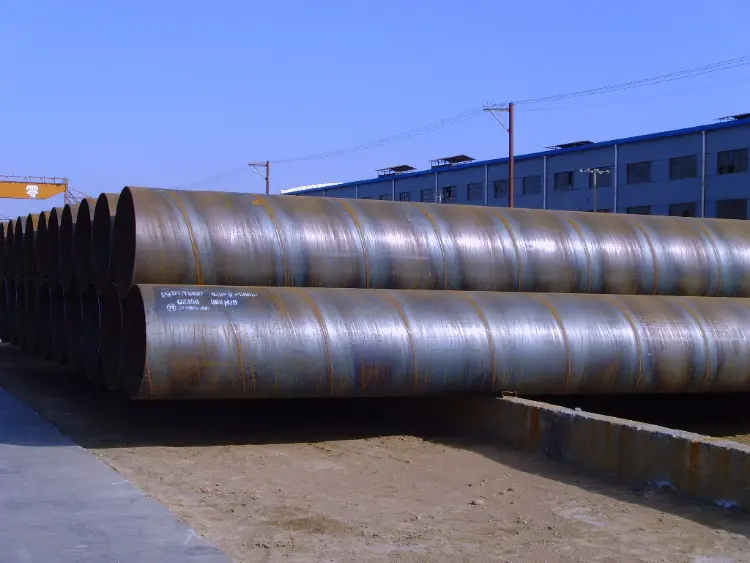
34CrMo4 Steel for Air Bottle Pipes per GB/T 18248
34CrMo4 Steel for Air Bottle Pipes per GB/T 18248 - Technical Data
Complete material data for 34CrMo4 quenched and tempered steel used in high-pressure seamless gas cylinders (air bottle pipes) according to GB/T 18248.
Hot rolling, cold drawing, quenching and tempering
- Phone : +8618037372205
- Email : [email protected]
- WhatsApp: Contact via Whtsapp
- WeChat: +8618037372205
34CrMo4 Steel for Air Bottle Pipes per GB/T 18248 Introduction
34CrMo4 is a low-alloy chromium-molybdenum steel specifically normalized or quenched and tempered for use in seamless steel tubes for high-pressure gas cylinders (air bottle pipes). Under the Chinese standard GB/T 18248, this grade is designed to provide an optimum combination of high strength, good toughness, and reliable performance under internal pressure.
- High tensile strength (980–1130 MPa) and yield strength (≥835 MPa) after quenching and tempering
- Excellent hardenability and uniform mechanical properties through the wall thickness
- Good impact toughness at room temperature (KV₂ ≥40 J)
- Controlled chemical composition with low phosphorus and sulfur for enhanced cleanliness
- Supplied in heat-treated condition, ready for cylinder forming and finishing
It is widely employed for industrial gas bottles, CNG vehicle cylinders, and other pressure vessels requiring a lightweight, strong, and safe material.
34CrMo4 Steel for Air Bottle Pipes per GB/T 18248 Chemical Composition
The chemical composition of 34CrMo4 according to GB/T 18248-2008 is tightly controlled to ensure high strength and good weldability. The steel is fully killed and has low residual elements to maintain ductility and toughness. All values refer to the ladle analysis.
| Element | Standard Value | Remarks |
|---|---|---|
| C | 0.30–0.37 | |
| Si | ≤ 0.40 | |
| Mn | 0.60–0.90 | |
| P | ≤ 0.020 | Low to avoid embrittlement |
| S | ≤ 0.010 | Strictly controlled for toughness |
| Cr | 0.90–1.20 | Provides hardenability and oxidation resistance |
| Mo | 0.15–0.30 | Enhances high-temperature strength |
| Ni | ≤ 0.30 | Residual element |
| Cu | ≤ 0.20 | Residual element |
| V | ≤ 0.02 | Micro-alloying residual |
34CrMo4 Steel for Air Bottle Pipes per GB/T 18248 Physical Properties
The physical properties are based on data from the GB/T 18248-2008 standard (informative annex) and general alloy steel references. They are representative for the quenched and tempered condition. Density is used for mass calculation, while elastic modulus and thermal expansion are temperature-dependent and critical for design calculations of pressurized cylinders.
| Property | Typical Value | Unit | Test Condition |
|---|---|---|---|
| Density (ρ) | 7.85 | g/cm³ | At 20 °C |
| Elastic modulus (E) | 206 | GPa | At 20 °C |
| Elastic modulus (E) | 203 | GPa | At 100 °C |
| Elastic modulus (E) | 198 | GPa | At 200 °C |
| Elastic modulus (E) | 192 | GPa | At 300 °C |
| Elastic modulus (E) | 186 | GPa | At 400 °C |
| Elastic modulus (E) | 179 | GPa | At 500 °C |
| Coefficient of thermal expansion (α) | 11.1 | 10⁻⁶/°C | Between 20 and 100 °C |
| Coefficient of thermal expansion (α) | 11.9 | 10⁻⁶/°C | Between 20 and 200 °C |
| Coefficient of thermal expansion (α) | 12.6 | 10⁻⁶/°C | Between 20 and 300 °C |
| Coefficient of thermal expansion (α) | 13.2 | 10⁻⁶/°C | Between 20 and 400 °C |
| Coefficient of thermal expansion (α) | 13.7 | 10⁻⁶/°C | Between 20 and 500 °C |
34CrMo4 Steel for Air Bottle Pipes per GB/T 18248 Mechanical Properties
The mechanical properties of 34CrMo4 seamless tubes for gas cylinders are determined after quenching and tempering heat treatment (austenitizing at 850–870 °C, oil quenching, tempering at 540–680 °C). The values below represent the minimum requirements per GB/T 18248-2008 for wall thickness ≤30 mm. All tests are carried out at room temperature unless otherwise stated.
| Property | Specified Value | Unit | Test Condition |
|---|---|---|---|
| Tensile strength (Rm) | 980–1130 | MPa | At room temperature, quenched & tempered |
| Yield strength (Rp0.2) | ≥ 835 | MPa | At room temperature, quenched & tempered |
| Elongation after fracture (A) | ≥ 12 | % | Longitudinal specimen, gauge length L₀=5.65√S₀ |
| Reduction of area (Z) | ≥ 45 | % | At room temperature |
| Impact energy (KV₂) | ≥ 40 | J | At 20 °C, Charpy V-notch |
| Bend test | No cracks or defects | – | Bend angle 180°, mandrel diameter 4a (a = wall thickness) |
34CrMo4 Steel for Air Bottle Pipes per GB/T 18248 Fully Equivalent Material Standards and Substitutable Grades
The following grades from international standards are considered fully equivalent to GB/T 18248 34CrMo4 in chemical composition and mechanical properties, and can be used as direct substitutes for air bottle pipe applications, subject to agreement between manufacturer and purchaser.
| Country/Region | Standard | Grade | Remarks |
|---|---|---|---|
| China | GB/T 18248 | 34CrMo4 | Original standard for gas cylinder tubes |
| Europe | EN 10297-1 | 34CrMo4 | Seamless circular steel tubes for mechanical and general engineering purposes – technical delivery conditions |
| Europe | EN 10216-2 | 34CrMo4 | Seamless steel tubes for pressure purposes – elevated temperature properties |
| International | ISO 9809-1 | 34CrMo4 | Gas cylinders – seamless steel gas cylinders – tube-based cylinders |
| Germany | DIN 17204 | 34CrMo4 | Steels for quenching and tempering – technical delivery conditions for seamless circular tubes |
| UK | BS EN 10297-1 | 34CrMo4 | British adoption of European standard |
34CrMo4 Steel for Air Bottle Pipes per GB/T 18248 Application Introduction
34CrMo4 air bottle pipes are specifically engineered for the manufacture of high-pressure seamless gas cylinders. The material's high strength-to-weight ratio allows lighter cylinders, making it ideal for mobile applications. Typical manufacturing routes include hot piercing, pilger rolling, cold drawing, and final heat treatment.
- Cylinders are designed according to international pressure vessel codes (e.g., ISO 9809-1) and local regulations.
- Pipes are inspected for defects using ultrasonic or eddy current testing per GB/T 18248.
- Post-fabrication procedures include necking, end forming, hydrostatic testing, and external coating.
Product Applications: Seamless high-pressure steel cylinders, CNG vehicle cylinders (Type 1 all-steel cylinders), Industrial oxygen, nitrogen, and argon bottles, SCBA (self-contained breathing apparatus) cylinders, Fire extinguisher bodies, Hydraulic accumulator shells
Processed into products: Cylinder body (tube section), Neck ring and end closures, Boss adapters for valve mounting, Longitudinally welded gas storage tubes (multi‑element vessels)
Application industries: Industrial gas manufacturing, Medical oxygen supply, Alternative fuel vehicles (CNG & hydrogen), Fire protection and fire extinguisher production, Aerospace and diving equipment, Energy storage (gas accumulators)
34CrMo4 Steel for Air Bottle Pipes per GB/T 18248 Similar / Nearby Alternative Material Recommendations
These grades exhibit comparable hardenability and strength levels but may differ slightly in alloying elements or delivery conditions. They are suitable for similar applications after adjusting heat treatment or design margins.
| Country/Region | Standard | Grade | Remarks |
|---|---|---|---|
| USA | ASTM A519 | 4140 | Very similar Cr-Mo chemistry; strength range overlaps with 34CrMo4; often used for mechanical tubing |
| USA | ASTM A29 / A322 | 4140 | Bar and forging material; can be converted to pipe for cylinders with suitable heat treatment |
| Japan | JIS G3441 | SCM440 | Japanese Cr-Mo alloy steel tube; chemistry and mechanicals comparable |
| China | GB/T 3077 | 42CrMo | Chinese alloy structural steel; same Cr-Mo class, slightly higher carbon; applicable after heat treatment |
| China | GB/T 18248 | 35CrMo | A nearby grade in the same standard with slightly lower tensile strength (≥870 MPa) and good toughness |
Notes:
Heat treatment details: Quenching in oil from 850–870 °C; tempering between 540 °C and 680 °C. Hardness: Typically in the range of 28–35 HRC after tempering, depending on the actual tempering temperature. Surface quality: Tubes must be free from scale, cracks, and other injurious defects; decarburization depth is limited. Non-destructive testing: Each tube is subjected to ultrasonic or eddy current inspection according to GB/T 5777 or GB/T 7735 (agreed level). Hydrostatic test: Cylinders are tested at a minimum of 1.5 times the design pressure. These supplementary requirements ensure the safe long-term service of the air bottle pipes under cyclic loading conditions.
- Share



