
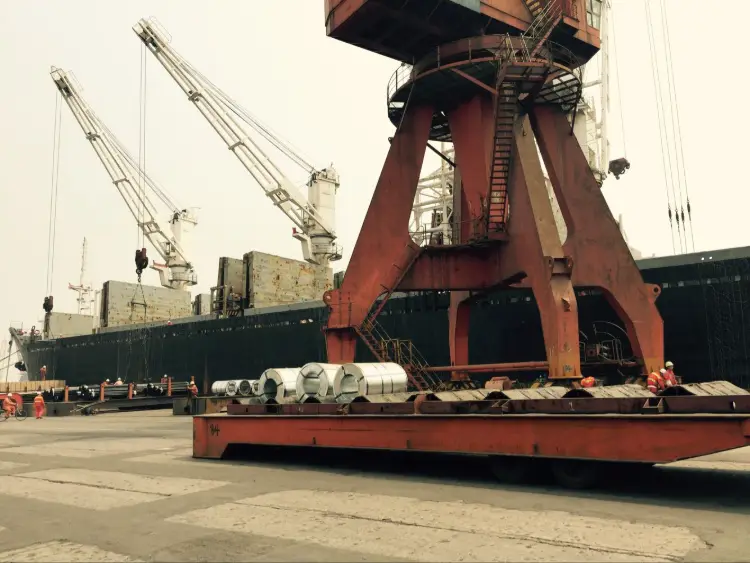
EN10025-2 S355J0 Carbon & Low-Alloy High-Strength Steel Coil
EN10025-2 S355J0 Carbon & Low-Alloy High-Strength Steel Coil - Datasheet & Equivalents
Complete technical datasheet for EN10025-2 S355J0 hot-rolled structural steel coil, including chemical composition, mechanical properties, thermal and electrical characteristics, international equivalents, and application guidelines.
Cutting, welding, bending, forming, punching, drilling, machining (moderate), hot-dip galvanizing, painting
- Phone : +8618037372205
- Email : [email protected]
- WhatsApp: Contact via Whtsapp
- WeChat: +8618037372205
EN10025-2 S355J0 Carbon & Low-Alloy High-Strength Steel Coil Introduction
S355J0 is a weldable, normalised or hot-rolled structural steel grade defined in EN 10025‑2. It offers a minimum yield strength of 355 MPa and guaranteed Charpy‑V impact energy of 27 J at 0 °C (longitudinal).
Key characteristics:
- Good balance of strength, ductility and weldability.
- Suitable for ambient temperature down to -10 °C (depending on thickness and design rules).
- Available in as-rolled (+AR) or normalised (+N) delivery condition.
- Widely used in building frames, bridges, offshore structures, machinery and transport equipment.
EN10025-2 S355J0 Carbon & Low-Alloy High-Strength Steel Coil Chemical Composition
Elements according to EN 10025‑2:2019, Table 2. The alloying concept relies on manganese and limited carbon to achieve required strength and toughness. Phosphorus and sulfur are kept low for enhanced weldability and ductility.
Note: For thicknesses >30 mm, CEV (carbon equivalent value) may be agreed. Nitrogen total content may be specified for fine‑grain practice.
| Element | Standard value (wt %) | Comments |
|---|---|---|
| C | ≤0.20 (t≤16 mm); ≤0.22 (16<t≤40); ≤0.24 (40<t≤150) | Decreasing carbon with increasing thickness ensures weldability. |
| Si | ≤0.55 | Silicon serves as deoxidiser; limit avoids excessive hardening. |
| Mn | 0.55 – 1.60 | Manganese range provides strength and toughness. |
| P | ≤0.030 | Maximum phosphorus for crack‑free welding and impact toughness. |
| S | ≤0.030 | Sulphur restriction for hot shortness resistance. |
| Cu | ≤0.55 | Copper may be specified as residual (for improved atmospheric corrosion resistance if content is elevated). |
| N | ≤0.012 | Nitrogen bound by aluminium or other grain‑refining elements. |
| Cr | ≤0.30 | Residual element; no deliberate addition required. |
| Ni | ≤0.30 | Same as above. |
| Mo | ≤0.10 | Traces from scrap; generally not added. |
| Nb | ≤0.05 | Micro‑alloying permitted; contributes to fine‑grain strengthening (optional). |
| Ti | ≤0.05 | Permitted for grain refinement and fix nitrogen (optional). |
| V | ≤0.12 | Optional micro‑alloy; typical in normalised fine‑grain practice. |
| CEV (CE) | ≤0.45 (typical for t≤30) | Carbon equivalent value; may be subject to agreement for thicker plates. |
EN10025-2 S355J0 Carbon & Low-Alloy High-Strength Steel Coil Thermal & Electrical Properties
Physical constants typical for C‑Mn structural steel. Values may vary slightly with composition and heat treatment. These data aid design calculations for thermal expansion, heat transfer, and electrical resistivity.
Thermal conductivity decreases with increasing temperature; the value below is valid near 20 °C. Specific heat shows a peak around 700‑800 °C due to phase transformation.
| Property | Typical value | Unit | Condition / Remarks |
|---|---|---|---|
| Density (ρ) | 7850 | kg/m³ | Ambient temperature |
| Young's modulus (E) | 210 | GPa | Room temperature; reference for design |
| Shear modulus (G) | ~ 81 | GPa | Calculated from E and Poisson's ratio |
| Poisson's ratio (ν) | 0.30 | — | Elastic range |
| Thermal expansion coefficient (α) | 12 × 10⁻⁶ | per K | Average between 20 °C and 100 °C |
| Thermal conductivity (λ) | ~ 50 | W/(m·K) | At 20 °C |
| Specific heat (cₚ) | ~ 460 | J/(kg·K) | At 20 °C |
| Electrical resistivity (ρₑ) | ~ 0.25 × 10⁻⁶ | Ω·m | At 20 °C |
EN10025-2 S355J0 Carbon & Low-Alloy High-Strength Steel Coil Mechanical Properties
Minimum values at room temperature unless stated otherwise. Tensile testing per EN ISO 6892‑1. Impact test per EN ISO 148‑1. Charpy‑V notch specimen orientation: longitudinal (default). Requirements for transverse specimens shall be agreed at the time of order.
Yield strength varies with product thickness; the highest strength is achieved in the thinner range (≤16 mm).
| Property | Standard Requirement | Unit | Test Condition / Product Thickness |
|---|---|---|---|
| Yield strength (ReH, min.) | 355 | MPa | t ≤ 16 mm |
| Yield strength (ReH, min.) | 345 | MPa | 16 < t ≤ 40 mm |
| Yield strength (ReH, min.) | 335 | MPa | 40 < t ≤ 63 mm |
| Yield strength (ReH, min.) | 325 | MPa | 63 < t ≤ 80 mm |
| Yield strength (ReH, min.) | 315 | MPa | 80 < t ≤ 100 mm |
| Yield strength (ReH, min.) | 295 | MPa | 100 < t ≤ 150 mm |
| Tensile strength (Rm) | 470 – 630 | MPa | t ≤ 100 mm |
| Tensile strength (Rm) | 450 – 600 | MPa | 100 < t ≤ 150 mm |
| Elongation (A, min.) | 20 (L₀=5.65√S₀) | % | t ≤ 40 mm, gauge length proportional to area |
| Elongation (A, min.) | 19 | % | 40 < t ≤ 63 mm |
| Elongation (A, min.) | 18 | % | 63 < t ≤ 100 mm |
| Elongation (A, min.) | 17 | % | 100 < t ≤ 150 mm |
| Impact energy (KV₂, min.) | ≥ 27 J at 0 °C | J | Charpy‑V, longitudinal, 10×10 mm specimen; for t >150 mm 7.5×10 mm permitted |
| Bend test (mandrel diameter) | Mandrel Ø = 3t (t ≤ 60 mm) or 4t (60| — | 180° bend, no cracks; test to ISO 7438 | |
EN10025-2 S355J0 Carbon & Low-Alloy High-Strength Steel Coil Identical Materials – Full Equivalent Grades
| Country / Region | Standard | Designation | Remarks |
|---|---|---|---|
| European Union / International | EN 10025‑2:2019 | S355J0 (1.0553) | Original standard; harmonised across CEN members |
| International | ISO 630‑2:2018 | S355J0 | Direct adoption of EN grade |
| Germany | DIN EN 10025‑2 | S355J0 (1.0553) | Identical to EN, formerly DIN St 52‑3 U (impact at 0 °C) |
| France | NF EN 10025‑2 | S355J0 (1.0553) | Replaces NF A 35‑501 E 36‑3 |
| United Kingdom | BS EN 10025‑2 | S355J0 (1.0553) | Formerly BS 4360 Grade 50 C |
| Italy | UNI EN 10025‑2 | S355J0 (1.0553) | |
| Spain | UNE EN 10025‑2 | S355J0 (1.0553) | |
| Sweden | SS‑EN 10025‑2 | S355J0 (1.0553) | |
| Belgium | NBN EN 10025‑2 | S355J0 (1.0553) | |
| Austria | ÖNORM EN 10025‑2 | S355J0 (1.0553) |
EN10025-2 S355J0 Carbon & Low-Alloy High-Strength Steel Coil Application Introduction
S355J0 steel combines ease of fabrication with reliable mechanical properties, making it a first choice for structural applications in moderate climates. Its certification at 0 °C allows its use in most outdoor steelworks except extremely low‑temperature environments.
Design and fabrication notes:
- Preheat before welding may be necessary for thick sections (>30 mm) or when ambient temperature is low.
- Suitable for all common welding processes (MAG, SMAW, SAW).
- Hot‑dip galvanising possible, but the high silicon content may influence coating thickness.
- Fire resistance ratings should be designed separately.
Product Applications: Hot‑rolled coils and plates, Wide flange beams (HEA/HEB/HEM), IPE, UPE, channels, angles, Welded structural hollow sections (circular, square, rectangular), Steel girder bridges, Crane rails and runway beams, Wind turbine tower cans and door frames, Shipbuilding profiles (bulk carriers, barges), Storage silos and grain bins
Processed into products: Columns and beams in multi‑storey frames, Bridge main girders and cross‑frames, Truss members and bracing, Anchor cages and foundation rings for wind towers, Boom and stick parts for excavators, Rail wagon underframes, Tank shells (non‑cryogenic), Support brackets and machinery bases
Application industries: Structural engineering (commercial buildings, industrial halls, stadiums), Bridge construction (highway and railway bridges), Offshore and marine (jacket structures, platform modules), Wind energy (turbine towers, foundation components), Transport and automotive (frames, chassis, rail wagons), Pressure vessels and storage tanks (medium‑stress parts), Mining and earthmoving equipment, Agricultural machinery
EN10025-2 S355J0 Carbon & Low-Alloy High-Strength Steel Coil Similar / Comparable Grades – Alternative Selection
| Country / Region | Standard | Designation | Remarks |
|---|---|---|---|
| European Union | EN 10025‑2 | S355JR (1.0045) | Impact at +20 °C; lower toughness requirement. Otherwise same strength. |
| European Union | EN 10025‑2 | S355J2 (1.0570) | Impact at -20 °C; higher toughness requirement. |
| European Union | EN 10025‑2 | S355K2 (1.0596) | Impact at -20 °C with higher energy (40 J) and restricted chemistry. |
| European Union | EN 10025‑3 | S355N/NL (1.0545/...) | Normalised or normalised‑rolled fine‑grain steel; often used for improved through‑thickness properties. |
| United States | ASTM A572/A572M | Grade 50 (Type 1) | Comparable strength (345 MPa min yield), but impact test temperature is +21 °C. Equivalent to S355JR rather than J0. |
| United States | ASTM A709/A709M | Grade 50 | For bridges; impact options – may be ordered with Zone 1 (+21 °C) or Zone 2 (‑34 °C). |
| Japan | JIS G3106 | SM490A | Yield ≥ 325 MPa (t≤16 mm); tensile 490‑610 MPa; impact at 0 °C 27 J (SM490B has 0 °C 27 J for reference). SM490A has no impact requirement. |
| China | GB/T 1591‑2018 | Q355C | Yield ≥ 355 MPa (t≤16 mm); impact at 0 °C 34 J. Chemical composition may differ (Mn 0.85‑1.60, minor Nb/V/Ti). |
| China | GB/T 1591‑2018 | Q355D | Impact at -20 °C; slightly different chemistry. Closer to S355J2. |
Notes:
CE‑marking: S355J0 under EN 10025‑2 can be CE marked according to the Construction Products Regulation (EU) 305/2011 when supplied with a Declaration of Performance (DoP).
Additional requirements: Upon agreement, through‑thickness properties (Z‑quality per EN 10164), improved perpendicular impact toughness, special surface conditions (EN 10163‑2), or ultrasonic testing to EN 10160 may be specified in the order.
Welding consumables: Matching electrodes should offer a minimum yield strength of 355 MPa and a Charpy impact of at least 27 J at 0 °C (e.g., E5018‑G or equivalent).
Note on data: All values are based on the official EN 10025‑2:2019 standard and represent minimum or typical figures. The user shall confirm the exact material specification and delivery condition before design.
- Share



