
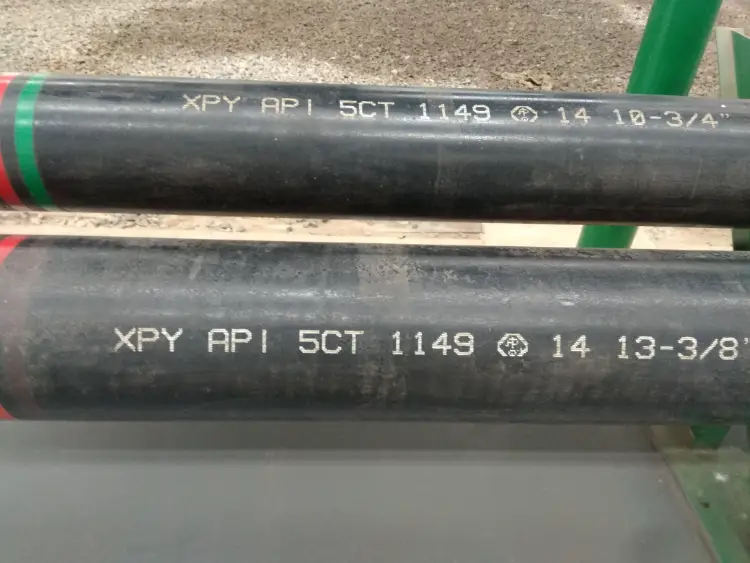
09CuPCrNi-B Weathering Steel Pipe
09CuPCrNi-B Weathering Steel Pipe: TB/T 1979 Grade for High Durability & Corrosion Resistance
Comprehensive data sheet for 09CuPCrNi-B weathering steel pipe under TB/T 1979. Chemical composition, mechanical properties, thermal and electrical performance, international equivalents, and typical applications in railway, construction, and anti-corrosion structures.
Welding, cold forming, hot forming, machining, bending
- Phone : +8618037372205
- Email : [email protected]
- WhatsApp: Contact via Whtsapp
- WeChat: +8618037372205
09CuPCrNi-B Weathering Steel Pipe Introduction
09CuPCrNi-B is a low-alloy structural weathering steel designed for superior atmospheric corrosion resistance, primarily used in railway vehicle manufacturing. It complies with the Chinese railway industry standard TB/T 1979. The steel contains copper, chromium, and nickel alloying elements, forming a stable, adherent protective oxide layer under alternating wet and dry cycles, eliminating the need for painting in many environments. It offers good weldability, cold forming properties, and excellent toughness, with yield strength ≥ 345 MPa. Typical delivery conditions include hot-rolled or cold-rolled pipes.
09CuPCrNi-B Weathering Steel Pipe Chemical Composition
The chemical composition of 09CuPCrNi-B steel is defined by TB/T 1979 to achieve optimum weathering resistance through precise additions of Cu, Cr, Ni. Phosphorus is intentionally elevated to enhance corrosion protection, while sulfur is kept low for weldability and toughness.
| Element | Standard Value | Remarks |
|---|---|---|
| Carbon (C) | ≤0.12% | Critical for weldability |
| Silicon (Si) | 0.25%-0.75% | Deoxidizer and strength contributor |
| Manganese (Mn) | 0.20%-0.50% | Enhances toughness |
| Phosphorus (P) | 0.06%-0.12% | Key element for weathering resistance |
| Sulfur (S) | ≤0.020% | Low level for clean steel |
| Copper (Cu) | 0.25%-0.50% | Promotes protective patina |
| Chromium (Cr) | 0.30%-1.00% | Improves oxidation resistance |
| Nickel (Ni) | ≤0.65% | Contributes to toughness and corrosion resistance |
09CuPCrNi-B Weathering Steel Pipe Thermal and Electrical Physical Properties
Typical physical properties for 09CuPCrNi-B at room temperature. Thermal expansion and conductivity values are averaged over the indicated temperature range. These properties are essential for design of welded structures and thermal management.
| Property | Typical Value | Unit | Test Condition |
|---|---|---|---|
| Density (ρ) | 7.85 | g/cm³ | At 20°C |
| Modulus of Elasticity (E) | 210 | GPa | At 20°C |
| Shear Modulus (G) | 80 | GPa | At 20°C |
| Poisson's Ratio (ν) | 0.3 | - | At 20°C |
| Thermal Expansion Coefficient (α) | 12.0 | 10⁻⁶/K | 20-100°C |
| Thermal Expansion Coefficient (α) | 12.8 | 10⁻⁶/K | 20-200°C |
| Thermal Expansion Coefficient (α) | 13.5 | 10⁻⁶/K | 20-400°C |
| Thermal Conductivity (λ) | 35 | W/(m·K) | At 20°C |
| Specific Heat Capacity (cp) | 470 | J/(kg·K) | At 20°C |
| Electrical Resistivity (ρe) | 0.25 | μΩ·m | At 20°C |
09CuPCrNi-B Weathering Steel Pipe Mechanical Properties
Mechanical properties are tested on flat specimens taken from pipe wall. Values are specified according to TB/T 1979. Bend test requirement ensures formability without cracks. Data valid for thickness range 3-12 mm.
| Property | Required Value | Unit | Test Condition |
|---|---|---|---|
| Upper Yield Strength (ReH) | ≥345 | MPa | Thickness ≤6 mm |
| Upper Yield Strength (ReH) | ≥325 | MPa | Thickness >6-12 mm |
| Tensile Strength (Rm) | ≥480 | MPa | Thickness ≤6 mm |
| Tensile Strength (Rm) | ≥470 | MPa | Thickness >6-12 mm |
| Elongation after Fracture (A) | ≥22 | % | Gauge length 50 mm, thickness ≤6 mm |
| Elongation after Fracture (A) | ≥22 | % | Gauge length 50 mm, thickness >6 mm |
| Bend Test (Bend Diameter) | d=1a | - | 180° bend, thickness ≤6 mm |
| Bend Test (Bend Diameter) | d=2a | - | 180° bend, thickness >6 mm |
| Impact Energy (KV) at 20°C | ≥27 | J | Longitudinal, V-notch |
09CuPCrNi-B Weathering Steel Pipe Completely Equivalent Material Standards and Replaceable Grades
| Country/Region | Standard | Grade | Remarks |
|---|---|---|---|
| China | TB/T 1979 | 09CuPCrNi-B | Base standard, identical |
| China | GB/T 4171 | Q355NH | Chemical composition closely matches, equivalent weathering structural steel |
09CuPCrNi-B Weathering Steel Pipe Application Introduction
09CuPCrNi-B pipe excels in unpainted outdoor applications where long-term corrosion protection through patina is desired. It is suitable for welded, bolted, and riveted structures. Due to its high toughness, it performs well in cold climates. Attention must be given to drainage and wet/dry cycling to form a uniform rust layer.
Product Applications: Freight and passenger railcar frames, Cargo container frames and panels, Steel pipe truss bridges, Lattice transmission towers, Weather-resistant facade panels
Processed into products: Pipe bollards and guardrails, Structural hollow sections for railway wagons, Welded structural nodes, Exhaust stacks and ducting, Cold-formed tubular profiles
Application industries: Railway vehicle manufacturing, Container and logistics, Bridge and civil engineering, Power transmission towers, Architectural architectural cladding and sculptures
09CuPCrNi-B Weathering Steel Pipe Similar/Comparable Alternative Material Recommendations
| Country/Region | Standard | Grade | Remarks |
|---|---|---|---|
| USA | ASTM A588 / A588M | Grade B | Similar weathering steel, min. yield 345 MPa, widely used for structural shapes and plates |
| Japan | JIS G3125 | SPA-H | High phosphorus weathering steel for pipe and sheet, equivalent corrosion resistance |
| Europe | EN 10025-5 | S355J2W+N | Structural weathering steel with yield 355 MPa, needs verification for phosphorus content |
| International | Proprietary | Cor-Ten B | Commercial equivalent to ASTM A588 Gr. B, similar patination and welding behavior |
Notes:
Welding guidelines: Use low-hydrogen electrodes (E7018 type) or gas-shielded flux-cored wire. Preheat to 50-100°C for thicknesses above 25 mm. Patina formation: An initial wet/dry cycling period of 6-18 months may be required before a stable protective layer develops. Avoid prolonged standing water or burial in damp soils. For contact with dissimilar metals, corrosion galvanic cell must be evaluated.
- Share



