
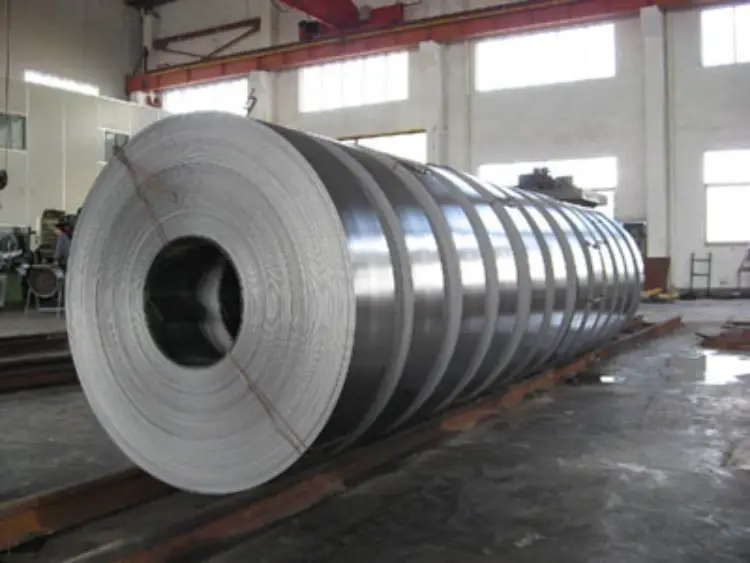
ASTM A709 Grade 36 Structural Steel Coil
ASTM A709 Grade 36 Structural Steel Coil: Properties, Equivalents & Applications
Comprehensive technical data for ASTM A709/A709M Grade 36 carbon and low-alloy high-strength steel coil, including chemical composition, mechanical and physical properties, international equivalents, and application guidance for structural engineering.
Hot rolling, welding, bolting, cold forming, machining, galvanizing
- Phone : +8618037372205
- Email : [email protected]
- WhatsApp: Contact via Whtsapp
- WeChat: +8618037372205
ASTM A709 Grade 36 Structural Steel Coil Introduction
ASTM A709/A709M Grade 36 is a carbon and low-alloy high-strength structural steel primarily used in bridge construction and general structural applications. It is supplied in coil, plate, bar, and shape forms. This grade provides a minimum yield strength of 250 MPa (36 ksi) and a tensile strength of 400–550 MPa (58–80 ksi), with good weldability, ductility, and machinability.
- Designed for welded, bolted, or riveted structures
- Excellent formability in hot-rolled condition
- Can be galvanized or painted for corrosion resistance
- Frequently used as a baseline structural steel worldwide
ASTM A709 Grade 36 Structural Steel Coil Chemical Composition
Chemical requirements for Grade 36 according to ASTM A709/A709M. Values represent ladle analysis. Copper is only specified when the steel is designated as copper-bearing (minimum 0.20%) for improved corrosion resistance. All other elements are as per the standard to ensure weldability and structural integrity.
| Element | Standard Value (max, unless range given) | Remarks |
|---|---|---|
| Carbon (C) | 0.26 | For thickness ≤20 mm, max 0.25%; >20 mm, max 0.26% |
| Manganese (Mn) | 0.80 – 1.20 | For plates over 20 mm, Mn 0.80–1.20, but may be adjusted as per standard |
| Silicon (Si) | 0.40 max | Optional; 0.15–0.40% when required for killed steel |
| Phosphorus (P) | 0.04 | Ladle analysis |
| Sulfur (S) | 0.05 | Ladle analysis |
| Copper (Cu) | 0.20 min (when specified) | Optional; for improved atmospheric corrosion resistance |
ASTM A709 Grade 36 Structural Steel Coil Thermal and Electrical Physical Properties
Typical physical properties for ASTM A709 Grade 36 steel, based on general carbon steel data. These values are not mandatory requirements of the standard but serve as reference for design calculations. Slight variations may occur depending on exact chemical composition and processing.
| Property | Typical Value | Unit | Test Condition / Remarks |
|---|---|---|---|
| Density (ρ) | 7.85 | g/cm³ | At 20 °C |
| Modulus of Elasticity (E) | 200 | GPa | At room temperature |
| Shear Modulus (G) | 80 | GPa | Calculated from E and Poisson ratio |
| Poisson's Ratio (ν) | 0.30 | — | In the elastic range |
| Thermal Expansion Coefficient (α) | 11.7 | ×10⁻⁶ /K | Mean value between 20 °C and 100 °C |
| Thermal Conductivity (λ) | 52 | W/(m·K) | At 20 °C |
| Specific Heat Capacity (c) | 486 | J/(kg·K) | At 20 °C |
| Electrical Resistivity (ρₑ) | 0.15 | µΩ·m | At 20 °C |
ASTM A709 Grade 36 Structural Steel Coil Mechanical Properties
Tensile properties and bending requirements for Grade 36 as per ASTM A709/A709M. Values depend on product thickness. Elongation is measured on a 200 mm (8 in.) gauge length for plates. Bending test is performed at 180°; mandrel diameter varies with thickness. If Charpy impact testing is specified, it is performed in accordance with ASTM A673/A673M, with energy values subject to agreement.
| Property | Standard Requirement | Unit | Test Condition / Remarks |
|---|---|---|---|
| Yield Strength (ReH) min | 250 | MPa (36 ksi) | For all thicknesses up to 100 mm |
| Tensile Strength (Rm) | 400 – 550 | MPa (58 – 80 ksi) | For all thicknesses up to 100 mm |
| Elongation (A200) min | 20 | % | Gauge length 200 mm, thickness ≤20 mm |
| Elongation (A200) min | 18 | % | Gauge length 200 mm, 20 mm < thickness ≤40 mm |
| Elongation (A200) min | 16 | % | Gauge length 200 mm, 40 mm < thickness ≤65 mm |
| Elongation (A200) min | 15 | % | Gauge length 200 mm, 65 mm < thickness ≤100 mm |
| Bend Test (180°) | No cracks, d = t | — | Thickness ≤ 20 mm |
| Bend Test (180°) | No cracks, d = 1.5t | — | 20 mm < thickness ≤ 25 mm |
| Bend Test (180°) | No cracks, d = 2t | — | 25 mm < thickness ≤ 30 mm |
ASTM A709 Grade 36 Structural Steel Coil Exact Equivalent Material Standards and Substitutable Grades
| Country/Region | Standard | Grade | Remarks |
|---|---|---|---|
| USA | ASTM A36/A36M | Grade 36 | The base standard for carbon structural steel; identical chemistry and mechanical requirements. |
| European Union | EN 10025-2 | S235JR (1.0038) | Equivalent yield 235 MPa, slightly lower; substitute with care for strength-critical applications. |
| Japan | JIS G3106 | SM400A | Tensile strength 400-510 MPa, yield ≥245 MPa; suitable substitute for welded structures. |
| China | GB/T 700 | Q235B | Good match in strength and weldability; widely used as direct replacement. |
| International | ISO 630-2 | S235B | Similar to EN S235JR; use as substitute where slightly lower yield strength is acceptable. |
ASTM A709 Grade 36 Structural Steel Coil Application Introduction
ASTM A709 Grade 36 steel is widely used in civil and structural engineering. Its balanced combination of strength, ductility, and cost-effectiveness makes it the default choice for primary and secondary structural members.
- Commonly supplied as hot-rolled coil, plates, and sections
- Suitable for severe environments when provided with protective coatings
- Ideal for welding, bolting, and riveting assemblies
Product Applications: Steel bridge girders, diaphragms, and bracing, Multi-story building columns and beams, Base plates and stiffeners, Welded pipe and tubular structures, Railroad and highway overpass components
Processed into products: Bridge bearing plates and splice plates, Structural gusset plates and connection angles, Crane runway beams, Welded box sections for pylons, Floor deck support channels, Machine frames and base plates, High-strength bolted assemblies
Application industries: Bridge construction and rehabilitation, Commercial and industrial building framing, Machinery manufacturing, Shipbuilding (auxiliary structures), Power transmission towers and substations, Storage tanks and silos
ASTM A709 Grade 36 Structural Steel Coil Similar or Alternative Material Recommendations
| Country/Region | Standard | Grade | Remarks |
|---|---|---|---|
| USA | ASTM A572/A572M | Grade 42 | Higher strength (≥290 MPa yield) with similar weldability; may replace Grade 36 to reduce section thickness. |
| USA | ASTM A572/A572M | Grade 50 | High-strength low-alloy steel (yield ≥345 MPa); offers weight savings in heavy structures. |
| European Union | EN 10025-2 | S355JR (1.0045) | Higher strength structural steel; suitable when increased load capacity is needed. |
| Japan | JIS G3101 | SS400 | General structural steel with comparable tensile strength, but less stringent compositional control. |
Notes:
Impact Testing: Not mandatory for Grade 36 unless specified as a supplementary requirement (e.g., S5.1 of ASTM A709/A709M). When required, Charpy V-notch tests are performed per ASTM A673/A673M at an agreed temperature and acceptance criteria.
Copper-bearing variant: When copper content ≥0.20%, the steel exhibits improved atmospheric corrosion resistance (about twice that of plain carbon steel).
Coil dimensions: Typical coil thickness 1.5–16 mm, width 900–2000 mm; can be slit to narrower widths. Heavier thicknesses are available as cut-to-length plates.
Welding: Low carbon equivalent ensures no preheating for sections up to about 25 mm; follow AWS D1.1 or equivalent welding code.
- Share



