
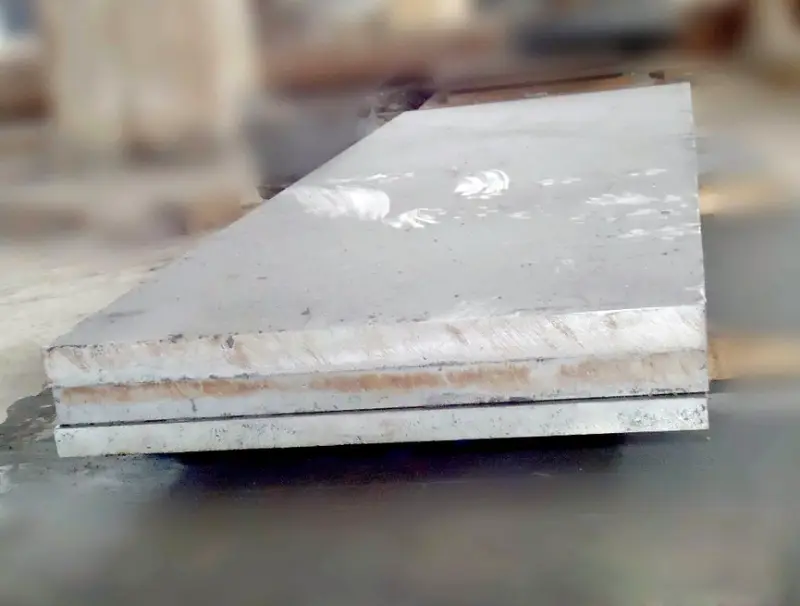
ASTM A514 Grade K
ASTM A514 Grade K - High-Strength Quenched & Tempered Steel for Welded Structures
Comprehensive technical data for ASTM A514/A514M Grade K carbon and low-alloy high-strength steel coil and plate, including chemical composition, mechanical properties, thermal properties, equivalent grades, and application guidance.
Hot rolling, cold forming, welding, machining (with care), flame cutting, plasma cutting
- Phone : +8618037372205
- Email : [email protected]
- WhatsApp: Contact via Whtsapp
- WeChat: +8618037372205
ASTM A514 Grade K Introduction
ASTM A514/A514M Grade K is a quenched and tempered (Q&T) low-alloy steel with a minimum yield strength of 690 MPa (100 ksi). It is primarily designed for welded structures where weight savings and high strength are critical. The steel exhibits excellent notch toughness at low temperatures when impact testing is specified, making it suitable for demanding applications such as bridges, heavy machinery, and offshore platforms.
- High strength-to-weight ratio allows thinner sections and reduced structural weight.
- Good weldability with proper preheat and post-weld heat treatment procedures.
- Enhanced atmospheric corrosion resistance due to controlled copper addition.
- Available in plate and coil form in various thicknesses.
ASTM A514 Grade K Chemical Composition
The chemical composition of ASTM A514 Grade K is tightly controlled to achieve the required strength and toughness after quenching and tempering. Boron is added to enhance hardenability, and copper provides some atmospheric corrosion resistance. All values are according to ASTM A514/A514M standard. Note: Boron range depends on plate thickness: 0.0005–0.005% for thickness ≤40 mm, and 0.001–0.005% for thickness >40 mm to 50 mm.
| Element | Standard Value (wt%) | Remarks |
|---|---|---|
| Carbon (C) | 0.10–0.20 | |
| Manganese (Mn) | 1.15–1.65 | |
| Phosphorus (P) | 0.035 max | |
| Sulfur (S) | 0.040 max | |
| Silicon (Si) | 0.15–0.40 | |
| Copper (Cu) | 0.20–0.40 | Provides atmospheric corrosion resistance |
| Nickel (Ni) | 1.00–1.50 | |
| Chromium (Cr) | 0.40–0.70 | |
| Molybdenum (Mo) | 0.15–0.25 | |
| Vanadium (V) | 0.02–0.06 | |
| Boron (B) | 0.0005–0.005 | Thickness-dependent; see description |
ASTM A514 Grade K Thermal and Electrical Physical Properties
Physical properties are typical for quenched and tempered low-alloy steel with similar chemical composition. These values are not mandatory in the ASTM A514/A514M standard and are provided as a guide for engineering calculations. Actual values may vary slightly depending on heat treatment and exact chemical composition.
| Property | Standard/Typical Value | Unit | Test Condition |
|---|---|---|---|
| Density (ρ) | 7.85 | g/cm³ | At 20°C |
| Modulus of Elasticity (E) | 200 | GPa | At 20°C |
| Shear Modulus (G) | 79 | GPa | At 20°C |
| Poisson's Ratio (ν) | 0.3 | - | At 20°C |
| Coefficient of Thermal Expansion (α) | 11.7 | ×10⁻⁶ /°C | 20–100°C |
| Thermal Conductivity (λ) | 42 | W/(m·K) | At 100°C |
| Specific Heat Capacity | 480 | J/(kg·K) | At 20°C |
| Electrical Resistivity (ρ_e) | 0.22 | ×10⁻⁶ Ω·m | At 20°C |
ASTM A514 Grade K Mechanical Properties
Tensile properties are specified in the quenched and tempered condition and depend on plate thickness. For plates up to 65 mm (2.5 in.) thick, the minimum yield strength is 690 MPa (100 ksi). Elongation is measured on a 2 in. (50 mm) gauge length. Charpy impact testing is an optional supplementary requirement (e.g., ASTM A514 Supplementary Requirement S3) and values shown are typical when specified at -45°C (-50°F). Bending test requirements vary with thickness.
| Property | Standard Requirement | Unit | Test Condition |
|---|---|---|---|
| Yield Strength (ReH) | ≥ 690 (100) | MPa (ksi) | Thickness ≤ 65 mm (2.5 in.) |
| Tensile Strength (Rm) | 760–895 (110–130) | MPa (ksi) | Thickness ≤ 65 mm (2.5 in.) |
| Elongation (A) | ≥ 18 | % | Gauge length 2 in. (50 mm) |
| Bend Test (bend diameter) | D=1.5t (for t ≤ 25.4 mm); D=2t (for t > 25.4 to 50.8 mm) | 180° bend, no cracks | |
| Charpy V-notch Impact Energy (KV) | ≥ 27 (20) (typical specified value, longitudinal) | J (ft·lbf) | At -45°C (-50°F), when supplementary requirement invoked |
| Hardness | Approx. 235-293 HBW | HBW | Typical after Q&T |
ASTM A514 Grade K Completely Equivalent Material Standards and Substitutable Grades
| Country/Region | Standard | Grade/Designation | Remarks |
|---|---|---|---|
| USA | ASME SA514/SA514M | Grade K | Identical to ASTM A514 Grade K; approved for pressure vessel attachments under ASME BPVC |
| USA | ASTM A514/A514M | Grade K | The original specification; plate and coil |
| Canada | CSA G40.21 | 700Q/700QL | Grade 700Q is similar but requires check on chemical limits; not fully identical |
| International | ISO 4951-2 | S690QL | S690QL compares closely, but B and Cu limits differ; verify case by case |
ASTM A514 Grade K Application Introduction
ASTM A514 Grade K is widely employed in heavy engineering where high yield strength allows for weight reduction and increased payload capacity. Key considerations:
- Welding must follow AWS D1.1 structural welding code with low-hydrogen electrodes and appropriate preheat/interpass temperatures to avoid cold cracking.
- Post-weld stress relieving is not typically required but may be specified for certain service conditions; however, temperature must be kept below 595°C (1100°F) to avoid temper embrittlement.
- Excellent fatigue resistance when designed and welded correctly.
- Not recommended for applications requiring hot-dip galvanizing above 450°C without prior evaluation due to risk of hydrogen embrittlement.
Product Applications: Welded plate girders, Box girder bridges, Mobile crane telescopic booms, Offshore platform legs and braces, Heavy-duty dump truck bodies, Hydraulic excavator buckets and arms, Pressure vessel reinforcement pads
Processed into products: Gusset plates and splice plates, Crane outrigger beams, Welded I-beams and H-columns, Machined pins and bushings (from thick plates), Ring stiffeners for wind turbine towers, Load-bearing structural nodes, Backing bars and lifting lugs
Application industries: Bridge construction and rehabilitation, Offshore and marine structures, Mining and earthmoving equipment, Pressure vessel attachments, Transportation (truck frames, trailers), Crane and lifting equipment, Structural supports in high-rise buildings
ASTM A514 Grade K Similar/Alternative Material Recommendations
| Country/Region | Standard | Grade/Designation | Remarks |
|---|---|---|---|
| Europe | EN 10025-6 | S690QL (1.8928) / S690Q (1.8931) | Similar high-strength Q&T steel; Ni and Mo levels may differ; boron not mandatory; welding and toughness properties are comparable. |
| Japan | JIS G3128 | SHY685 | High yield strength steel for welded structures; similar strength range, but chemical composition not identical; check for substitution. |
| China | GB/T 16270 | Q690D / Q690E | High-strength quenched and tempered structural steel; impact temperature and Cu content may differ; often used as substitute after detailed review. |
| South Korea | KS D 3867 | SHY685N | Similar to JIS SHY685; comparable strength, may have slight difference in carbon equivalent. |
Notes:
Heat treatment: The material is supplied in the quenched and tempered condition. Re-heating for forming or welding should avoid exceeding the original tempering temperature to preserve mechanical properties. Hydrogen cracking risk: Due to high strength and alloy content, proper hydrogen control during welding and coating processes is critical. Thickness availability: ASTM A514 Grade K is typically produced in thicknesses up to 50 mm (2 in.) for coil and up to 65 mm for plate, but wider thickness ranges may be available upon mill agreement. Ultrasonic testing: Can be ordered to ASTM A435/A435M or other NDE specifications to ensure internal soundness. Corrosion resistance: The copper addition provides a modest level of atmospheric corrosion resistance, but for severe environments, protective coating is still recommended.
- Share



