
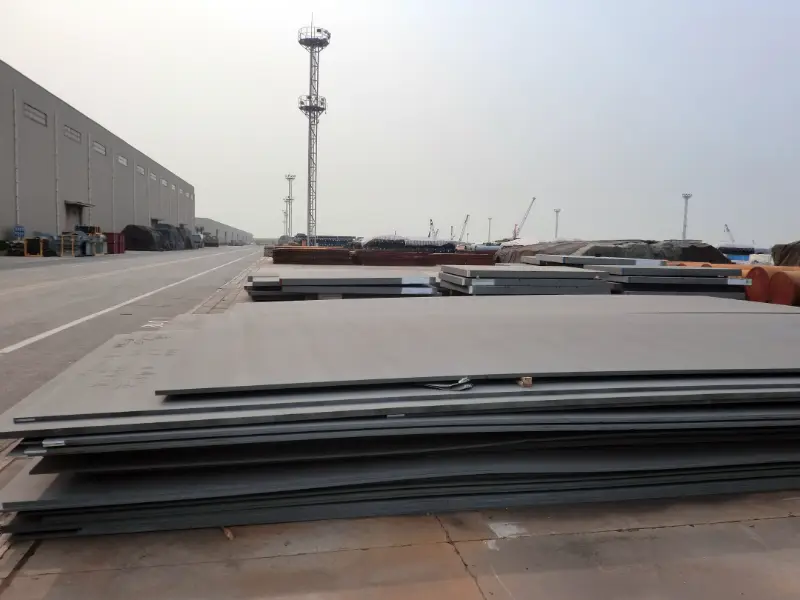
GB/T 16270 Q500D Steel Plate
Q500D High-Strength Structural Steel Plate: GB/T 16270 Properties & Applications
Comprehensive technical data for Q500D grade low-alloy high-strength structural steel plate under GB/T 16270. Includes chemical composition, mechanical properties, thermal and electrical physics, international equivalents, and application guidance.
Hot rolling, quenching and tempering, cutting, cold forming (limited), welding (with precautions), machining
- Phone : +8618037372205
- Email : [email protected]
- WhatsApp: Contact via Whtsapp
- WeChat: +8618037372205
GB/T 16270 Q500D Steel Plate Introduction
Q500D is a quenched and tempered high-strength low-alloy structural steel plate defined in Chinese standard GB/T 16270. With a minimum yield strength of 500 MPa, it is designed for heavy-duty structural applications where weight savings and high load-bearing capacity are critical. The grade D suffix indicates guaranteed impact toughness at -20°C, making it suitable for cold climate service. Typical delivery condition is quenched and tempered (Q+T). It offers good weldability with appropriate preheating and low-hydrogen practices, combined with excellent strength-to-weight ratio and moderate atmospheric corrosion resistance.
GB/T 16270 Q500D Steel Plate Chemical Composition
The chemical composition as per GB/T 16270 for grade Q500D. Elements are given in weight percent. The steel is low-carbon micro-alloyed with niobium, vanadium, titanium, or aluminum for grain refinement and precipitation strengthening. Carbon equivalent (CEV) is typically controlled to ensure weldability.
| Element | Standard Value (≤ max, unless range) | Notes |
|---|---|---|
| Carbon (C) | 0.18 | Max |
| Silicon (Si) | 0.50 | Max |
| Manganese (Mn) | 1.70 | Max |
| Phosphorus (P) | 0.020 | Max |
| Sulfur (S) | 0.010 | Max |
| Chromium (Cr) | 0.80 | Max |
| Nickel (Ni) | 1.00 | Max |
| Molybdenum (Mo) | 0.50 | Max |
| Copper (Cu) | 0.50 | Max |
| Niobium (Nb) | 0.06 | Max |
| Vanadium (V) | 0.08 | Max |
| Titanium (Ti) | 0.05 | Max |
| Aluminum (Al total) | 0.015 | Min usually added for grain refinement |
| Nitrogen (N) | 0.015 | Max |
| Boron (B) | 0.005 | Max |
| Carbon Equivalent (CEV) | To be agreed, typically ≤ 0.50 | Based on product thickness and welding requirements |
GB/T 16270 Q500D Steel Plate Thermal and Electrical Physical Properties
Typical physical properties for Q500D quenched and tempered steel at ambient and elevated temperatures. These are representative values for low-alloy structural steel; variations may occur depending on exact composition and heat treatment.
| Property | Standard/Typical Value | Unit | Test Condition |
|---|---|---|---|
| Density (ρ) | 7.85 | g/cm³ | Room temperature |
| Modulus of Elasticity (E) | 205 - 210 | GPa | Room temperature |
| Shear Modulus (G) | ~ 80 | GPa | Room temperature |
| Poisson's Ratio (ν) | 0.28 - 0.30 | — | Room temperature |
| Thermal Expansion Coefficient (α) | 11.5 - 12.5 | 10⁻⁶/K | 20°C - 100°C |
| Thermal Expansion Coefficient (α) | 12.5 - 13.5 | 10⁻⁶/K | 20°C - 200°C |
| Thermal Expansion Coefficient (α) | 13.5 - 14.0 | 10⁻⁶/K | 20°C - 400°C |
| Thermal Expansion Coefficient (α) | 14.0 - 14.8 | 10⁻⁶/K | 20°C - 600°C |
| Thermal Conductivity (λ) | 42 - 48 | W/(m·K) | 20°C |
| Thermal Conductivity (λ) | 40 - 45 | W/(m·K) | 200°C |
| Thermal Conductivity (λ) | 35 - 40 | W/(m·K) | 400°C |
| Specific Heat Capacity (c) | 450 - 500 | J/(kg·K) | 20°C - 100°C |
| Electrical Resistivity (ρ_e) | 0.20 - 0.30 | µΩ·m | Room temperature |
GB/T 16270 Q500D Steel Plate Mechanical Properties
Mechanical properties according to GB/T 16270 for Q500D. Values are based on quenched and tempered condition and apply to specified thickness ranges. Tensile testing at room temperature, impact test at -20°C.
| Property | Standard Required Value | Unit | Test Condition / Thickness |
|---|---|---|---|
| Yield Strength (ReH) min | 500 | MPa | t ≤ 50 mm |
| Yield Strength (ReH) min | 480 | MPa | 50 < t ≤ 100 mm |
| Yield Strength (ReH) min | 460 | MPa | 100 < t ≤ 150 mm |
| Tensile Strength (Rm) | 610 - 770 | MPa | t ≤ 50 mm |
| Tensile Strength (Rm) | 600 - 760 | MPa | 50 < t ≤ 100 mm |
| Tensile Strength (Rm) | 590 - 740 | MPa | 100 < t ≤ 150 mm |
| Elongation (A) min | 17 | % | t ≤ 50 mm (gauge 5.65√S₀) |
| Elongation (A) min | 16 | % | 50 < t ≤ 100 mm |
| Elongation (A) min | 15 | % | 100 < t ≤ 150 mm |
| Impact Energy (KV₂) min | 47 | J | -20°C, longitudinal, t ≤ 100 mm |
| Impact Energy (KV₂) min | 31 | J | -20°C, longitudinal, 100 < t ≤ 150 mm |
| Bend Test (diameter a) | 3a | — | 180°, t ≤ 50 mm (a=thickness) |
| Bend Test (diameter a) | 4a | — | 180°, 50 < t ≤ 100 mm |
| Through-thickness reduction of area (Z) if required | As per GB/T 5313 (Z15/Z25/Z35) | % | Optional, based on purchase agreement |
GB/T 16270 Q500D Steel Plate Completely Equivalent Material Standards and Substitute Grades
| Country/Region | Standard | Grade | Remarks |
|---|---|---|---|
| China | GB/T 16270 | Q500D | Base specification, quenched and tempered, impact @ -20°C |
| Europe | EN 10025-6 | S500Q | Similar strength, Q=Quenched and Tempered; impact tested at -20°C (option L applied) |
| Europe | EN 10025-6 | S500QL | Equivalent to Q500D in low-temperature toughness (L = -50°C min, but also covers -20°C) |
| International | ISO 4950-2 | E500DD | High yield strength flat products; DD denotes impact at -20°C |
| Germany | DIN EN 10025-6 | S500QL | Technically identical to EN version |
| Japan | JIS G 3128 | SHY 685 | Similar strength level (685 MPa tensile class), impact at -20°C; not fully equivalent but commonly cross-referenced |
GB/T 16270 Q500D Steel Plate Application Introduction
Q500D steel plate is engineered for demanding structural applications that require high strength, good toughness at sub-zero temperatures, and reliable weldability. Its quenched and tempered condition provides a favorable balance of strength and ductility. Typical usage involves fabricated components subject to high static and dynamic loads.
Product Applications: Bridge main beams and cross girders, Crane booms and outriggers, Excavator arms and buckets, Mining truck chassis and frames, Offshore platform legs and braces, Pressure vessel shells and heads, Wind tower sections, Hydraulic press frames
Processed into products: Welded box sections and built-up beams, Heavy-duty structural joints, Flanges and web plates for plate girders, Pinned connections and lugs, C-shaped and Z-shaped cold-formed sections (limited deformation), Machined bearing plates and shafts, Gusset plates and stiffeners, Mobile crane turntables
Application industries: Bridge construction (main girders, box girders), Heavy engineering machinery (cranes, excavators, bulldozers), Mining and earthmoving equipment (dump truck bodies, shovel buckets), Offshore and marine engineering (jack-up rig components, deck structures), Pressure vessels and penstocks (where strength and toughness are required), Building and infrastructure (high-rise columns, trusses, stadium structures), Wind turbine towers (thick-walled sections), Penstocks and hydraulic structures
GB/T 16270 Q500D Steel Plate Similar / Comparable Substitute Materials
| Country/Region | Standard | Grade | Remarks |
|---|---|---|---|
| China | GB/T 16270 | Q550D | Slightly higher strength (550 MPa yield), same impact class D; can be a substitute with design adjustment |
| USA | ASTM A514 | Grade B | Quenched and tempered alloy steel plate, 690 MPa tensile class; higher strength but often used in similar heavy structural applications |
| USA | ASTM A514 | Grade H | Similar to Grade B, with slight composition variations, used in pressure vessels and structures |
| Europe | EN 10025-6 | S690Q/QL | Higher strength class (690 MPa yield); may be over-matching alternative for Q500D |
| Japan | JIS G 3128 | SHY 685NS | 685 N/mm² tensile class, impact at -20°C; close mechanical properties |
| Japan | JIS G 3106 | SM570 | 590 MPa tensile class, rolled steel; lower strength but often considered for structural applications with reduced loads |
Notes:
- Q500D is typically produced as plates with thickness up to 150 mm under GB/T 16270. For thicknesses above 150 mm, properties shall be agreed upon.
- Welding requires low-hydrogen processes and preheating (typically 100-150°C) depending on thickness and combined carbon equivalent. Post-weld heat treatment is generally not required but may be applied based on service conditions.
- The steel can be ordered with through-thickness properties (Z-quality) per GB/T 5313 to resist lamellar tearing.
- Surface condition: The standard allows as-rolled or shot-blasted and primed surfaces under agreement.
- Tolerances on dimensions and shape should comply with GB/T 709 or other relevant standards.
- Ultrasonic testing can be performed according to GB/T 2970 or equivalent specifications.
- Share



