
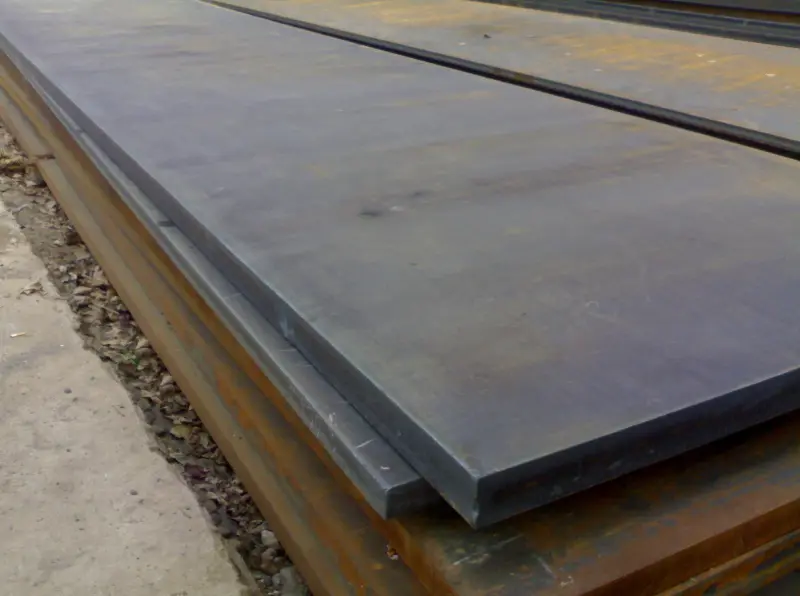
DIN 17102 TStE255 Fine
DIN 17102 TStE255 Weldable Fine-Grain Steel Plate – Composition, Properties & Equivalents
Complete data sheet for TStE255 steel according to DIN 17102: chemical composition, mechanical and physical properties, international equivalents (S355N), and applications in welded structures and machinery.
Hot rolling, normalized rolling, normalizing, cold forming, welding, gas cutting, machining
- Phone : +8618037372205
- Email : [email protected]
- WhatsApp: Contact via Whtsapp
- WeChat: +8618037372205
DIN 17102 TStE255 Fine Introduction
TStE255 is a weldable fine-grain structural steel originally specified in the German standard DIN 17102. It offers a minimum yield strength of 255 MPa in the as-delivered normalized condition and guarantees notch toughness at temperatures down to -20 °C. The steel is microalloyed with elements such as niobium, vanadium, or titanium to achieve fine grain size, providing an excellent combination of strength, toughness, and weldability. Because of its balanced mechanical properties and reliable low-temperature performance, TStE255 has been widely used in heavy steel construction, bridges, offshore structures, and machinery components.
Although DIN 17102 has been superseded by EN 10025-3, the grade remains a reference for many projects; its direct modern equivalent is S355N (or S355NL for -50 °C requirements).
DIN 17102 TStE255 Fine Chemical Composition Chart
Heat analysis according to DIN 17102 for grade TStE255. The steel is fully killed and fine-grain treated. Limits for carbon and manganese are controlled to guarantee the specified mechanical properties and good weldability.
- Carbon (C) ≤ 0.18 % for product thickness ≤ 16 mm; ≤ 0.20 % for thickness > 16 mm.
- Manganese (Mn) 0.90 – 1.65 %.
- Grain refinement is achieved with a minimum of 0.02 % total aluminum and optional microalloying additions (Nb ≤ 0.05 %, V ≤ 0.12 %, Ti ≤ 0.05 %).
- The carbon equivalent value (CEV) is typically limited to ≤ 0.40 % to prevent cold cracking during welding.
| Chemical Element | Standard Value | Remarks |
|---|---|---|
| C | ≤ 0.18 (t ≤ 16 mm); ≤ 0.20 (t > 16 mm) | Thickness dependent |
| Si | ≤ 0.50 | |
| Mn | 0.90 – 1.65 | |
| P | ≤ 0.030 | |
| S | ≤ 0.025 | |
| N | ≤ 0.020 | Total nitrogen |
| Al (total) | ≥ 0.02 | Fine grain practice |
| Nb | ≤ 0.05 | Optional microalloy |
| V | ≤ 0.12 | Optional microalloy |
| Ti | ≤ 0.05 | Optional microalloy |
| CEV | ≤ 0.40 (typical) | Carbon equivalent, depending on thickness |
DIN 17102 TStE255 Fine Thermal & Electrical Physical Properties
Physical properties for low-carbon fine-grain structural steel in the normalized condition. These typical values are suitable for design calculations and may vary slightly depending on exact composition and heat treatment.
- Density (ρ): 7.85 g/cm³ at 20 °C.
- Modulus of elasticity (E): 210 GPa; shear modulus (G) approx. 81 GPa; Poisson's ratio (ν) 0.3.
- Thermal expansion coefficient (α): around 12.0 × 10⁻⁶/K between 20 °C and 100 °C, increasing to approx. 13.0 × 10⁻⁶/K up to 300 °C.
- Thermal conductivity (λ): about 50 W/(m·K) at room temperature, decreasing with rising temperature.
- Specific heat capacity (cp): 460 J/(kg·K) at 20 °C.
- Electrical resistivity (ρ_e): in the range 0.22 – 0.25 µΩ·m.
| Property Item | Standard Required Value | Unit | Test Condition |
|---|---|---|---|
| Density (ρ) | 7.85 | g/cm³ | 20 °C |
| Modulus of elasticity (E) | 210 | GPa | 20 °C |
| Shear modulus (G) | ≈ 81 | GPa | 20 °C |
| Poisson's ratio (ν) | 0.3 | — | 20 °C |
| Thermal expansion coefficient (α) | 12.0 | 10⁻⁶/K | 20 – 100 °C |
| Thermal expansion coefficient (α) | 12.5 | 10⁻⁶/K | 20 – 200 °C |
| Thermal expansion coefficient (α) | 13.0 | 10⁻⁶/K | 20 – 300 °C |
| Thermal conductivity (λ) | 50 | W/(m·K) | 20 °C |
| Thermal conductivity (λ) | 47 | W/(m·K) | 200 °C |
| Specific heat capacity (cp) | 460 | J/(kg·K) | 20 °C |
| Electrical resistivity (ρ_e) | 0.22 – 0.25 | µΩ·m | 20 °C |
DIN 17102 TStE255 Fine Mechanical Characteristics
Minimum mechanical properties for TStE255 in the normalized condition, as required by DIN 17102. Tensile testing is performed at room temperature on transverse specimens (flat products). Impact energy is measured on longitudinal Charpy V-notch specimens.
- Yield strength (ReH) decreases gradually with increasing product thickness.
- Tensile strength (Rm) range is 360 – 480 MPa for all thicknesses.
- Elongation (A5) is guaranteed ≥ 24 % for thickness ≤ 40 mm and ≥ 23 % for 40–63 mm.
- Notch toughness at -20 °C must be at least 27 J (average of three tests).
- Bend test requirements ensure cold formability: mandrel diameter 2t (t ≤ 16 mm) and 3t (16 < t ≤ 40 mm), bend angle 180°.
| Property Item | Standard Required Value | Unit | Test Condition |
|---|---|---|---|
| Yield strength (ReH) | ≥ 255 | MPa | Thickness ≤ 16 mm |
| Yield strength (ReH) | ≥ 245 | MPa | Thickness 16 < t ≤ 40 mm |
| Yield strength (ReH) | ≥ 235 | MPa | Thickness 40 < t ≤ 63 mm |
| Tensile strength (Rm) | 360 – 480 | MPa | All thicknesses |
| Elongation (A5) | ≥ 24 | % | Thickness ≤ 40 mm |
| Elongation (A5) | ≥ 23 | % | Thickness 40 < t ≤ 63 mm |
| Impact energy (KV, longitudinal) | ≥ 27 | J | -20 °C |
| Bend test (mandrel diameter) | 2t (t ≤ 16 mm); 3t (16 < t ≤ 40 mm) | — | Bend angle 180° |
DIN 17102 TStE255 Fine Fully Equivalent Material Standards & Substitute Grade Recommendations
| Country / Region | Standard Specification | Grade | Remarks |
|---|---|---|---|
| Europe | EN 10025-3:2004 | S355N | Direct successor; fully equivalent normalized fine-grain steel. For -50 °C toughness use S355NL. |
| Germany (obsolete) | DIN 17102 | TStE255 | Original standard, now withdrawn. |
| International | ISO 4950-2 | E355DD | High yield strength (min 355 MPa) fine-grain steel with similar toughness concept. |
| Japan | JIS G3106 | SM490B | Yield 325 MPa min; SM490C for guaranteed toughness at 0 °C, comparable application. |
| USA | ASTM A572/A572M | Grade 50 [345] | Higher yield, similar strength; ASTM A709 Grade 50 for bridges. |
| China | GB/T 1591 | Q345D | Fine-grain steel with min yield 345 MPa and -20 °C impact requirement. |
DIN 17102 TStE255 Fine Application Introduction
TStE255 (currently supplied as S355N) is a versatile structural steel intended for welded, bolted, and riveted constructions. It is particularly suitable for components subjected to dynamic loads and low ambient temperatures down to -20 °C. The normalized condition ensures uniform through-thickness properties and predictable forming behavior.
Industries, products, and specific components include:
Product Applications: Welded structural frameworks, Composite steel-concrete bridges, Crane girders and runway beams, Offshore jacket and topside structures, Heavy-duty machinery bases and housings, Storage tanks and silos, Tubular towers and masts
Processed into products: Beams, columns and truss members, Bridge box sections and orthotropic decks, Lifting arms, booms and jibs, Base frames for mining and earthmoving equipment, Bolted flanges, end plates and stiffeners, Welded fabrications for hydraulic cylinders, Wind tower flanges and door frames
Application industries: Building and civil engineering (multi-story frames, industrial halls), Bridge construction (road and railway bridges), Offshore and marine engineering (platform substructures, deck modules), Heavy machinery and plant construction (cranes, excavators, presses), Pressure vessels and boiler making (medium-temperature service), Railway vehicle and transportation equipment, Renewable energy (wind turbine towers, support structures)
DIN 17102 TStE255 Fine Recommendations for Similar / Comparable Substitute Materials
| Country / Region | Standard Specification | Grade | Remarks |
|---|---|---|---|
| Europe | EN 10025-3 | S355N | Higher yield strength (355 MPa) but identical toughness and processing; directly replaces TStE255 in new designs. |
| Germany | DIN 17100 (obsolete) | St52-3 | General structural steel with yield ~355 MPa, not fine-grain treated; suitable only if low-temperature toughness is not critical. |
| Russia | GOST 19281 | 17G1S | Low-alloy structural steel with approx. 345 MPa yield, good weldability and moderate low-temperature toughness. |
| USA | ASTM A572 | Grade 50 [345] | Close in strength, but requires supplementary Charpy requirements (e.g., S5) to match -20 °C toughness. |
| Japan | JIS G3106 | SM490B | Comparable weldable structural steel; SM490YA provides improved weldability for thick sections. |
Notes:
- Standard withdrawal: DIN 17102 has been replaced by the European standard EN 10025-3. For new projects, order S355N or S355NL to obtain identical material with updated certification.
- Thickness range: The given properties apply to products up to 63 mm thickness. For heavier gauges, the standard provided reduced minimum yield strength and/or supplementary requirements – consult the original 1983 edition of DIN 17102.
- Welding: Preheating and interpass temperature control should follow EN 1011-2. Typical preheat for TStE255/S355N is 75–150 °C depending on thickness and hydrogen scale.
- CEV limitations: The typical maximum carbon equivalent for S355N is 0.43 % (t ≤ 30 mm) and 0.45 % (t > 30 mm). These values guarantee good weldability without cold cracking when using low-hydrogen processes.
- Delivery condition: Always specify '+N' (normalized) to ensure the declared toughness. Normalized rolling alone may not achieve the specified -20 °C impact values unless agreed.
- Share



