
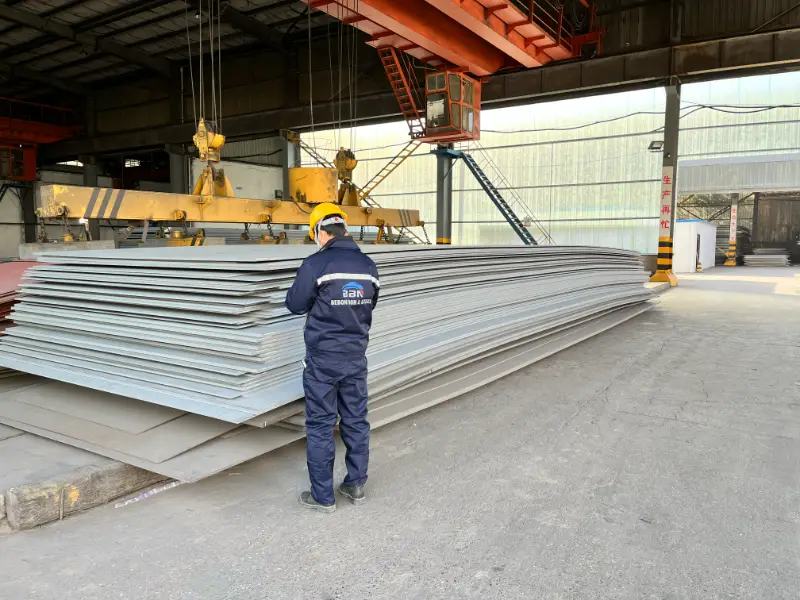
DIN 17102 EStE255 Carbon and Low-alloy High-strength Steel Plate
DIN 17102 EStE255 Carbon and Low-alloy High-strength Steel Plate: Composition, Properties & Global Equivalents
Comprehensive technical data for EStE255 steel according to DIN 17102: chemical composition, mechanical and thermal properties, international equivalents, and application guidelines.
Welding, bending, cold forming, flame cutting, machining, hot forming after re-normalizing
- Phone : +8618037372205
- Email : [email protected]
- WhatsApp: Contact via Whtsapp
- WeChat: +8618037372205
DIN 17102 EStE255 Carbon and Low-alloy High-strength Steel Plate Introduction
EStE255 is a weldable, normalized fine-grain structural steel grade defined in the former German standard DIN 17102. It is specifically designed for welded structures that require high strength, good toughness, and excellent weldability, even at low temperatures. The 'E' prefix denotes electric-furnace production with specific measures to achieve fine grain size through aluminium and microalloying elements (Nb, V, Ti).
- Minimum yield strength of 255 MPa for thicknesses up to 16 mm
- Guaranteed impact toughness at -20°C (KV ≥ 27 J)
- Good cold formability and suitability for hot-dip galvanizing
- Typical applications include bridges, cranes, offshore structures, and heavy machinery
DIN 17102 EStE255 Carbon and Low-alloy High-strength Steel Plate Chemical Composition
The following table shows the chemical composition requirements for EStE255 according to DIN 17102. The steel is fully killed, fine-grain treated with aluminium and microalloying additions to ensure a minimum grain size of ASTM 6 or finer. Maximum values apply unless a range is given.
| Element | Standard Value | Remarks |
|---|---|---|
| Carbon (C) | ≤ 0.18 | Ladle analysis |
| Silicon (Si) | ≤ 0.50 | |
| Manganese (Mn) | 0.50 - 1.30 | |
| Phosphorus (P) | ≤ 0.025 | |
| Sulfur (S) | ≤ 0.025 | |
| Aluminium (Al total) | ≥ 0.020 | Fine grain practice |
| Niobium (Nb) | ≤ 0.05 | Optional microalloying element |
| Vanadium (V) | ≤ 0.10 | Optional microalloying element |
| Titanium (Ti) | ≤ 0.05 | Optional microalloying element |
| Nitrogen (N) | ≤ 0.020 | High nitrogen levels are bound by Al, V etc. |
| Chromium (Cr) | ≤ 0.30 | Residual element |
| Nickel (Ni) | ≤ 0.30 | Residual element |
| Copper (Cu) | ≤ 0.30 | Residual element |
| Molybdenum (Mo) | ≤ 0.10 | Residual element |
DIN 17102 EStE255 Carbon and Low-alloy High-strength Steel Plate Thermal & Electrical Physical Properties
The following physical properties are representative for fine-grain structural steels like EStE255 at room temperature unless otherwise noted. Actual values may vary slightly with composition and manufacturing parameters. These values are useful for design calculations involving thermal loads, welding, and electrical applications.
| Property | Standard Value | Unit | Test Conditions |
|---|---|---|---|
| Density (ρ) | 7.85 | kg/dm³ (g/cm³) | 20°C |
| Modulus of elasticity (E) | 210 | GPa | 20°C |
| Shear modulus (G) | 81 | GPa | 20°C |
| Poisson's ratio (ν) | 0.3 | – | 20°C |
| Thermal expansion coefficient (α) | 11.1 | 10⁻⁶/K | 20 - 100°C |
| Thermal expansion coefficient (α) | 12.3 | 10⁻⁶/K | 20 - 200°C |
| Thermal expansion coefficient (α) | 13.1 | 10⁻⁶/K | 20 - 300°C |
| Thermal conductivity (λ) | 53 | W/(m·K) | 20°C |
| Thermal conductivity (λ) | 50 | W/(m·K) | 100°C |
| Specific heat capacity | 461 | J/(kg·K) | 20°C |
| Electrical resistivity (ρ_e) | 0.14 - 0.16 | µΩ·m | 20°C (typical for C-Mn steel) |
DIN 17102 EStE255 Carbon and Low-alloy High-strength Steel Plate Mechanical Properties
Mechanical properties are determined by tensile and impact testing in the normalized delivery condition. The values below comply with DIN 17102 for longitudinal test pieces. Different thickness ranges have different requirements; multiple rows are provided where necessary.
- Yield strength (ReH) decreases with increasing thickness.
- Elongation is measured on a gauge length of 5.65√So (A5).
- Impact energy (KV) is guaranteed at -20°C for longitudinal specimens.
| Property | Standard Requirement | Unit | Test Conditions |
|---|---|---|---|
| Yield strength (ReH) | ≥ 255 | MPa | Thickness ≤ 16 mm |
| Yield strength (ReH) | ≥ 245 | MPa | Thickness 16 < t ≤ 40 mm |
| Yield strength (ReH) | ≥ 235 | MPa | Thickness 40 < t ≤ 63 mm |
| Tensile strength (Rm) | 360 - 510 | MPa | Thickness ≤ 63 mm |
| Elongation (A) | ≥ 24 | % | Longitudinal, thickness ≤ 40 mm |
| Elongation (A) | ≥ 23 | % | Longitudinal, thickness 40 < t ≤ 63 mm |
| Impact energy (KV) | ≥ 27 | J | Longitudinal, at -20°C |
| Bend test (bend angle 180°) | No cracks | – | Mandrel diameter: 2t for t ≤ 16 mm, 3t for t > 16 mm |
DIN 17102 EStE255 Carbon and Low-alloy High-strength Steel Plate Fully Equivalent Material Standards & Replaceable Grades
| Country/Region | Standard | Grade | Remark |
|---|---|---|---|
| Germany | DIN 17102 (withdrawn) | EStE255 | Original designation, electric furnace fine grain steel |
| European Union | EN 10025-3 | S275N | Nearest current standard, normalized fine grain steel with similar strength and -20°C toughness |
| International | ISO 630-2 | E275C | Comparable fine grain structural steel, Charpy at -20°C, yield 255-275 MPa |
| Japan | JIS G3106 | SM490B | Similar yield and tensile strength, but toughness class may differ; check for fine grain practice |
DIN 17102 EStE255 Carbon and Low-alloy High-strength Steel Plate Application Introduction
EStE255 steel is a versatile structural material widely used in welded constructions that demand reliability under static and dynamic loading, even at sub-zero temperatures. Its fine-grain structure and controlled composition ensure excellent weldability without preheating in moderate thicknesses, as well as good cold-forming characteristics. The normalizing delivery condition provides uniform mechanical properties across the plate.
Product Applications: Welded beams and columns for high-rise buildings, Box girders and orthotropic bridge decks, Boom and jib sections for mobile cranes, Offshore platform legs and bracings, Penstocks and pressure vessel shells, Machine frames and base plates, Trailer chassis and rail car underframes
Processed into products: Flanges and web plates in plate girders, Bracket and node connections in truss structures, Bearing pads and load distribution plates, Stiffeners and diaphragms in box sections, Mounting brackets for heavy machinery, Splice plates and gussets in bolted/welded joints, Structural parts requiring guaranteed toughness at -20°C
Application industries: Bridge engineering, Building and civil engineering, Crane and heavy lifting equipment manufacturing, Shipbuilding and offshore structures, Pressure vessel and storage tank fabrication, Railway vehicle and automotive chassis construction, Wind turbine tower and foundation structures
DIN 17102 EStE255 Carbon and Low-alloy High-strength Steel Plate Similar / Alternative Material Recommendations
| Country/Region | Standard | Grade | Remark |
|---|---|---|---|
| European Union | EN 10025-3 | S275NL | Low-temperature version, guaranteed -50°C impact, otherwise mechanically similar |
| European Union | EN 10025-2 | S275J2 | Non-fine-grain structural steel with guaranteed -20°C impact; use if fine grain is not mandatory |
| USA | ASTM A572/A572M | Grade 50 [345] | Higher yield strength (345 MPa) but similar weldable structural steel; adjust design accordingly |
| China | GB/T 1591 | Q345C | Higher strength grade, normalized, 0°C impact; check -20°C requirements for substitution |
Notes:
- DIN 17102 has been superseded by the European standard EN 10025-3. When ordering, it is recommended to use the current designation S275N or S275NL and specify the matching Z-quality if required.
- The electric furnace process (E) ensures high purity and low sulfur/phosphorus levels, which directly contributes to excellent toughness and resistance to lamellar tearing.
- For thicker sections, normalizing after welding may be required to restore toughness. Always refer to the latest welding guidelines (e.g., EN 1011) for preheat and interpass temperature control.
- Share



