
DIN 17102 StE285 Weldable Fine
DIN 17102 StE285 Weldable Fine-Grain Structural Steel for Low-Temperature Service
Comprehensive technical data for StE285 carbon and low-alloy high-strength steel plate according to DIN 17102, including chemical composition, mechanical properties, thermal and electrical characteristics, international equivalents, and application guidance.
Hot rolling followed by normalizing; suitable for cold forming, cutting, and all common welding processes
- Phone : +8618037372205
- Email : [email protected]
- WhatsApp: Contact via Whtsapp
- WeChat: +8618037372205
DIN 17102 StE285 Weldable Fine Introduction
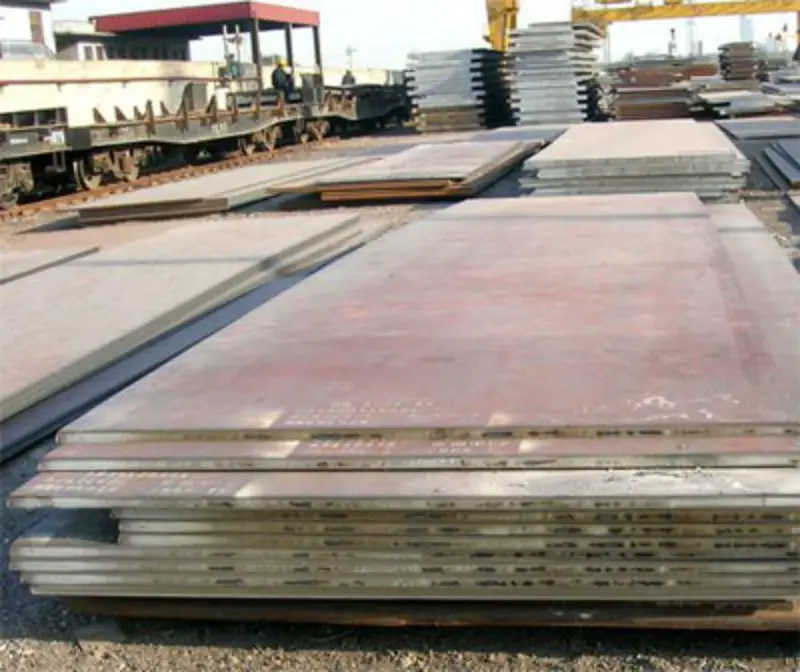
StE285 is a weldable fine-grain structural steel specified in the withdrawn German standard DIN 17102. It is supplied in the normalized condition and is intended for welded structures subject to high static and dynamic loads, often operating at low temperatures. The steel exhibits a minimum yield strength of 275 MPa for thicknesses up to 16 mm, combined with good toughness and excellent weldability, achieved through fine-grain practice and controlled microalloying with elements such as niobium, vanadium, and aluminium. Typical applications include bridge construction, crane building, offshore structures, pressure vessels, and heavy machinery. The grade is the historical precursor to modern European grades such as S275N and S275NL under EN 10025-3.
DIN 17102 StE285 Weldable Fine Chemical Composition
The chemical composition of StE285 according to DIN 17102 is designed to achieve fine grain structure and good weldability. Microalloying elements such as aluminium, niobium, and vanadium are added for grain refinement and precipitation strengthening. The maximum carbon equivalent (CEV) is typically controlled to ensure crack-free welding.
- Values are maximum unless a range is given.
- Ladle analysis is shown; permissible product analysis deviations are not included.
| Element | Specified Value (%) | Remarks |
|---|---|---|
| C | ≤ 0.18 | Carbon; for thickness > 100 mm may be slightly higher by agreement |
| Si | ≤ 0.50 | Silicon |
| Mn | 0.90 – 1.65 | Manganese |
| P | ≤ 0.025 | Phosphorus |
| S | ≤ 0.015 | Sulphur |
| Al (total) | ≥ 0.020 | Aluminium; minimum total content for fine-grain practice |
| Nb | ≤ 0.05 | Niobium |
| V | ≤ 0.08 | Vanadium; sum of Nb+V+Ti ≤ 0.12 |
| Ti | ≤ 0.03 | Titanium; optional |
| N | ≤ 0.015 | Nitrogen; if sufficient Al is present, N is bound as AlN |
| Cu | ≤ 0.35 | Copper; for improved atmospheric corrosion resistance optional |
| Ni | ≤ 0.70 | Nickel; may be present as residual or intentionally added |
| Cr | ≤ 0.30 | Chromium; residual |
| Mo | ≤ 0.10 | Molybdenum; residual or optional |
| CEV | ≤ 0.40 (typical) | Carbon equivalent value (CEV = C + Mn/6 + (Cr+Mo+V)/5 + (Ni+Cu)/15); maximum agreed between purchaser and manufacturer |
DIN 17102 StE285 Weldable Fine Thermal and Electrical Physical Properties
The following physical properties are typical for low-alloy structural steels similar to StE285 in the normalized condition. These values are not mandatory but are useful for design calculations. They may vary depending on exact composition and temperature.
- Density is practically independent of slight composition variations.
- Thermal properties are given at 20°C unless otherwise noted.
| Property | Typical Value | Unit | Condition / Reference |
|---|---|---|---|
| Density (ρ) | 7.85 | g/cm³ | Room temperature |
| Elastic modulus (E) | 210 | GPa | Room temperature; dynamic modulus ~212 GPa |
| Shear modulus (G) | 81 | GPa | Calculated from E and ν |
| Poisson's ratio (ν) | 0.30 | – | In the elastic range |
| Thermal expansion coefficient (α) | 12.0 | 10⁻⁶/K | 20°C to 100°C |
| Thermal expansion coefficient (α) | 12.5 | 10⁻⁶/K | 20°C to 200°C |
| Thermal expansion coefficient (α) | 13.0 | 10⁻⁶/K | 20°C to 300°C |
| Thermal conductivity (λ) | 48 | W/(m·K) | At 20°C |
| Specific heat capacity (cp) | 460 | J/(kg·K) | At 20°C; approximate value for low-alloy steel |
| Electrical resistivity (ρ_e) | 0.25 | μΩ·m | At 20°C, typical for carbon-manganese steel |
DIN 17102 StE285 Weldable Fine Mechanical Properties
Mechanical properties are guaranteed for normalized supply condition and must be verified in accordance with the inspection standard. Tensile and impact requirements are dependent on product thickness and test temperature. For thicknesses beyond the ranges shown, properties may be agreed. Typical Charpy-V impact values are given for both standard (N) and low-temperature (NL) variants, where the original StE285 grade may be associated with test temperatures of 0°C or -20°C.
- Values are transverse test pieces unless otherwise specified.
- 1 MPa = 1 N/mm².
| Property | Specified Value | Unit | Test Condition / Thickness Range |
|---|---|---|---|
| Yield Strength (ReH) | ≥ 275 | MPa | Thickness ≤ 16 mm |
| Yield Strength (ReH) | ≥ 275 (≥ 265) | MPa | 16 < t ≤ 35 mm (35 < t ≤ 50 mm) - typical; original StE285 may specify 275 up to 50 mm |
| Yield Strength (ReH) | ≥ 255 | MPa | 50 < t ≤ 80 mm |
| Tensile Strength (Rm) | 370 – 510 | MPa | Thickness ≤ 35 mm |
| Tensile Strength (Rm) | 370 – 510 (350 – 510) | MPa | 35 < t ≤ 50 mm (50 < t ≤ 80 mm) |
| Elongation (A5) | ≥ 24 | % | Longitudinal, thickness ≤ 40 mm, gauge length L0=5.65√S0 |
| Elongation (A5) | ≥ 23 | % | Thickness > 40 mm |
| Charpy-V Impact Energy (KV) | ≥ 27 (N quality, 0°C) | J | Longitudinal, 0°C test temperature |
| Charpy-V Impact Energy (KV) | ≥ 27 (NL quality, -20°C) | J | Longitudinal, -20°C test temperature (for low-temperature variant) |
| Bend Test (mandrel diameter) | No cracks | Mandrel diameter = 1.5 × thickness (for t ≤ 25 mm), 180° bend |
DIN 17102 StE285 Weldable Fine Complete Equivalent Material Standards and Substitutable Grades
| Country/Region | Standard | Grade | Remarks |
|---|---|---|---|
| Europe | EN 10025-3 | S275N | Normalized weldable fine-grain structural steel; direct successor, 0°C impact test |
| Europe | EN 10025-3 | S275NL | Low-temperature grade, -20°C impact test; comparable to StE285NL |
| International | ISO 630-3 | E275C | Fine-grain structural steel, normalized, impact at 0°C |
| International | ISO 630-3 | E275D | Fine-grain structural steel, normalized, impact at -20°C |
| Italy | UNI EN 10025-3 | S275N | Adopts EN standard |
| UK | BS EN 10025-3 | S275N | Adopts EN standard; former BS 4360 Gr. 43D/EE approximate |
| USA | ASTM A572/A572M | Grade 42 | Not a full equivalent; similar strength, not normalized; supplementary S5 for fine-grain practice required for equivalence |
| Japan | JIS G3106 | SM400B | Comparable in strength, but not exactly matching toughness and fine-grain requirements |
DIN 17102 StE285 Weldable Fine Application Introduction
StE285 was specifically developed for welded structures requiring guaranteed through-thickness properties and impact toughness at low temperatures. Its normalized delivery condition ensures uniform mechanical properties across large plates and heavy sections. The material is well suited for dynamic loading and fatigue-sensitive structures. Designers can select this steel for applications where modern S275N is specified, retrofitting projects, or where the original standard is still referenced in existing specifications.
Product Applications: Welded bridge girders and box sections, Offshore platform decks and legs, Crane booms and chassis, Penstocks and hydraulic structures, Wind turbine tower flanges and shells, Storage tanks for low-temperature media, Reinforcement ribs for tunnel linings
Processed into products: Main load-bearing plates in bridges (webs, flanges), Lifting equipment structural members (hooks, booms), Offshore module frames and nodes, Heavy-duty vehicle chassis and subframes, Pressure vessel shells and heads (for moderate temperatures), Base plates and fastening elements for machinery, Welded rotors and hubs for wind turbines
Application industries: Construction and civil engineering, Shipbuilding and offshore engineering, Energy (conventional and renewable) including wind turbine towers, Transportation infrastructure (bridges, rail cars), Heavy machinery manufacturing, Pressure vessel and storage tank fabrication
DIN 17102 StE285 Weldable Fine Similar / Approximate Substitute Materials Recommendation
| Country/Region | Standard | Grade | Remarks |
|---|---|---|---|
| Europe | EN 10025-3 | S260N / S260NL | Lower yield strength (260 MPa); similar chemistry and delivery condition; may be considered for thickness-limited design |
| Europe | EN 10025-3 | S355N / S355NL | Higher strength (355 MPa); use when weight saving is necessary; weldability still excellent |
| Germany | DIN 17102 | StE355 | Former higher-strength grade in the same standard; direct substitution where strength up-rate is acceptable |
| International | ISO 630-3 | E355C / E355D | Higher strength normalized fine-grain steel; suitable for higher loads |
| USA | ASTM A572/A572M | Grade 50 | Higher strength, 345 MPa minimum; may require normalizing and fine-grain practice to match toughness |
| China | GB/T 1591 | Q345D | Similar strength (345 MPa) and low-temperature toughness (-20°C); normalized or TMCP supply; close substitute for StE355 |
| Russia | GOST 19281 | 09G2S | Low-alloy structural steel, yield ~275 MPa, similar weldability and toughness, but not fine-grain guaranteed |
Notes:
- DIN 17102 is withdrawn and replaced by EN 10025-3. However, StE285 is still found in many older designs and maintenance projects, making its data essential for repair and upgrading works.
- The steel can be supplied with improved through-thickness properties (Z15, Z25, Z35) according to EN 10164 when required for highly restrained welded joints.
- Welding procedures should follow standard codes (e.g., EN 1011) with preheat depending on thickness and hydrogen control. The fine-grain structure and low carbon equivalent make it resistant to cold cracking.
- For cold forming, the steel can be bent to tight radii; however, aging effects may require stress-relief annealing after severe deformation.
- Consult the actual material certificate for exact property values as they may exceed minimum requirements significantly.
- Share



