
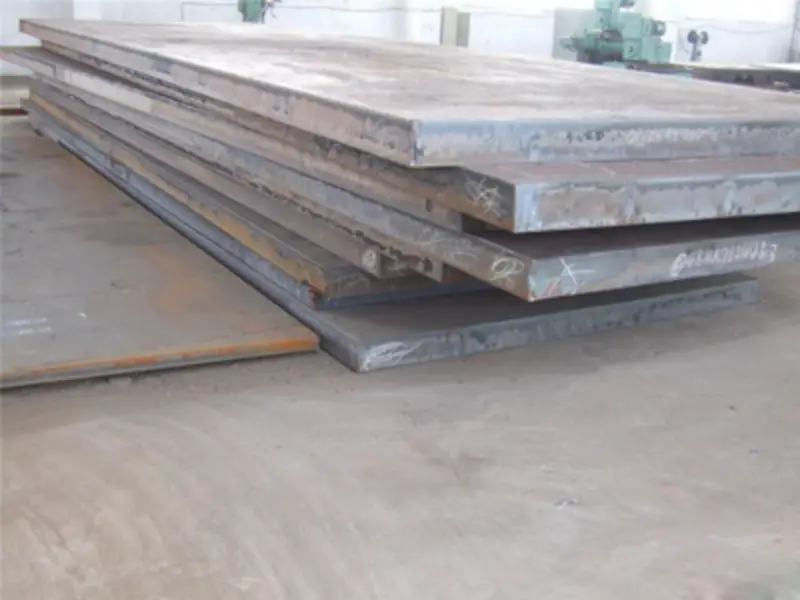
SM520C Steel Plate per JIS G3106
SM520C Steel Plate per JIS G3106: High-Strength Carbon & Low-Alloy for Welded Structures
Explore the chemical composition, mechanical and thermal properties, international equivalents, and applications of JIS G3106 SM520C carbon and low-alloy high-strength steel plate.
Welding, thermal cutting (oxy-fuel, plasma, laser), cold and hot bending, machining, drilling
- Phone : +8618037372205
- Email : [email protected]
- WhatsApp: Contact via Whtsapp
- WeChat: +8618037372205
SM520C Steel Plate per JIS G3106 Introduction
JIS G3106 SM520C is a carbon and low-alloy high-strength structural steel plate intended for welded constructions. It belongs to the SM series specified in the Japanese Industrial Standard for rolled steels for welded structures. SM520C offers a minimum tensile strength of 520 MPa and a yield point of at least 365 MPa for thicknesses up to 16 mm, with guaranteed Charpy impact toughness at 0°C. This grade is suitable for heavy-duty applications demanding elevated strength and reliable notch toughness, including bridges, buildings, offshore platforms, penstocks, and industrial machinery. The steel is typically supplied in as-rolled, normalized, or thermo-mechanical controlled processed (TMCP) conditions. Its good weldability and balanced mechanical properties make it a preferred choice for large welded structures subjected to dynamic loads and low-temperature service.
SM520C Steel Plate per JIS G3106 Chemical Composition
The following table lists the maximum permissible content of elements in SM520C as per JIS G3106. Microalloying elements such as niobium, vanadium, and titanium may be added at the manufacturer's discretion to achieve the required strength and toughness, but no fixed limits are specified in the standard unless agreed upon.
| Chemical Element | Standard Value (wt%) | Remarks |
|---|---|---|
| Carbon (C) | ≤ 0.20 | Max |
| Silicon (Si) | ≤ 0.55 | Max |
| Manganese (Mn) | ≤ 1.60 | Max |
| Phosphorus (P) | ≤ 0.035 | Max |
| Sulfur (S) | ≤ 0.035 | Max |
SM520C Steel Plate per JIS G3106 Thermal and Electrical Physical Properties
The values below are typical for carbon and low-alloy structural steels of this category and are not specified in JIS G3106. They are provided for design and calculation purposes. Actual properties may vary slightly depending on exact composition and heat treatment.
| Property | Typical Value | Unit | Test Condition / Remarks |
|---|---|---|---|
| Density (ρ) | 7 850 | kg/m³ | Room temperature |
| Elastic Modulus (E) | 205 | GPa | Room temperature |
| Shear Modulus (G) | 80 | GPa | Room temperature |
| Poisson's Ratio (ν) | 0.30 | – | Room temperature |
| Thermal Expansion Coefficient (α) | 11.7 | 10⁻⁶ /K | 20–100 °C |
| Thermal Conductivity (λ) | 51 | W/(m·K) | At 20 °C |
| Specific Heat Capacity (cₚ) | 486 | J/(kg·K) | At 20 °C |
| Electrical Resistivity (ρₑ) | 0.17 | 10⁻⁶ Ω·m | At 20 °C |
SM520C Steel Plate per JIS G3106 Mechanical Properties
Mechanical properties vary with plate thickness. The yield point or proof stress, tensile strength, elongation, bend test, and Charpy impact requirements are as follows. Test pieces and conditions are per JIS Z2241 and Z2201. Impact test applies only to plates thicker than 12 mm.
| Property | Standard Required Value | Unit | Test Condition / Thickness (mm) |
|---|---|---|---|
| Yield Strength (ReH) | ≥ 365 | N/mm² (MPa) | t ≤ 16 |
| Yield Strength (ReH) | ≥ 355 | N/mm² (MPa) | 16 < t ≤ 40 |
| Yield Strength (ReH) | ≥ 335 | N/mm² (MPa) | 40 < t ≤ 75 |
| Yield Strength (ReH) | ≥ 325 | N/mm² (MPa) | 75 < t ≤ 100 |
| Yield Strength (ReH) | ≥ 305 | N/mm² (MPa) | 100 < t ≤ 160 |
| Yield Strength (ReH) | ≥ 295 | N/mm² (MPa) | 160 < t ≤ 200 |
| Tensile Strength (Rm) | 520 – 640 | N/mm² (MPa) | t ≤ 100 |
| Tensile Strength (Rm) | 510 – 640 | N/mm² (MPa) | 100 < t ≤ 200 |
| Elongation (A) | ≥ 14 | % | t ≤ 5; No.5 test piece |
| Elongation (A) | ≥ 19 | % | 5 < t ≤ 16; No.1A test piece |
| Elongation (A) | ≥ 21 | % | 16 < t ≤ 40; No.1A test piece |
| Elongation (A) | ≥ 23 | % | 40 < t ≤ 200; No.4 test piece |
| Bend Test (180°) | Inside radius 1.5t | – | t ≤ 16 |
| Bend Test (180°) | Inside radius 2.0t | – | 16 < t ≤ 100 |
| Bend Test (180°) | Inside radius 2.5t | – | 100 < t ≤ 200 |
| Charpy Impact (KV₂) | ≥ 47 / 34 (av./indiv.) | J | At 0 °C, V-notch, longitudinal, t > 12 mm |
SM520C Steel Plate per JIS G3106 Fully Equivalent Material Standards and Replaceable Grades
| Country/Region | Standard | Grade | Remarks |
|---|---|---|---|
| China | GB/T 1591 | Q390C | Comparable, yield ≥390 MPa for t≤16 mm; impact at 0°C |
| EU | EN 10025-4 | S420M | Thermo-mechanical rolled, yield ≥420 MPa for t≤16 mm; impact at -20°C (more stringent) |
| USA | ASTM A572 | Grade 55 | Yield ≥380 MPa (55 ksi), tensile ≥485 MPa; impact test optional |
| International | ISO 4950-2 | E420 DD | High-strength structural steel, yield ≥420 MPa, similar weldability |
SM520C Steel Plate per JIS G3106 Application Introduction
SM520C is engineered for welded fabrications where a combination of high strength, good low‑temperature toughness (0°C), and reliable performance under static and dynamic loads is essential. Its superior weldability and formability make it a workhorse in modern infrastructure and heavy industries.
Product Applications: Steel plates for welded beams and girders, Box columns and built‑up sections for high‑rise structures, Offshore structural modules (topsides, jackets), Penstock pipes and bifurcations, Heavy‑duty machinery frames and booms, Load‑bearing structures in ports and terminals
Processed into products: Main bridge girders and cross beams, Support columns and truss chords, Flanges and web plates of built‑up sections, Stiffeners, gusset plates, and splice plates, Ship hull plates and bulkheads, Crane boom elements and chassis frames, Pressure vessel shells and heads, Joints and connection plates in seismic‑resistant frames
Application industries: Bridge construction (highway and railway bridges), Shipbuilding and marine engineering (hulls, decks, offshore platforms), Building and civil engineering (high‑rise frames, stadiums, airport terminals), Heavy machinery (cranes, excavators, mining equipment), Pressure vessels and storage tanks (where toughness at low ambient temperatures is required), Hydroelectric and water supply (penstocks, gates, spiral cases)
SM520C Steel Plate per JIS G3106 Similar or Alternative Material Recommendations
| Country/Region | Standard | Grade | Remarks |
|---|---|---|---|
| Japan | JIS G3106 | SM490C | Lower strength (yield ≥325 MPa for t≤16 mm), same impact class (0°C) |
| Japan | JIS G3106 | SM570 | Higher strength (yield ≥460 MPa for t≤16 mm), suitable for heavier sections |
| EU | EN 10025-2 | S355J0 | Lower strength (yield ≥355 MPa), impact at 0°C, widely available |
| USA | ASTM A572 | Grade 50 | Yield ≥345 MPa, common in welded structures, lower strength alternative |
| China | GB/T 1591 | Q345D | Yield ≥345 MPa, impact at -20°C, cost-effective alternative for less demanding applications |
Notes:
SM520C offers good weldability for its strength level; however, preheating and post‑weld heat treatment may be required depending on plate thickness and welding procedure to avoid hydrogen‑induced cold cracking. Care should be taken to control heat input to maintain toughness in the heat‑affected zone (HAZ). The steel can be cold‑formed to reasonable radii, and flame cutting does not significantly degrade edge properties when recommended practices are followed. For severe corrosive environments, protective coatings or cathodic protection are recommended. Always refer to the latest revision of JIS G3106 and the manufacturer's test certificate for guaranteed properties.
- Share



