
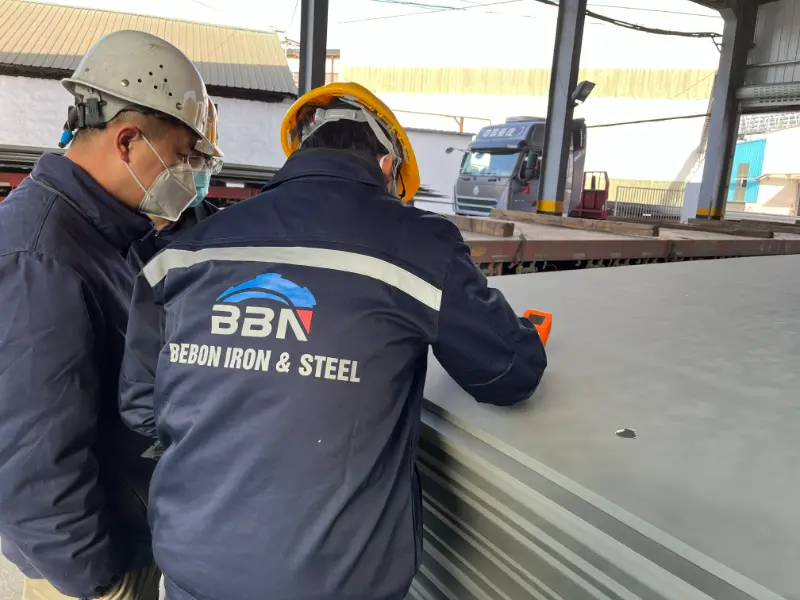
JIS G3101 SS540 Carbon and Low-alloy High-strength Steel Plate
JIS G3101 SS540 Carbon and Low-alloy High-strength Steel Plate Data & Equivalents
Comprehensive technical data for JIS G3101 SS540 carbon structural steel plate. Includes composition, mechanical and physical properties, equivalent grades, and application guide for construction and machinery.
Hot rolling, cold forming, welding, flame cutting, machining
- Phone : +8618037372205
- Email : [email protected]
- WhatsApp: Contact via Whtsapp
- WeChat: +8618037372205
JIS G3101 SS540 Carbon and Low-alloy High-strength Steel Plate Introduction
JIS G3101 SS540 is a Japanese standard carbon structural steel with a minimum tensile strength of 540 MPa. It is classified under the JIS G3101 specification for hot-rolled steels for general structure and is widely used in welded structural applications requiring good strength, formability, and weldability. The steel is essentially a carbon steel with limited alloying elements, and its properties are controlled primarily by carbon and manganese content. Typical delivery condition is as-rolled, making it cost-effective for heavy-duty structural members. SS540 is suitable for bridges, buildings, shipbuilding, and heavy machinery where high strength and reliable performance are essential.
JIS G3101 SS540 Carbon and Low-alloy High-strength Steel Plate Chemical Composition
Chemical composition according to JIS G3101 for SS540. Only C, Mn, P, and S are specified; silicon is not controlled but typically remains at low residual levels. Residual elements such as Ni, Cr, Cu are incidental.
| Chemical Element | Standard Value (wt%) | Remarks |
|---|---|---|
| C | ≤ 0.30% | |
| Mn | ≤ 1.60% | |
| P | ≤ 0.040% | |
| S | ≤ 0.040% | |
| Si | - | Not specified; typical residual ≤ 0.50% |
JIS G3101 SS540 Carbon and Low-alloy High-strength Steel Plate Thermal and Electrical Physical Properties
Physical properties at room temperature, typical for carbon steel of this grade. Values may vary slightly with composition and heat treatment. Thermal expansion coefficient and thermal conductivity are given for 20°C unless otherwise noted.
| Property | Typical Value | Unit | Test Condition |
|---|---|---|---|
| Density (ρ) | 7.85 | g/cm³ | 20°C |
| Elastic Modulus (E) | 205 | GPa | 20°C |
| Shear Modulus (G) | 80 | GPa | 20°C |
| Poisson's Ratio (ν) | 0.30 | - | 20°C |
| Thermal Expansion Coeff. (α) | 11.7 × 10⁻⁶ | /K | 20°C – 100°C |
| Thermal Conductivity (λ) | 53 | W/(m·K) | 20°C |
| Specific Heat Capacity | 486 | J/(kg·K) | 20°C |
| Electrical Resistivity (ρ_e) | 0.20 | μΩ·m | 20°C |
JIS G3101 SS540 Carbon and Low-alloy High-strength Steel Plate Mechanical Properties
Mechanical properties as per JIS G3101, tested in accordance with JIS Z2241 (tensile) and JIS Z2248 (bend test). Tensile properties depend on plate thickness. No impact test is required unless separately agreed. Elongation values apply to JIS No.5 test piece for t≤5mm and No.1A test piece for t>5mm.
| Property | Standard Requirement | Unit | Test Condition |
|---|---|---|---|
| Yield Strength (ReH) | ≥ 400 | MPa | Thickness ≤ 16 mm |
| Yield Strength (ReH) | ≥ 390 | MPa | 16 mm < thickness ≤ 40 mm |
| Yield Strength (ReH) | ≥ 380 | MPa | 40 mm < thickness ≤ 100 mm |
| Tensile Strength (Rm) | 540 – 660 | MPa | All thicknesses |
| Elongation (A) | ≥ 14 | % | Thickness ≤ 5 mm (No.5 test piece) |
| Elongation (A) | ≥ 16 | % | 5 mm < thickness ≤ 16 mm (No.1A test piece) |
| Elongation (A) | ≥ 18 | % | 16 mm < thickness ≤ 50 mm (No.1A test piece) |
| Elongation (A) | ≥ 22 | % | 50 mm < thickness ≤ 100 mm (No.1A test piece) |
| Bend Test (Bend Dia.) | 1.0 a | - | Thickness ≤ 16 mm, 180° bend |
| Bend Test (Bend Dia.) | 1.5 a | - | 16 mm < thickness ≤ 100 mm, 180° bend |
JIS G3101 SS540 Carbon and Low-alloy High-strength Steel Plate Fully Equivalent Material Standards and Replaceable Grades
No international standard provides a fully matching grade. The table lists only the original JIS designation. Substitution with materials of similar strength level should be carefully evaluated for chemical composition, guaranteed properties, and weldability.
| Country/Region | Standard | Grade | Remarks |
|---|---|---|---|
| Japan | JIS G3101 | SS540 | Original specification |
JIS G3101 SS540 Carbon and Low-alloy High-strength Steel Plate Application Introduction
SS540 is designed for welded structures where high strength can reduce section thickness and overall weight. Its good formability and weldability make it suitable for both field and shop fabrication. Common applications include heavy-duty frameworks, bridges, and machinery components subjected to static and moderate dynamic loads.
Product Applications: Hot-rolled steel plates for structural beams and columns, Steel strips and sheets for cold-formed profiles, Wide flats and sections for welded assemblies, Skelp and hollow sections
Processed into products: Bridge main girders and crossbeams, Building columns and truss members, Ship hull plates and deck supports, Bogie frames for railway cars, Excavator booms and dump truck bodies, Machine bases and press frames, Tubular structures and lattice towers
Application industries: Construction and civil engineering, Bridge engineering, Shipbuilding and marine structures, Railway vehicle manufacturing, Heavy machinery and equipment, Industrial storage and handling systems
JIS G3101 SS540 Carbon and Low-alloy High-strength Steel Plate Similar / Alternative Material Recommendations
The following grades offer comparable tensile strength ranges and are often considered for substitution, although chemical and toughness requirements may differ. Always verify with the respective standard and intended service conditions.
| Country/Region | Standard | Grade | Remarks |
|---|---|---|---|
| China | GB/T 1591 | Q420B | Yield ≥420 MPa, similar strength; check CEV and impact |
| USA | ASTM A572 | Grade 60 | Yield 415 MPa min, tensile 520-620 MPa; limited C/Mn |
| EU | EN 10025-2 | S420N | Yield ≥420 MPa, normalized delivery; good weldability |
Notes:
SS540 is generally supplied in the as-rolled condition. Preheating is recommended for welding thick sections or when low ambient temperatures to avoid hydrogen cracking. The material is not intended for severe low-temperature service; supplementary impact testing can be specified by agreement. When substituting with similar grades, ensure that strength, ductility, and fabrication requirements align with design codes.
- Share



