
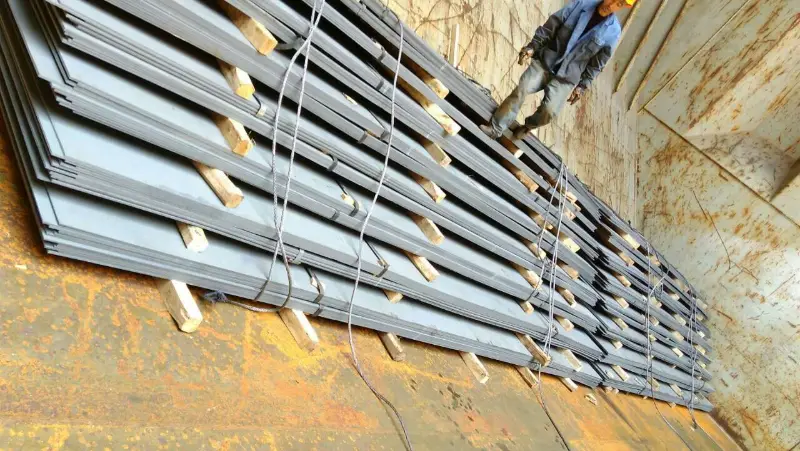
JIS G3106 SM570 Steel Plate
JIS G3106 SM570 Steel Plate - High-Strength Carbon & Low-Alloy Steel for Welded Structures
Comprehensive material data for JIS G3106 SM570 carbon and low-alloy high-strength steel plate, including chemical composition, mechanical & thermal properties, international equivalents, and application guidelines.
Welding, bending, cutting, machining, cold forming (limited for thick sections)
- Phone : +8618037372205
- Email : [email protected]
- WhatsApp: Contact via Whtsapp
- WeChat: +8618037372205
JIS G3106 SM570 Steel Plate Introduction
JIS G3106 SM570 is a carbon and low-alloy high-strength structural steel plate designed for welded structures such as bridges, buildings, pressure vessels, and heavy machinery. It offers a minimum yield strength of 460 MPa and tensile strength in the range of 570–720 MPa, ensuring high load-bearing capacity and good weldability. The steel is typically supplied in the as-rolled, normalized, or TMCP (thermo-mechanical controlled process) condition. Its balanced chemistry with low carbon content and optional microalloying elements provides excellent toughness and formability, making it suitable for demanding engineering applications where weight reduction and high strength are required.
JIS G3106 SM570 Steel Plate Chemical Composition
The chemical composition of SM570 steel is governed by JIS G3106. The standard specifies maximum limits for major elements. Low carbon content ensures good weldability, while manganese and silicon contribute to strength. Microalloying elements such as niobium, vanadium, titanium, or molybdenum may be added to meet the required mechanical properties, especially for thicker plates. The table below lists the standard guaranteed values.
| Element | Standard Value (max, wt.%) | Remarks |
|---|---|---|
| Carbon (C) | 0.18 | Ladle analysis |
| Silicon (Si) | 0.55 | Ladle analysis |
| Manganese (Mn) | 1.60 | Ladle analysis |
| Phosphorus (P) | 0.035 | Ladle analysis |
| Sulfur (S) | 0.035 | Ladle analysis |
| Others | Cr, Ni, Cu, Mo, Nb, V, Ti, etc. | May be added singly or in combination as necessary |
JIS G3106 SM570 Steel Plate Thermal and Electrical Physical Properties
Typical physical properties for SM570 steel at room temperature and elevated temperatures are presented below. These values are not part of the standard but are based on general data for similar low-alloy structural steels. Values may vary slightly depending on the exact chemical composition and manufacturing process.
| Property | Typical Value | Unit | Test Condition / Temperature |
|---|---|---|---|
| Density (ρ) | 7.85 | g/cm³ | 20 °C |
| Modulus of Elasticity (E) | 205 | GPa | 20 °C |
| Shear Modulus (G) | 80 | GPa | 20 °C |
| Poisson's Ratio (ν) | 0.3 | — | 20 °C |
| Thermal Expansion Coefficient (α) | 12.0 × 10⁻⁶ | K⁻¹ | 20 – 100 °C |
| Thermal Expansion Coefficient (α) | 12.8 × 10⁻⁶ | K⁻¹ | 20 – 200 °C |
| Thermal Expansion Coefficient (α) | 13.4 × 10⁻⁶ | K⁻¹ | 20 – 300 °C |
| Thermal Expansion Coefficient (α) | 14.0 × 10⁻⁶ | K⁻¹ | 20 – 400 °C |
| Thermal Conductivity (λ) | 52 | W/(m·K) | 20 °C |
| Specific Heat Capacity (c) | 460 | J/(kg·K) | 20 °C |
| Electrical Resistivity (ρₑ) | 0.15 × 10⁻⁶ | Ω·m | 20 °C |
JIS G3106 SM570 Steel Plate Mechanical Properties
Mechanical properties are specified in JIS G3106 and depend on plate thickness. The tensile test uses test pieces according to JIS Z2201 (No.5 or No.1A). Yield strength (ReH) and elongation values decrease as thickness increases, while tensile strength (Rm) remains within a fixed range. The bend test is performed at 180° with an inner radius related to plate thickness. Unless specially agreed, impact toughness is not specified.
| Property | Required Value | Unit | Test Condition / Thickness (mm) |
|---|---|---|---|
| Yield Strength (ReH) | ≥ 460 | MPa | t ≤ 16 |
| Yield Strength (ReH) | ≥ 450 | MPa | 16 < t ≤ 40 |
| Yield Strength (ReH) | ≥ 430 | MPa | 40 < t ≤ 75 |
| Yield Strength (ReH) | ≥ 420 | MPa | 75 < t ≤ 100 |
| Tensile Strength (Rm) | 570 – 720 | MPa | t ≤ 100 |
| Elongation (A) | ≥ 19 | % | t ≤ 16, JIS No.5 test piece, longitudinal |
| Elongation (A) | ≥ 24 | % | 16 < t ≤ 40, JIS No.5 test piece, longitudinal |
| Elongation (A) | ≥ 22 | % | 40 < t ≤ 75, JIS No.1A test piece, longitudinal |
| Elongation (A) | ≥ 22 | % | 75 < t ≤ 100, JIS No.1A test piece, longitudinal |
| Bend Test | 180°, inner radius r = 1.5a | — | t ≤ 16; a = specimen thickness |
| Bend Test | 180°, inner radius r = 2.0a | — | 16 < t ≤ 100 |
JIS G3106 SM570 Steel Plate Directly Equivalent Standards & Substitutable Grades
The table lists international standards and grades that are considered directly equivalent or commercially interchangeable with JIS G3106 SM570. Most have similar strength levels (yield ~460 MPa, tensile 570–720 MPa) and comparable chemical requirements, but minor differences may exist. Always verify specific requirements for each project.
| Country / Region | Standard | Grade | Remarks |
|---|---|---|---|
| Japan | JIS G3106 | SM570 | Original standard, yield 460 MPa min. |
| Korea | KS D3515 | SM570 | Identical to JIS standard. |
| Europe | EN 10025-3 | S460N / S460NL | Normalized; S460NL has specified low-temperature toughness. Tensile 540–720 MPa (lower min. tensile than SM570). |
| Europe | EN 10025-4 | S460M / S460ML | TMCP; S460ML with low-temperature toughness. Tensile 540–720 MPa. |
| USA | ASTM A572 | Grade 65 | Yield 450 MPa min., tensile 550 MPa min. Slightly lower strength; can often substitute. |
| China | GB/T 1591 | Q460C/D/E | Yield ≥460 MPa, tensile 550–720 MPa. Wide range of toughness classes. |
| International | ISO 630-3 | S460N / S460NL | Equivalent to EN 10025-3 S460N/NL. |
JIS G3106 SM570 Steel Plate Application Introduction
SM570 steel is extensively used in industries that demand high strength and good weldability. It can be formed, machined, and welded with standard processes. Preheating and post-weld heat treatment may be required for thick sections to avoid cold cracking. Typical applications and components are listed below.
Product Applications: Welded bridge girders and box sections, High-strength building columns and beams, Offshore platform legs and braces, Pressure vessel shells and heads, Crane booms and chassis, Heavy-duty truck frames, Storage tanks, Ship hull structures
Processed into products: Flanges and webs of heavy welded sections, Boom sections of mobile cranes, Structural nodes and gusset plates, Main frames of mining dump trucks, Piling and foundation components, Reinforced members in high-stress areas, Penstock pipes and bifurcations, Large-diameter welded pipes
Application industries: Bridge and civil engineering, Building construction (high-rise, stadiums), Shipbuilding and offshore platforms, Pressure vessels and boilers, Heavy machinery and mining equipment, Crane and lifting equipment, Transportation (truck frames, rail cars), Energy (wind turbine towers, hydroelectric penstocks)
JIS G3106 SM570 Steel Plate Similar / Alternative Materials
In addition to the directly equivalent grades, several other high-strength structural steels can serve as alternatives depending on application requirements (e.g., higher toughness, improved weldability, or different delivery conditions). These materials are not full equivalents but can be considered for engineering substitutions with appropriate design adjustments.
| Country / Region | Standard | Grade | Remarks |
|---|---|---|---|
| Europe | EN 10025-6 | S500Q / S500QL | Quenched and tempered, higher strength (yield ≥500 MPa), used when higher load capacity is needed. |
| Europe | EN 10149-2 | S500MC | High yield (~500 MPa) hot-rolled TMCP steel for cold forming. Tensile lower (550–700 MPa). |
| USA | ASTM A709 | Grade 65 | Structural steel for bridges; similar strength to A572 Gr.65. |
| USA | ASTM A913 | Grade 65 | High-strength low-alloy steel with yield 450 MPa, often used in structural shapes. |
| China | GB/T 1591 | Q500C/D/E | Higher strength grade (yield ≥500 MPa), tensile 610–770 MPa. |
| Russia | GOST 19281 | 16G2AF (16Г2АФ) | Similar low-alloy steel with yield ~440 MPa, used in welded structures. |
Notes:
Welding recommendations: SM570 can be welded using all common arc welding processes (SMAW, GMAW, SAW). Low hydrogen electrodes and appropriate preheating (typically 50–150 °C depending on plate thickness) are advisable. Post-weld heat treatment (PWHT) is generally not required but may be applied for stress relief at 550–600 °C. Cold forming: For thicknesses above 16 mm, minimum bending radii should be followed to avoid cracking; hot forming is recommended for complex shapes. Inspection: Ultrasonic testing (UT) can be performed according to JIS G0801 or other agreed standards. Certification: Material test certificates (EN 10204 3.1 or 3.2) are usually available upon request.
- Share



