
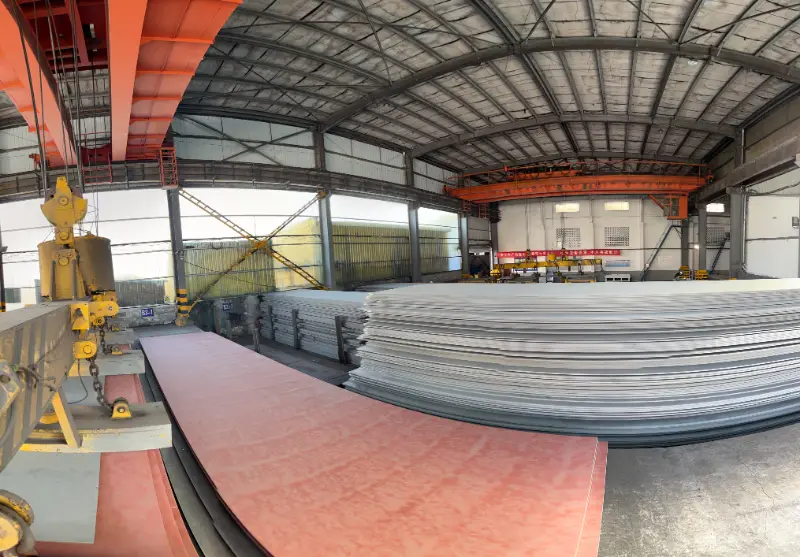
EN 10025-6 S690Q Steel
EN10025-6 S690Q Steel Plate: High Strength Quenched & Tempered Structural Steel
Detailed material data for EN10025-6 S690Q carbon and low-alloy high-strength steel plate, including chemical composition, mechanical properties, thermal and electrical physical properties, international equivalents, similar alternatives, and application guidance.
Hot rolled, quenched and tempered; suitable for welding, cold forming, and machining
- Phone : +8618037372205
- Email : [email protected]
- WhatsApp: Contact via Whtsapp
- WeChat: +8618037372205
EN 10025-6 S690Q Steel Introduction
EN10025-6 S690Q is a quenched and tempered high-yield-strength structural steel plate with a minimum yield strength of 690 MPa. It belongs to the family of fine-grain structural steels for welded constructions, offering an outstanding combination of high strength, good toughness, and excellent weldability. The 'Q' designation indicates the quenching and tempering heat treatment condition. Typical applications include heavy machinery, crane booms, offshore structures, pressure vessels, bridges, and high-stress components where weight reduction and high load-bearing capacity are critical.
- High yield strength up to 690 MPa
- Excellent low-temperature impact toughness (≥27 J at -20°C)
- Good formability and weldability with proper procedures
EN 10025-6 S690Q Steel Chemical Composition
Chemical composition limits according to EN 10025-6 for grade S690Q (ladle analysis). The steel is microalloyed with niobium, vanadium, titanium, and aluminum to achieve fine grain size and high strength through controlled rolling and heat treatment. Low sulfur and phosphorus ensure improved cleanliness and toughness.
| Chemical Element | Nominal Value (max, %) | Remarks |
|---|---|---|
| Carbon (C) | 0.20 | Max value |
| Silicon (Si) | 0.80 | Max value |
| Manganese (Mn) | 1.70 | Max value |
| Phosphorus (P) | 0.020 | Max value |
| Sulfur (S) | 0.010 | Max value |
| Niobium (Nb) | 0.06 | Max value |
| Vanadium (V) | 0.12 | Max value |
| Titanium (Ti) | 0.05 | Max value |
| Chromium (Cr) | 1.50 | Max value |
| Nickel (Ni) | 2.0 | Max value |
| Molybdenum (Mo) | 0.70 | Max value |
| Copper (Cu) | 0.30 | Max value |
| Boron (B) | 0.005 | Max value |
| Nitrogen (N) | 0.015 | Max value |
| Aluminum (Al) total | ≥ 0.015 | Minimum for fine grain practice |
EN 10025-6 S690Q Steel Thermal and Electrical Physical Properties
Physical properties are typical for low-alloy quenched and tempered steels at room temperature (20°C) unless otherwise noted. Thermal expansion, thermal conductivity, and specific heat capacity vary with temperature. The values below are approximate and suitable for engineering calculations.
| Property | Standard Requirement | Unit | Test Condition |
|---|---|---|---|
| Density (ρ) | 7850 | kg/m³ | At 20°C |
| Elastic modulus (E) | 205 – 210 | GPa | At 20°C |
| Shear modulus (G) | 80 – 82 | GPa | Calculated from E and ν |
| Poisson's ratio (ν) | 0.29 – 0.30 | – | At 20°C |
| Thermal expansion coefficient (α) | 11.5 – 12.5 | ×10⁻⁶ /K | 20°C to 100°C range |
| Thermal conductivity (λ) | 35 – 45 | W/(m·K) | At 20°C |
| Specific heat capacity (cp) | 460 – 480 | J/(kg·K) | At 20°C |
| Electrical resistivity (ρe) | 0.20 – 0.25 | µΩ·m | At 20°C |
EN 10025-6 S690Q Steel Mechanical Properties
Mechanical properties are guaranteed at delivery condition (quenched and tempered) and tested in accordance with EN 10025-6. Values depend on product thickness. Impact energy is measured on longitudinal Charpy V-notch specimens at -20°C.
| Property | Standard Requirement | Unit | Test Condition / Thickness |
|---|---|---|---|
| Yield strength (ReH) minimum | 690 | MPa | Thickness ≤ 50 mm |
| Yield strength (ReH) minimum | 650 | MPa | 50 mm < thickness ≤ 100 mm |
| Yield strength (ReH) minimum | 630 | MPa | 100 mm < thickness ≤ 150 mm |
| Tensile strength (Rm) | 770 – 940 | MPa | Thickness ≤ 50 mm |
| Tensile strength (Rm) | 760 – 930 | MPa | 50 mm < thickness ≤ 100 mm |
| Tensile strength (Rm) | 710 – 900 | MPa | 100 mm < thickness ≤ 150 mm |
| Elongation after fracture (A) | ≥ 14 | % | Gauge length 5.65√So, thickness ≤ 100 mm |
| Elongation after fracture (A) | ≥ 14 | % | 100 mm < thickness ≤ 150 mm |
| Impact energy (KV, min.) | 27 | J | Longitudinal, at -20°C |
| Bending test (mandrel diameter) | Optional; agreed at enquiry | – | Minimum recommended bending radius depends on thickness |
EN 10025-6 S690Q Steel Fully Equivalent Material Standards and Substitutable Grade Recommendations
| Country/Region | Standard | Grade | Remarks |
|---|---|---|---|
| Europe | EN 10025-6 | S690Q | Original standard; quenched and tempered |
| Germany | DIN EN 10025-6 | S690Q | Identical adoption of EN |
| UK | BS EN 10025-6 | S690Q | Identical adoption of EN |
| France | NF EN 10025-6 | S690Q | Identical adoption of EN |
| Italy | UNI EN 10025-6 | S690Q | Identical adoption of EN |
| International (ISO) | ISO 630-6:2023 | S690Q | New ISO standard replaces ISO 4950-3; directly equivalent |
EN 10025-6 S690Q Steel Application Introduction
S690Q is designed for heavy-load structures where high strength, low weight, and good weldability are essential. It is widely used in welded constructions under static and dynamic loading. The steel can be cold formed within limits; hot forming is not recommended as it would degrade the quenched and tempered condition. Preheating and post-weld heat treatment should follow EN 1011-2 and manufacturer recommendations.
- Excellent for weight-saving designs in mobile cranes and heavy vehicles
- Suitable for offshore and marine engineering in non-sour service conditions
- Can replace lower strength grades to reduce material thickness and overall cost
Product Applications: Crane booms and lattice structures, Excavator buckets and chassis, Offshore platform components, Bridges and large span structures, Heavy-duty trailer frames, Hydraulic cylinders and outriggers, Wind turbine towers
Processed into products: Welded structural beams and columns, High-stress joint plates and gussets, Crane telescopic arms, Pile driving equipment, Pressure vessel shells and heads, Mining dump truck bodies, Heavy-duty gear covers and housings
Application industries: Construction and civil engineering, Heavy machinery and equipment, Offshore and marine structures, Mining and earthmoving, Transport and lifting equipment, Pressure vessel fabrication (non-sour), Wind energy towers and foundations
EN 10025-6 S690Q Steel Similar/Alternative Material Recommendations
| Country/Region | Standard | Grade | Remarks |
|---|---|---|---|
| USA | ASTM A514 / A514M | Grade Q | Quenched & tempered, min YS 690 MPa, similar composition but some differences in alloy limits |
| Japan | JIS G 3128 | SHY685 | High yield strength steel, YS ≥685 MPa; close to S690Q, often used for similar applications |
| China | GB/T 16270 | Q690D / Q690E | High strength quenched and tempered structural steel plates; impact tested at -20°C (D) or -40°C (E) |
| Russia | GOST 19281 | 14KhG2SAFD | Approximate equivalent; may require evaluation for direct substitution |
| International | ISO 4950-3 (withdrawn) | E690Q | Previous ISO designation; replaced by ISO 630-6 S690Q |
Notes:
Welding considerations: Use low-hydrogen processes and matching or undermatching filler metals with minimum yield strength around 690 MPa. Preheating up to 150–200°C may be required depending on thickness. Heat input should be controlled to avoid softening in the heat-affected zone.
Forming: Cold forming with a minimum bending radius of 3–4 times the plate thickness is typical; stress relief annealing is generally not needed.
Inspection: Ultrasonic testing in accordance with EN 10160 or equivalent is common for critical applications.
- Share



