
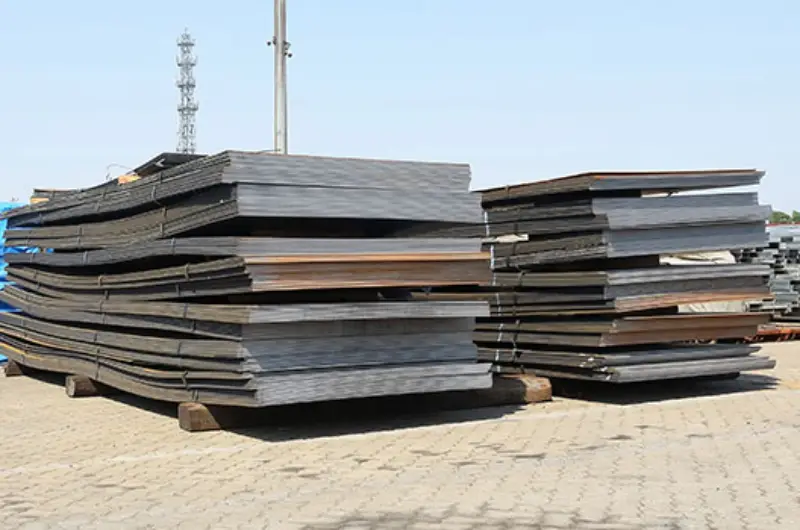
EN10025-6 S620QL1 Heavy-Duty Structures
EN10025-6 S620QL1 High-Strength Quenched and Tempered Steel Plate for Heavy-Duty Structures
Detailed material data of EN 10025-6 S620QL1, a low-alloy high-strength structural steel for quenched and tempered condition with minimum yield strength 620 MPa, excellent toughness at -20°C, used in heavy machinery and welded structures.
Hot rolling, quenching and tempering, welding (with suitable preheating and low-hydrogen practices), cold forming (limited, springback considered), subsequent stress relieving possible
- Phone : +8618037372205
- Email : [email protected]
- WhatsApp: Contact via Whtsapp
- WeChat: +8618037372205
EN10025-6 S620QL1 Heavy-Duty Structures Introduction
S620QL1 is a high-strength, low-alloy structural steel defined in EN 10025-6, delivered in the quenched and tempered condition. It offers a minimum yield strength of 620 MPa for thicknesses up to 50 mm and good weldability with a low carbon equivalent. The grade guarantees impact toughness at -20°C (L1 designation), making it suitable for dynamic loading and low-temperature applications. Typical uses include heavy-duty machinery, crane booms, bridges, and offshore structures. Its fine-grain microstructure ensures high strength and toughness balance.
EN10025-6 S620QL1 Heavy-Duty Structures Chemical Composition
The chemical composition of S620QL1 is tightly controlled to guarantee strength, toughness, and weldability. Maximum limits are given, except for aluminium which has a minimum content. The steel is fully killed and fine grain treated.
Key features:
- Low carbon content for weldability.
- Microalloying with Nb, V, Ti for grain refinement and precipitation strengthening.
- Cu, Ni, Cr, Mo added for hardenability and strength after quenching and tempering.
| Element | Standard Value (max, %) | Remarks |
|---|---|---|
| Carbon (C) | ≤ 0.18 | |
| Silicon (Si) | ≤ 0.50 | |
| Manganese (Mn) | ≤ 1.70 | |
| Phosphorus (P) | ≤ 0.020 | |
| Sulfur (S) | ≤ 0.010 | |
| Nitrogen (N) | ≤ 0.015 | |
| Boron (B) | ≤ 0.005 | |
| Chromium (Cr) | ≤ 1.50 | |
| Copper (Cu) | ≤ 0.50 | |
| Molybdenum (Mo) | ≤ 0.60 | |
| Niobium (Nb) | ≤ 0.06 | |
| Nickel (Ni) | ≤ 1.50 | |
| Titanium (Ti) | ≤ 0.05 | |
| Vanadium (V) | ≤ 0.08 | |
| Zirconium (Zr) | ≤ 0.15 | |
| Aluminium (Al) | ≥ 0.015 (total) | Minimum for grain refinement |
EN10025-6 S620QL1 Heavy-Duty Structures Thermal and Electrical Physical Properties
The following physical properties are typical for quenched and tempered low-alloy steel similar to S620QL1 at room temperature, unless otherwise stated. Slight variations may occur depending on exact heat treatment and composition. For design calculations, these values provide a reliable baseline.
| Property | Typical Value | Unit | Test Conditions / Remarks |
|---|---|---|---|
| Density (ρ) | 7.85 | g/cm³ | At 20°C |
| Modulus of elasticity (E) | 210 | GPa | At 20°C, tension |
| Shear modulus (G) | ~81 | GPa | Calculated from E and ν |
| Poisson's ratio (ν) | 0.3 | – | Elastic range |
| Thermal expansion coefficient (α) | 11.1 × 10⁻⁶ | /K | Temperature range 20–100°C |
| Thermal expansion coefficient (α) | 12.3 × 10⁻⁶ | /K | Temperature range 20–200°C |
| Thermal expansion coefficient (α) | 13.3 × 10⁻⁶ | /K | Temperature range 20–400°C |
| Thermal conductivity (λ) | ~38 | W/(m·K) | At 20°C |
| Thermal conductivity (λ) | ~40 | W/(m·K) | At 100°C |
| Specific heat capacity (cₚ) | ~460 | J/(kg·K) | At 20–100°C |
| Electrical resistivity (ρₑ) | ~0.22 × 10⁻⁶ | Ω·m | At 20°C |
EN10025-6 S620QL1 Heavy-Duty Structures Mechanical Properties
The specified mechanical properties are valid for the quenched and tempered delivery condition and apply to plates and wide flats. Values depend on product thickness. Tensile test specimens are taken in transverse or longitudinal direction (here longitudinal values given where applicable).
Impact energy values are guaranteed at -20°C (KV2). Bending test radius is indicative; actual requirements may be negotiated.
| Property | Typical Value / Requirement | Unit | Test Conditions / Remarks |
|---|---|---|---|
| Upper yield strength (ReH) | ≥ 620 | MPa | Thickness ≤ 50 mm, longitudinal |
| Upper yield strength (ReH) | ≥ 580 | MPa | Thickness > 50 ≤ 100 mm |
| Upper yield strength (ReH) | ≥ 560 | MPa | Thickness > 100 ≤ 150 mm |
| Tensile strength (Rm) | 700 – 890 | MPa | Thickness ≤ 50 mm |
| Tensile strength (Rm) | 650 – 850 | MPa | Thickness > 50 ≤ 100 mm |
| Tensile strength (Rm) | 630 – 810 | MPa | Thickness > 100 ≤ 150 mm |
| Elongation after fracture (A5) | ≥ 14 | % | Gauge length 5.65√S₀, longitudinal, thickness ≤ 50 mm |
| Elongation after fracture (A5) | ≥ 15 | % | Thickness > 50 ≤ 100 mm, typical value; min may be 13–14% depending on condition |
| Impact energy (KV₂) | ≥ 27 (-20°C) | J | Charpy-V, transverse test pieces, average of 3 |
| Bend test (mandrel diameter) | a = 3t | – | 180° bending, t = specimen thickness, for thickness ≤ 16 mm (indicative) |
EN10025-6 S620QL1 Heavy-Duty Structures Complete Equivalent Material Standards and Substitute Grades
| Country / Region | Standard | Grade | Remarks |
|---|---|---|---|
| Europe (CEN) | EN 10025-6:2019 | S620QL1 | Original specification |
| Germany | DIN EN 10025-6:2019 | S620QL1 | Adopted EN standard |
| United Kingdom | BS EN 10025-6:2019 | S620QL1 | Adopted EN standard |
| France | NF EN 10025-6:2019 | S620QL1 | Adopted EN standard |
| Italy | UNI EN 10025-6:2019 | S620QL1 | Adopted EN standard |
| Spain | UNE EN 10025-6:2019 | S620QL1 | Adopted EN standard |
| Sweden | SS-EN 10025-6:2019 | S620QL1 | Adopted EN standard |
| Netherlands | NEN-EN 10025-6:2019 | S620QL1 | Adopted EN standard |
| Austria | ÖNORM EN 10025-6:2019 | S620QL1 | Adopted EN standard |
| Poland | PN-EN 10025-6:2019 | S620QL1 | Adopted EN standard |
| International (ISO) | ISO 630-6:2023 | S620QL1 | ISO equivalent, aligned with EN 10025-6 |
EN10025-6 S620QL1 Heavy-Duty Structures Application Introduction
S620QL1 is designed for highly stressed welded structures where weight savings, high strength, and reliable toughness at low temperatures are critical. It can be processed by water-jet or plasma cutting, followed by edge grinding. Welding requires low-hydrogen procedures and preheating to avoid cold cracking. Post-weld heat treatment may be applied under controlled conditions.
Typical processing: hot rolled + QT, then cut, beveled, welded, and painted.
Product Applications: Structural welded frames and booms for mobile cranes, Mining truck bodies and excavator buckets, Heavy-duty transport trailers and low-loaders, Bridge gusset plates and main girder flanges, Offshore module support structures, Wind turbine monopile and jacket sections, High-pressure gas cylinders and separator shells
Processed into products: Boom sections and lattice mast segments for crawler cranes, Welded box beams and torsion bars, Telescopic boom sections, Slew rings and base frames, Track frames for mining shovels, Load-bearing pins and thick plate connections, Flange plates in large gearboxes
Application industries: Heavy engineering and machine building, Mobile crane and lifting equipment manufacturing, Mining and earthmoving machinery, Bridge construction (steel box girders, arch bridges), Offshore oil & gas platforms (structural components), Wind energy (tower sections, transition pieces), Pressure vessel and storage tank construction, Shipbuilding (selected hull and deck components)
EN10025-6 S620QL1 Heavy-Duty Structures Similar or Comparable Substitute Materials
| Country / Region | Standard | Grade | Remarks |
|---|---|---|---|
| Europe | EN 10025-6 | S620QL | Higher toughness (KV₂≥27 J at -40°C), similar strength |
| Europe | EN 10025-6 | S690QL1 | Higher strength grade (ReH≥690 MPa), similar toughness (-20°C) |
| Europe | EN 10025-6 | S620Q | Quenched and tempered, no L1 designation; impact temperature may be -20°C by agreement, but not mandatory; use with caution for guaranteed -20°C toughness |
| Europe | EN 10025-6 | S690QL | Higher strength and -40°C impact toughness, premium grade |
| USA | ASTM A514/A514M | Grade B (e.g., T-1 type B) | Similar yield strength ~690 MPa, delivers quenched and tempered, good toughness. Not identical but often used in similar heavy structural applications |
| USA | ASTM A709/A709M | Grade HPS 70W (or 690W) | High performance steel for bridges, comparable tensile strength, low-temperature toughness may differ |
| China | GB/T 16270 | Q620D / Q620E | High strength quenched and tempered structural steel; Q620E offers -40°C impact, close to S620QL |
| Japan | JIS G 3128 | SHY685 or SHY685N | High yield strength steel for welded structures; equivalent to S690Q class; can be considered as a higher-strength alternative |
| International | ISO 630-6 | S620Q | Similar to S620QL but without guaranteed -20°C toughness unless specified in the order |
Notes:
Additional requirements: The S620QL1 shall be fully killed and fine grain treated with a minimum aluminium/nitrogen ratio. The product may be ordered with specific carbon equivalent value (CEV) to ensure good weldability; typical CEV ≤ 0.48–0.55% depending on thickness. Supplementary testing like ultrasonic examination (according to EN 10160) and Z-direction tensile test (EN 10164) can be specified for improved through-thickness properties. Before welding, follow manufacturer recommendations regarding preheat temperature (typically 100–175°C) and interpass temperature control. In severely stressed welded joints, post-weld hydrogen bake-out or stress relief may be necessary. When exposed to fatigue loading, special edge preparation and weld toe grinding should be considered.
- Share



