
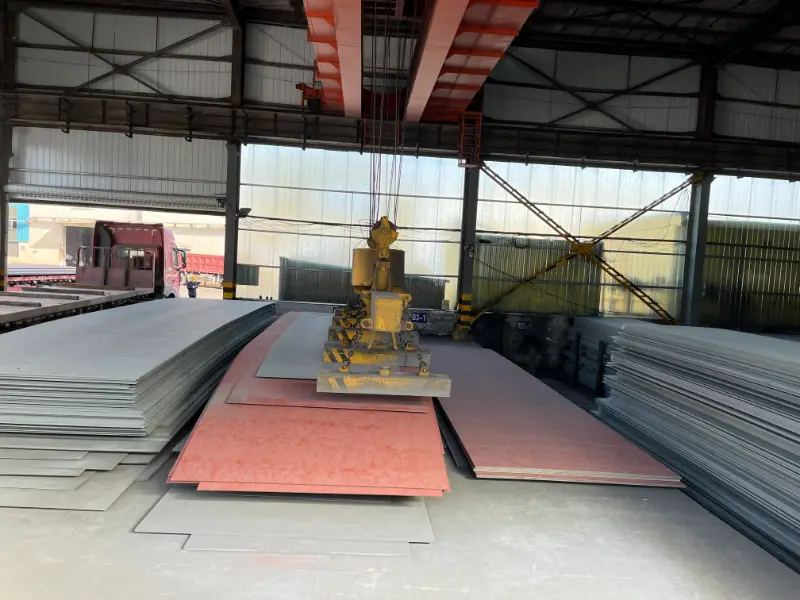
EN10025-6 S550QL1 Structural Steel Plate
EN10025-6 S550QL1 High Strength Quenched and Tempered Structural Steel Plate
Comprehensive technical data for S550QL1 quenched and tempered fine grain structural steel according to EN 10025-6, covering chemical composition, mechanical properties, physical data, equivalent grades, and application guide.
Hot rolling, quenching and tempering (+QT), welding, cold forming
- Phone : +8618037372205
- Email : [email protected]
- WhatsApp: Contact via Whtsapp
- WeChat: +8618037372205
EN10025-6 S550QL1 Structural Steel Plate Introduction
S550QL1 is a quenched and tempered fine grain structural steel defined in EN 10025-6. It offers a minimum yield strength of 550 MPa and guaranteed impact toughness at temperatures down to -50°C. The steel is produced with a fine-grained microstructure through a controlled quenching and tempering process, which provides an excellent combination of high strength, toughness, and weldability. Typical applications include mobile cranes, heavy-duty vehicles, bridges, and offshore structures where weight reduction and reliable low-temperature performance are essential.
EN10025-6 S550QL1 Structural Steel Plate Chemical Composition
Chemical composition limits according to EN 10025-6:2019 for grade S550QL1. Elements not listed shall not be intentionally added without the agreement of the purchaser. The maximum carbon equivalent value (CEV) depends on product thickness:
CEV (max): 0.47% for t ≤ 50 mm; 0.49% for 50 < t ≤ 100 mm; 0.52% for 100 < t ≤ 150 mm.
| Element | Standard Value (max %) | Remarks |
|---|---|---|
| C | 0.20 | - |
| Si | 0.80 | - |
| Mn | 1.70 | - |
| P | 0.025 | For S550QL1 (Quality Level 1) |
| S | 0.015 | For S550QL1 (Quality Level 1) |
| Al (total) | ≥ 0.015 | Minimum requirement |
| N | 0.015 | - |
| Cr | 1.50 | - |
| Ni | 2.0 | - |
| Mo | 0.70 | - |
| Cu | 0.50 | - |
| V | 0.12 | - |
| Ti | 0.05 | - |
| Nb | 0.06 | - |
| B | 0.005 | - |
EN10025-6 S550QL1 Structural Steel Plate Physical Properties
The following physical property data are typical for quenched and tempered high-strength steel suitable for grade S550QL1. Actual values can vary slightly depending on manufacturing route and temperature. These are not mandatory specification requirements but serve as guidelines for design calculations.
| Property | Typical Value | Unit | Test Condition |
|---|---|---|---|
| Density (ρ) | 7850 | kg/m³ | At 20°C |
| Modulus of elasticity (E) | 205 | GPa | At 20°C |
| Shear modulus (G) | 80 | GPa | At 20°C |
| Poisson's ratio (ν) | 0.3 | – | At 20°C |
| Thermal expansion coefficient (α) | 11.1 | 10⁻⁶/K | Between 20°C and 100°C |
| Thermal expansion coefficient (α) | 12.1 | 10⁻⁶/K | Between 20°C and 200°C |
| Thermal expansion coefficient (α) | 12.9 | 10⁻⁶/K | Between 20°C and 300°C |
| Thermal expansion coefficient (α) | 13.5 | 10⁻⁶/K | Between 20°C and 400°C |
| Thermal conductivity (λ) | 42 | W/(m·K) | At 20°C |
| Thermal conductivity (λ) | 39 | W/(m·K) | At 200°C |
| Thermal conductivity (λ) | 36 | W/(m·K) | At 300°C |
| Specific heat capacity (cp) | 460 | J/(kg·K) | At 20°C |
| Electrical resistivity (ρe) | 0.25 | Ω·mm²/m | At 20°C |
EN10025-6 S550QL1 Structural Steel Plate Mechanical Properties
Minimum mechanical properties are valid for transverse test specimens taken from quenched and tempered plates. The values depend on the nominal thickness of the product. Impact energy values are based on Charpy V‑notch tests at -50°C. Bend test requirements apply to ensure adequate ductility.
| Property | Standard Requirement | Unit | Test Condition |
|---|---|---|---|
| Yield strength (ReH) | ≥ 550 | MPa | Thickness ≤ 50 mm (transverse) |
| Yield strength (ReH) | ≥ 530 | MPa | 50 < thickness ≤ 100 mm (transverse) |
| Yield strength (ReH) | ≥ 490 | MPa | 100 < thickness ≤ 150 mm (transverse) |
| Tensile strength (Rm) | 640 – 820 | MPa | Thickness ≤ 50 mm (transverse) |
| Tensile strength (Rm) | 590 – 770 | MPa | 50 < thickness ≤ 100 mm (transverse) |
| Tensile strength (Rm) | 590 – 770 | MPa | 100 < thickness ≤ 150 mm (transverse) |
| Elongation after fracture (A) | ≥ 14 | % | Thickness ≤ 150 mm, L0=5.65√S0 (transverse) |
| Impact energy (KV) | ≥ 27 | J | At -50°C (transverse, 10×10 mm specimen) |
| Bend test (bend angle 180°) | d = 3t | - | Thickness ≤ 16 mm |
| Bend test | d = 4t | - | 16 < thickness ≤ 40 mm |
| Bend test | d = 5t | - | 40 < thickness ≤ 63 mm |
| Bend test | d = 7t | - | 63 < thickness ≤ 80 mm |
| Bend test | d = 9t | - | 80 < thickness ≤ 100 mm |
| Bend test | By agreement | - | Thickness > 100 mm |
EN10025-6 S550QL1 Structural Steel Plate Identical Standard Equivalents and Replacement Grades
| Country/Region | Standard | Grade | Remarks |
|---|---|---|---|
| Europe | EN 10025-6 | S550QL1 | Base standard |
| Germany | DIN EN 10025-6 | S550QL1 | Identical adoption |
| United Kingdom | BS EN 10025-6 | S550QL1 | Identical adoption |
| France | NF EN 10025-6 | S550QL1 | Identical adoption |
| Italy | UNI EN 10025-6 | S550QL1 | Identical adoption |
| Spain | UNE EN 10025-6 | S550QL1 | Identical adoption |
| Sweden | SS EN 10025-6 | S550QL1 | Identical adoption |
| Poland | PN-EN 10025-6 | S550QL1 | Identical adoption |
EN10025-6 S550QL1 Structural Steel Plate Application Introduction
S550QL1 plates are engineered for demanding structural applications that require high strength, low self-weight, and reliable toughness under low ambient or service temperatures. Their fine grain and clean microstructure ensure good weldability (with appropriate low‑hydrogen processes) and moderate cold formability.
Product Applications: Telescopic crane booms, outriggers, and chassis, Heavy transport trailers and low-loaders, Pedestrian, road, and railway bridges, Jack-up rig legs and offshore platform components, Welded high-strength tubular structures, Excavator booms and dipper arms
Processed into products: Boom sections and extension elements, Load-bearing chassis frames and cross-members, Turntable slewing rings and slewing bearings, Welded T-joint and cruciform structural nodes, Support brackets and lifting lugs, Flanges and base plates for wind turbine towers
Application industries: Mobile crane and lifting equipment manufacturing, Heavy-duty mining and earthmoving machinery, Bridge and structural engineering, Offshore and marine structures, Pressure vessel and boiler fabrication, Wind turbine tower and foundation components
EN10025-6 S550QL1 Structural Steel Plate Similar or Alternative Materials for Comparison
| Country/Region | Standard | Grade | Remarks |
|---|---|---|---|
| Europe | EN 10025-6 | S550QL | Same strength but guaranteed impact temperature only -40°C; not a direct substitute for -50°C applications |
| Europe | EN 10025-6 | S690QL1 | Higher yield strength (≥690 MPa); can be used in overdesigned parts but requires revised welding procedures |
| USA | ASTM A514/A517 | Grade B / Grade H | Quenched and tempered steel with min yield 690 MPa; comparable strength but chemical composition differs; need engineering assessment |
Notes:
- Ultrasonic testing to EN 10160 or equivalent is normally performed on plates for critical applications.
- Improved through-thickness properties (Z-quality, e.g., Z25 or Z35) can be supplied under EN 10164 by agreement.
- Welding must follow qualified procedures, typically with low-hydrogen processes and controlled preheat/interpass temperatures.
- The grade may be delivered with optional stricter chemical limits for enhanced weldability.
- Surface condition and edge preparation are subject to the requirements of EN 10163.
- Share



