
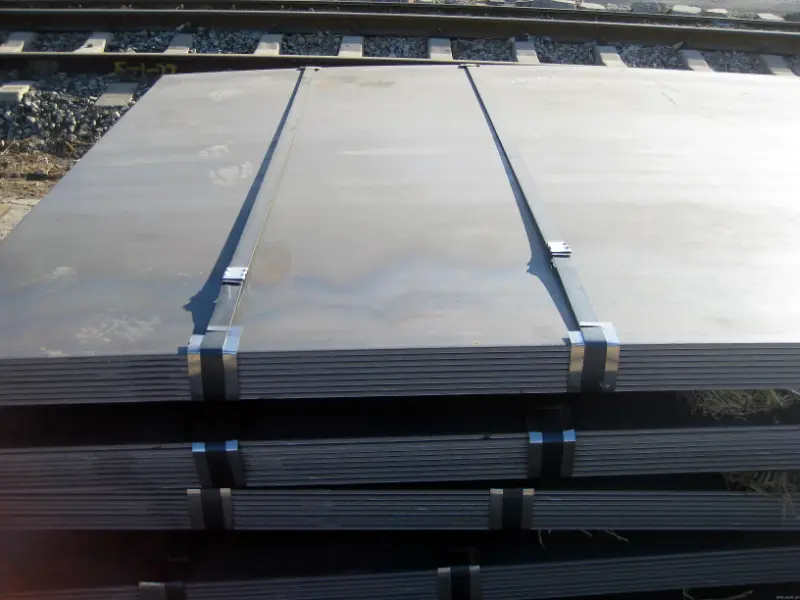
S620Q Quenched & Tempered High-Strength Steel
S620Q Quenched & Tempered High-Strength Steel - EN 10025-6 Properties & Equivalents
Complete technical data for S620Q low-alloy structural steel according to EN 10025-6: chemical composition, mechanical and physical properties, international equivalents, and application guide.
Welding, hot forming (with restrictions), cutting, machining, cold forming (limited)
- Phone : +8618037372205
- Email : [email protected]
- WhatsApp: Contact via Whtsapp
- WeChat: +8618037372205
S620Q Quenched & Tempered High-Strength Steel Introduction
S620Q is a high-strength quenched and tempered structural steel conforming to EN 10025-6. It offers a minimum yield strength of 620 MPa in thicknesses up to 50 mm, combined with good toughness at low temperatures. The steel is designed for weight-critical structures in heavy machinery, mobile cranes, and offshore engineering.
- High yield and tensile strength
- Good weldability with low carbon equivalent
- Guaranteed Charpy impact energy at -20°C
- Quenched and tempered condition (Q)
S620Q Quenched & Tempered High-Strength Steel Chemical Composition
Ladle analysis limits according to EN 10025-6:2019, Table 2. Maximum values unless range is given. Fine grain practice and micro-alloying additions (Nb, V, Ti) are typically applied.
| Element | Standard Value (%) | Remarks |
|---|---|---|
| Carbon (C) | ≤ 0.20 | For t ≤ 100 mm |
| Silicon (Si) | ≤ 0.80 | Maximum |
| Manganese (Mn) | ≤ 1.70 | Maximum |
| Phosphorus (P) | ≤ 0.020 | Maximum |
| Sulfur (S) | ≤ 0.010 | Maximum |
| Chromium (Cr) | ≤ 1.50 | Maximum |
| Molybdenum (Mo) | ≤ 0.70 | Maximum |
| Nickel (Ni) | ≤ 2.0 | Maximum |
| Aluminium (Altotal) | ≥ 0.015 | Minimum for fine grain |
| Nitrogen (N) | ≤ 0.015 | Maximum |
| Titanium (Ti) | ≤ 0.05 | Maximum |
| Vanadium (V) | ≤ 0.12 | Maximum |
| Niobium (Nb) | ≤ 0.06 | Maximum |
| Boron (B) | ≤ 0.005 | Maximum |
| Zirconium (Zr) | ≤ 0.15 | Maximum |
| Copper (Cu) | ≤ 0.50 | Maximum |
S620Q Quenched & Tempered High-Strength Steel Thermal and Electrical Physical Properties
Typical physical data for low-alloy quenched and tempered steel at room temperature, unless otherwise specified. These values are for guidance and not mandatory in the standard. Density, modulus of elasticity, thermal expansion, and thermal conductivity are similar to those of common structural steels.
| Property | Typical Value | Unit | Test Condition / Remarks |
|---|---|---|---|
| Density (ρ) | 7.85 | g/cm³ | At 20 °C |
| Modulus of Elasticity (E) | 205 – 210 | GPa | At 20 °C |
| Shear Modulus (G) | ~ 80 | GPa | At 20 °C, calculated |
| Poisson's Ratio (ν) | 0.30 | - | Elastic range |
| Thermal Expansion Coefficient (α) | 12.5 × 10⁻⁶ | K-1 | 20 – 100 °C |
| Thermal Expansion Coefficient (α) | 13.5 × 10⁻⁶ | K-1 | 20 – 200 °C |
| Thermal Conductivity (λ) | 35 – 40 | W/(m·K) | At 20 °C |
| Specific Heat Capacity (cp) | 460 – 480 | J/(kg·K) | At 20 °C |
| Electrical Resistivity (ρe) | 0.15 – 0.20 | μΩ·m | At 20 °C |
S620Q Quenched & Tempered High-Strength Steel Mechanical Properties
Minimum longitudinal properties as required by EN 10025-6:2019, Table 4. Yield strength (ReH), tensile strength (Rm), elongation (A), and Charpy impact energy (KV2) are guaranteed for the quenched and tempered condition. Bend test requirements from Table 5.
| Property | Specified Value | Unit | Test Condition |
|---|---|---|---|
| Yield Strength (ReH) | ≥ 620 | MPa | Thickness ≤ 50 mm |
| Yield Strength (ReH) | ≥ 580 | MPa | 50 mm < thickness ≤ 100 mm |
| Tensile Strength (Rm) | 700 – 890 | MPa | Thickness ≤ 50 mm |
| Tensile Strength (Rm) | 650 – 830 | MPa | 50 mm < thickness ≤ 100 mm |
| Elongation (A) | ≥ 15 | % | Thickness ≤ 50 mm (L0=5.65√S0) |
| Elongation (A) | ≥ 14 | % | 50 mm < thickness ≤ 100 mm |
| Charpy Impact Energy (KV2) | ≥ 27 | J | Longitudinal, -20 °C, thickness ≤ 100 mm |
| Bend Test | 2t (bend radius) | - | Thickness ≤ 50 mm, 180°, specimen width ≥ 50 mm |
| Bend Test | 3t (bend radius) | - | 50 mm < thickness ≤ 100 mm, 180° |
S620Q Quenched & Tempered High-Strength Steel Fully Equivalent Material Standards and Designations
| Country/Region | Standard | Designation | Remarks |
|---|---|---|---|
| Europe (EU) | EN 10025-6:2019 | S620Q | Original designation |
| Germany | DIN EN 10025-6 | S620Q | Adopted European standard |
| United Kingdom | BS EN 10025-6 | S620Q | Adopted European standard |
| France | NF EN 10025-6 | S620Q | Adopted European standard |
| Italy | UNI EN 10025-6 | S620Q | Adopted European standard |
| Spain | UNE EN 10025-6 | S620Q | Adopted European standard |
S620Q Quenched & Tempered High-Strength Steel Application Introduction
S620Q is ideal for welded load-bearing structures where weight saving is critical. Its high strength combined with good toughness at -20°C makes it suitable for mobile equipment and heavy machinery. Typical applications include:
Product Applications: Crane booms and lattice structures, Excavator arms and buckets, Offshore platform components (deck frames, legs), Heavy vehicle chassis, Bridge girders and box sections, Highly stressed welded structural members
Processed into products: Welded hollow sections and tubular joints, Cut and bent plate components, Machined pins and brackets, Boom extensions and outrigger parts, Load-bearing plates and stiffeners, Structural nodes in tubular constructions
Application industries: Construction and earthmoving machinery, Mobile crane manufacturing, Offshore and marine engineering, Heavy transport equipment, Steel bridge construction, Mining equipment, Pressure vessel and storage tank fabrication (where permitted by design codes)
S620Q Quenched & Tempered High-Strength Steel Similar / Substitution Steel Grades
| Country/Region | Standard | Designation | Remarks |
|---|---|---|---|
| Europe | EN 10025-6 | S690Q | Higher strength (≥690 MPa), similar toughness, direct upgrade |
| Europe | EN 10025-6 | S550Q | Slightly lower strength (≥550 MPa), may replace S620Q in some designs |
| Europe | EN 10025-6 | S620QL | Same strength with guaranteed low-temperature toughness (down to -40°C or lower) |
| USA | ASTM A514/A514M | Grade S or similar | Quenched and tempered alloy steel plate with comparable strength (690 MPa typical), different chemical approach |
| International | ISO 4951-2 | S620Q | Equivalent to EN 10025-6 S620Q for high yield strength steels |
Notes:
Welding considerations: Low carbon equivalent (CEV typically ≤ 0.52 for thickness ≤ 50 mm) allows good weldability; preheating and controlled interpass temperature are recommended depending on thickness and hydrogen level. Heat treatment: The steel is supplied in quenched and tempered condition; hot forming may alter properties and requires re-heat treatment. Documentation: Inspection certificates according to EN 10204 type 3.1 or 3.2 are normally provided.
- Share



