
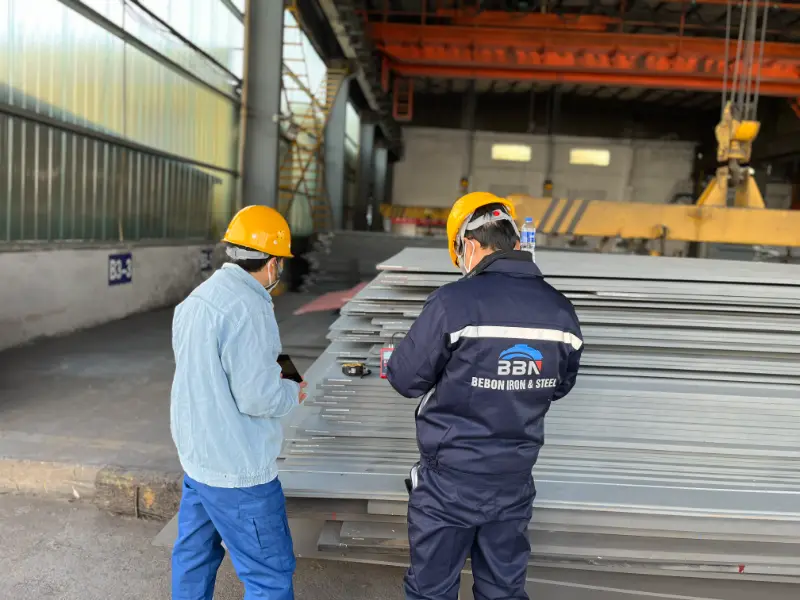
EN10025-6 S620QL Steel Plate
EN10025-6 S620QL Quenched & Tempered High-Strength Steel Plate
Detailed material data for S620QL structural steel according to EN 10025-6, including chemical composition, mechanical and physical properties, international equivalents and application guidance.
Quenching and tempering (Q+T); suitable for welding, hot/cold forming, and machining
- Phone : +8618037372205
- Email : [email protected]
- WhatsApp: Contact via Whtsapp
- WeChat: +8618037372205
EN10025-6 S620QL Steel Plate Introduction
S620QL is a quenched and tempered weldable fine-grain structural steel specified in EN 10025-6. It offers a minimum yield strength of 620 MPa and excellent low-temperature impact toughness down to -50°C (QL quality). The material combines high strength with good weldability, making it suitable for heavily loaded welded structures subjected to dynamic loads and low ambient temperatures.
- Designation: S = structural steel; 620 = minimum yield strength (MPa); Q = quenched and tempered; L = low-temperature toughness at -50°C.
- Fine-grain practice ensures homogeneous properties.
- Typical delivery condition: quenched and tempered. Available as heavy plates and wide flats.
EN10025-6 S620QL Steel Plate Chemical Composition
Maximum values according to EN 10025-6:2004 for product thickness ≤ 50 mm. Elements not listed are not intentionally added.
- Fine grain practice is ensured by specified amounts of Al, Nb, V, Ti.
- Sulfur and phosphorus are tightly controlled to enhance toughness.
| Element | Standard Value (max %) | Remarks |
|---|---|---|
| Carbon (C) | 0.20 | For thickness ≤ 50 mm |
| Silicon (Si) | 0.80 | – |
| Manganese (Mn) | 1.70 | – |
| Phosphorus (P) | 0.020 | – |
| Sulfur (S) | 0.010 | – |
| Nitrogen (N) | 0.015 | – |
| Boron (B) | 0.005 | – |
| Chromium (Cr) | 1.50 | – |
| Copper (Cu) | 0.50 | – |
| Molybdenum (Mo) | 0.70 | – |
| Niobium (Nb) | 0.06 | – |
| Nickel (Ni) | 2.00 | – |
| Titanium (Ti) | 0.05 | – |
| Vanadium (V) | 0.12 | – |
| Zirconium (Zr) | 0.15 | – |
| Aluminium (Al) | 0.015 min | Total aluminium, for fine grain practice |
| Other elements (Arsenic, Antimony, Tin) | As+Sn+Sb ≤ 0.25 | Trace elements |
EN10025-6 S620QL Steel Plate Physical, Thermal and Electrical Properties
Typical values for quenched and tempered S620QL at room temperature unless noted. These data are indicative and may vary with manufacturing process and exact chemistry; they are not part of the EN 10025-6 standard requirements but are widely accepted for design purposes.
- Density and thermal expansion are similar to other low-alloy steels.
- Thermal conductivity decreases slightly with increasing alloy content.
| Property | Typical Value | Unit | Test Condition / Remarks |
|---|---|---|---|
| Density (ρ) | 7850 | kg/m³ | At 20°C |
| Elastic Modulus (E) | 210 | GPa | At 20°C, longitudinal direction |
| Shear Modulus (G) | 81 | GPa | Calculated from E and ν |
| Poisson's Ratio (ν) | 0.3 | – | Elastic range |
| Thermal Expansion Coefficient (α) | 12.0 | 10⁻⁶/K | 20–100°C |
| Thermal Expansion Coefficient (α) | 12.5 | 10⁻⁶/K | 20–200°C |
| Thermal Expansion Coefficient (α) | 13.0 | 10⁻⁶/K | 20–300°C |
| Thermal Conductivity (λ) | 50 | W/(m·K) | At 20°C |
| Thermal Conductivity (λ) | 45 | W/(m·K) | At 200°C |
| Specific Heat Capacity (c) | 460 | J/(kg·K) | At 20°C |
| Electrical Resistivity (ρe) | 0.23 | µΩ·m | At 20°C |
EN10025-6 S620QL Steel Plate Mechanical Properties
Minimum values for longitudinal test pieces from flat products, thickness ≤ 50 mm, unless otherwise stated. Test samples are taken in the quenched and tempered condition. Transverse properties may be lower; consult standard for details.
- Impact testing is performed at -50°C for grade QL.
- Bending test is carried out at 180° over mandrel diameters related to plate thickness.
| Property | Standard Requirement | Unit | Test Condition |
|---|---|---|---|
| Yield Strength (ReH) | ≥ 620 | MPa | Thickness ≤ 50 mm, transverse or longitudinal |
| Tensile Strength (Rm) | 700 – 890 | MPa | Thickness ≤ 50 mm |
| Elongation A5 (L₀=5.65√S₀) | ≥ 14 | % | Longitudinal; thickness ≤ 50 mm |
| Elongation A5 (transverse) | ≥ 12 | % | Transverse; thickness ≤ 50 mm |
| Bend Radius (180° bend) | 2t | – | Thickness ≤ 8 mm |
| Bend Radius (180° bend) | 3t | – | Thickness > 8 ≤ 20 mm |
| Bend Radius (180° bend) | 4t | – | Thickness > 20 mm |
| Impact Energy (KV) at -50°C | ≥ 27 (longitudinal) | J | Charpy V-notch, average of 3 tests |
| Impact Energy (KV) at -50°C | ≥ 16 (transverse) | J | Charpy V-notch, average of 3 tests |
EN10025-6 S620QL Steel Plate Completely Equivalent Material Standards and Replaceable Grades
| Country / Region | Standard | Grade | Remarks |
|---|---|---|---|
| European Union | EN 10025-6 | S620QL | The reference grade; QL suffix guarantees -50°C impact energy ≥ 27 J. |
| Germany | DIN EN 10025-6 | S620QL | Identical to EN; former DIN designations E690T etc. are obsolete. |
| France | NF EN 10025-6 | S620QL | Identical to EN; old NF A36-231 grade E620 is no longer used. |
| United Kingdom | BS EN 10025-6 | S620QL | Identical BS EN adoption; formerly BS 4360 Grade 75C or similar (withdrawn). |
| Italy | UNI EN 10025-6 | S620QL | Identical to EN. |
| International (ISO) | ISO 4950-2:1995* | FeE620V* | *Note: ISO standard is withdrawn; FeE620V was a comparable Q+T grade but not identical (higher S, P limits). Only for historical reference. |
EN10025-6 S620QL Steel Plate Application Introduction
S620QL is specifically designed for heavy welded structures that demand high strength and very good toughness at sub-zero temperatures. Its fine-grained microstructure after quenching and tempering ensures low-temperature ductility and resistance to brittle fracture.
- Preferred for dynamic loads and fatigue resistance.
- Excellent weldability with proper heat input control; preheating and interpass temperature guidelines should be followed.
- Can be cold bent to minimum recommended radii.
- Available in plate form, often used in as-delivered +QT condition.
Product Applications: Telescopic crane booms, Excavator arms and buckets, Bulldozer blades and rippers, Trailer frames and semi-trailer undercarriages, Offshore wind turbine transition pieces, Hydraulic press frames, Heavy lifting beams
Processed into products: Welded box sections, Flanges and webs of welded beams, Machined support brackets, Bent plates for curved structural elements, Welded pipe piles, Cut and drilled connection plates, Formed cold-bent profiles (with appropriate radii)
Application industries: Mobile and crawler cranes (booms, outriggers), Heavy transport vehicle chassis, Offshore platform construction (deck plates, crane pedestals), Bridge building (tension members, orthotropic decks), Mining and earth-moving equipment, Pressure vessels (limited to moderate temperatures), High-rise building structural components
EN10025-6 S620QL Steel Plate Similar or Alternative Material Grades
| Country / Region | Standard | Grade | Remarks |
|---|---|---|---|
| EU | EN 10025-6 | S690QL | Higher strength (yield ≥ 690 MPa); same low-temperature toughness; may be substituted if higher strength is acceptable. |
| EU | EN 10025-6 | S620Q | Identical strength but impact tested only at -20°C. Suitable if low-temperature requirement can be relaxed. |
| USA | ASTM A514 / A517 | Grade B, H, Q | Quenched and tempered plate with minimum yield 690 MPa; impact properties often rated at -34°C or -46°C. Not exact match for -50°C at 620 MPa but widely used for similar applications. |
| China | GB/T 16270 | Q620D | High-strength structural steel plate; yield ≥ 620 MPa; impact temperature -20°C (not -50°C). For -50°C, Q620E may be used but availability varies. |
| Japan | JIS G3128 | SHY685 | High yield strength steel plate for welded structures; yield ≥ 590 MPa (not directly 620 MPa). Some variants offer impact testing at -40°C or lower. |
| Russia | GOST 19281 | 14Kh2GMR | High-strength quenched and tempered steel; yield approx. 590–685 MPa. Not fully equivalent due to different chemistry and toughness requirements. |
Notes:
Delivery conditions and inspection: The material is normally supplied with inspection certificate 3.1 according to EN 10204. Surface condition and edge trimming should be agreed upon at the time of order. For thicknesses > 50 mm, please consult the standard for adjusted mechanical property requirements. Welding recommendations: Low-hydrogen processes (SMAW, GMAW, SAW) are recommended; consumables should match the strength and toughness level. Heat input should be limited to preserve the heat-affected zone toughness. Preheating (100–150°C) is generally applied, especially for thick sections. Post-weld heat treatment is usually not required but may be applied if stress relief is necessary (care must be taken to avoid temper embrittlement).
- Share



